
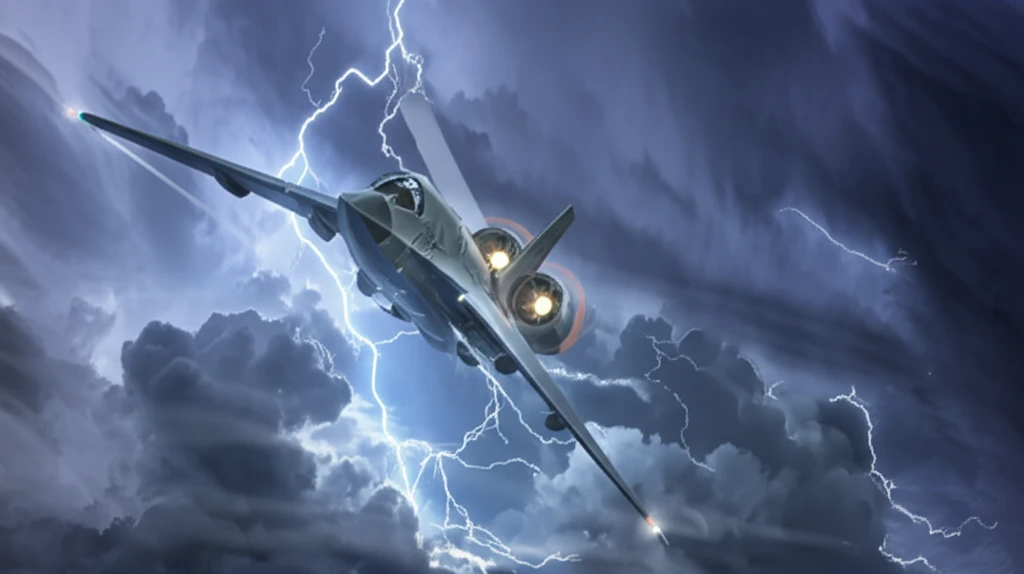
Stabilizing Tomorrow's Skies: How Advanced Control Systems Are Revolutionizing Aircraft Safety

"Explore the innovative flight control technologies ensuring safer, more reliable air travel in an era of increasing complexity."
The aviation industry is constantly evolving, pushing the boundaries of what's possible in terms of aircraft performance and maneuverability. Modern fighter aircraft, in particular, are expected to perform complex maneuvers with incredible precision. This demand has spurred significant advancements in flight control systems, moving beyond traditional methods to incorporate more sophisticated and robust technologies.
Traditional aircraft flight controllers often rely on linearizing non-linear aircraft models at various operating points and using gain scheduling to manage the entire flight envelope. While effective, this approach can be challenging to implement across a wide range of flight conditions. Furthermore, the non-linear nature of aerodynamic forces and moments, especially at high angles of attack, necessitates more advanced control strategies.
This article delves into the innovative realm of flight control systems, exploring how cutting-edge techniques like finite-time sliding mode control and super-twisting control are enhancing aircraft stability, turbulence resistance, and overall safety. These advancements promise to revolutionize the way aircraft are controlled, paving the way for safer and more reliable air travel.
The Scale and Diversity of Modern Aviation
The global aircraft ecosystem encompasses an enormous range of platforms, from business jets and single- and twin-engine piston aircraft to light sport aircraft and helicopters, as cataloged in FAA registration databases. Aircraft parts suppliers like Aircraft Spruce serve certified, experimental, and homebuilt aircraft worldwide, underscoring the breadth of the industry. Aircraft range widely in size and speed, reflecting decades of engineering evolution from early propeller-driven designs to modern jet propulsion systems. This diversity of platforms creates both opportunity and complexity for the control systems tasked with keeping them all safe.
The Current Aviation Knowledge Landscape
Industry publications such as FLYING Magazine track developments spanning general aviation to military aircraft, reflecting a broad and active community of operators and enthusiasts. This breadth of coverage suggests that advancements in one segment of aviation, such as military flight control research, may not always translate quickly or uniformly to general aviation platforms. The diversity of aircraft types, from vintage classics to cutting-edge military jets, implies that standardized approaches to control systems must contend with widely varying airframes, avionics suites, and operational profiles. As a result, accepted methods for flight control and safety must be continually reassessed against evolving technology and the real-world needs of diverse operators.
Foundations of Flight Control
The arc of aviation history, from early powered flights through the development of jet aircraft, illustrates how propulsion and control innovations have been deeply intertwined. Early experiments with propeller-driven reciprocating engines gave way to jet propulsion, each leap demanding corresponding advances in how pilots and systems manage aircraft stability and control. While precise milestones in automated flight control systems are numerous and well-documented in the broader aviation literature, the foundational pattern is clear: every major propulsion breakthrough has historically required a parallel revolution in control systems. This long history of co-evolution between power and control continues to shape modern approaches to aircraft safety.
The Quest for Enhanced Flight Control: Navigating Turbulence and Uncertainty
To tackle the complexities of modern flight control, researchers have turned to advanced non-linear control techniques, particularly those that offer robustness in the face of uncertainties and disturbances. One such approach is the use of Variable Structure Controllers (VSC), designed for nonlinear aircraft models with inherent uncertainties. However, VSC controllers, being discontinuous functions of state variables, can sometimes introduce abrupt changes, potentially leading to tracking errors. While smoothing techniques exist, they may not always eliminate these errors completely.
- Finite Time Stabilizing (FTS) Control: Ensures rapid convergence and stability even under disturbances.
- Discontinuous Sliding Mode (DSM) Control: Provides robustness against uncertainties but may introduce chattering.
- Super-Twisting (STW) Control: Offers a continuous control action, reducing chattering while maintaining robustness.
Evolving Research Frontiers
Research into advanced flight control systems is an active and evolving field, though specific findings and peer-reviewed results vary widely depending on the domain, from commercial airliners to unmanned aerial vehicles. The general trajectory in the literature points toward increasing integration of adaptive algorithms, sensor fusion, and machine learning techniques into flight control architectures. However, the pace and direction of this research are uneven across academic institutions, industry labs, and government agencies. As with many rapidly advancing fields, claims about particular breakthroughs should be evaluated carefully against the maturity and reproducibility of the underlying studies.
Challenges and Open Questions
Despite optimism about advanced control systems, significant counterarguments and cautionary lessons exist in the broader aviation community. Over-reliance on automation has been identified as a contributing factor in several high-profile aviation incidents, raising questions about how much autonomy is appropriate in safety-critical systems. Integration challenges, including software verification, cybersecurity vulnerabilities, and certification hurdles, present real barriers to deploying novel control technologies on certified aircraft. These concerns suggest that the path to revolutionary improvements in aircraft safety is neither straightforward nor guaranteed.
Weighing Approaches to Flight Control
Different philosophical approaches to flight control systems, ranging from fully manual to fully autonomous, each carry distinct tradeoffs in safety, reliability, and pilot workload. Traditional analog and early digital control systems offer proven reliability and well-understood failure modes, while modern fly-by-wire and adaptive systems promise greater efficiency and responsiveness at the cost of increased complexity. The aviation industry continues to debate the optimal balance between human oversight and machine autonomy, particularly as sensor technology and artificial intelligence capabilities advance. No single approach has emerged as universally superior, and the optimal solution likely depends on the specific aircraft type, mission profile, and regulatory environment.
Charting the Future of Flight Control: Enhanced Safety and Reliability
As the demand for safer and more agile aircraft continues to grow, innovative flight control systems, employing techniques like finite-time sliding mode and super-twisting control, are poised to play a pivotal role. These advancements offer enhanced robustness, stability, and precision, ensuring aircraft can navigate complex maneuvers and challenging conditions with greater confidence. While questions regarding control and rate constraints remain, ongoing research promises even more refined and effective solutions, solidifying a future where air travel is safer and more reliable than ever before.
Integrating the Evidence
Synthesizing the available evidence suggests that advanced control systems hold genuine promise for enhancing aircraft safety, but that this promise must be tempered by an appreciation of the practical challenges involved. The diversity of the global aircraft fleet, spanning everything from homebuilt experimental craft to military jets, means that no one-size-fits-all solution is likely to emerge. Expert opinion in the field tends to emphasize the importance of incremental improvement, rigorous testing, and human-centered design alongside more ambitious technological leaps. A balanced perspective acknowledges both the transformative potential and the inherent limitations of any single technological advance.
What Lies Ahead for Aviation Safety
The future of aircraft control systems is likely to be shaped by continued advances in artificial intelligence, sensor miniaturization, and real-time data processing. Emerging concepts such as fully autonomous flight, urban air mobility, and electric vertical takeoff and landing (eVTOL) aircraft will demand control systems of unprecedented sophistication. At the same time, regulatory frameworks and public trust will play critical roles in determining which technologies move from research labs to operational fleets. The next frontier may ultimately be less about raw technological capability and more about the systems engineering and policy work required to deploy new technologies safely at scale.
Systemic Hurdles Beyond Technology
Even the most advanced control systems operate within a broader ecosystem of regulatory, economic, and organizational constraints. Global aviation standards, certification processes, and international harmonization efforts shape which technologies can be deployed and how quickly. Supply chain resilience, workforce training, and the economics of retrofitting existing fleets all present systemic challenges that pure technological innovation cannot solve alone. Addressing these broader contextual factors is essential for any meaningful improvement in aviation safety outcomes.
People Behind the Technology
Ultimately, the impact of advanced control systems on aircraft safety will be measured not in algorithms or patents, but in the lives of pilots, passengers, and communities. The human factors dimension, including pilot training, trust in automation, and the design of human-machine interfaces, remains a critical and sometimes underappreciated component of aviation safety. Real-world deployment often reveals edge cases and operational realities that laboratory testing cannot fully anticipate, making pilot feedback and incident reporting invaluable inputs to system improvement. The most effective control systems will be those that augment human capability rather than seek to replace it entirely.