
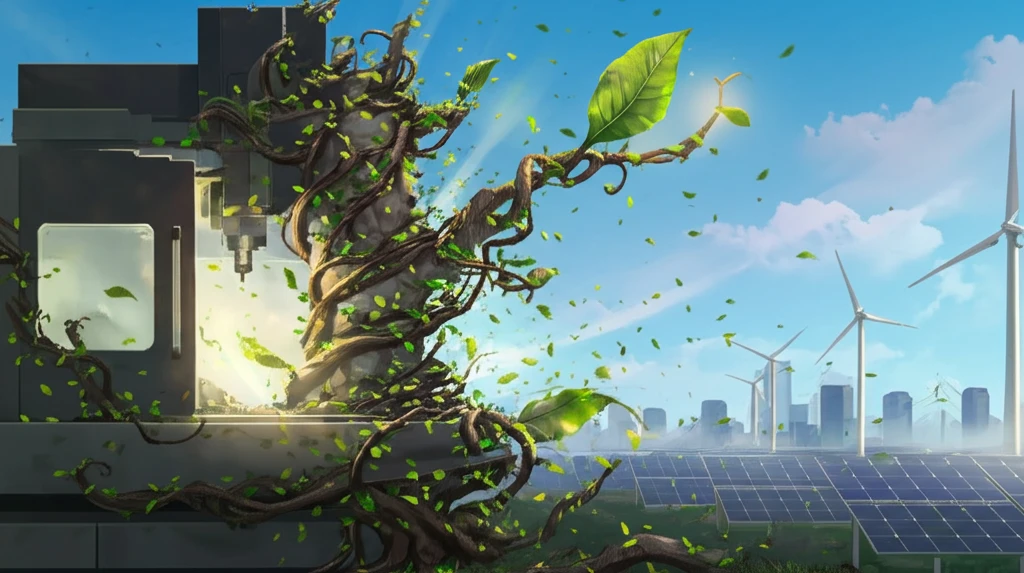
Eco-Friendly Machining: How Sustainable Practices Can Save You Money and the Planet

"Discover the secrets to reducing your machine shop's environmental impact while boosting your bottom line with sustainable machining techniques."
In today's world, where environmental concerns are escalating, businesses across all sectors are under increasing pressure to adopt sustainable practices. The manufacturing industry, particularly machining operations, faces significant scrutiny due to its high energy consumption and waste generation. But what if going green could also boost your bottom line? This article explores the concept of sustainable machining, demonstrating how reducing your environmental impact can lead to substantial cost savings and improved efficiency.
Computer Numerical Control (CNC) machining, a cornerstone of modern manufacturing, is known for its precision and automation. However, it also accounts for a considerable portion of the energy consumed by the manufacturing sector. Traditional machining processes often involve the use of coolants, which, while essential for performance, contribute to environmental pollution and increase operational costs. Therefore, optimizing energy efficiency and minimizing waste in machining operations are critical steps towards achieving sustainable manufacturing.
This article dives into the practical aspects of sustainable machining, drawing insights from a case study on turning AISI 1045 steel. We'll explore strategies for optimizing cutting parameters, reducing energy consumption, and improving surface quality—all while minimizing environmental impact. Get ready to discover how sustainable machining practices can benefit your business and the planet.
CNC Growth and Sustainability
A 2024 review says CNC machining can reduce carbon emissions by optimizing machining parameters and tool paths to limit material waste and energy consumption. A separate 2026 industry-statistics source reports that the global CNC machining market is $14.5 billion and projects a 6.7% compound annual growth rate through 2030. It also reports production advantages of 40–60% less time than manual work and up to 35% higher overall equipment effectiveness.
Methods and Sustainability Tradeoffs
A 2022 summary describes hot machining as a way to machine difficult-to-cut components using low-cost cutting equipment, potentially enabling cost-effective machining. It frames the broader challenge as simplifying sustainable machining through the triple bottom line, rather than optimizing a single production measure. A 2026 review of CNC parameter optimization describes a shift toward intelligent, sustainable, multi-objective frameworks, indicating that balancing competing goals remains central to the approach.
What is Sustainable Machining and Why Does It Matter?
Sustainable machining is an approach to manufacturing that seeks to minimize the environmental impact of machining processes while maintaining or improving economic viability and social responsibility. It involves optimizing cutting parameters, reducing energy consumption, minimizing waste, and using eco-friendly materials. The goal is to create a closed-loop system where resources are used efficiently, and the environmental burden is significantly reduced.
- Cost Savings: Reducing energy consumption and waste can lead to significant cost savings in the long run. Optimized processes require less energy, fewer raw materials, and reduced disposal costs.
- Environmental Responsibility: Sustainable practices help reduce your company's carbon footprint and minimize pollution, contributing to a healthier planet.
- Improved Efficiency: Optimizing cutting parameters and processes can lead to faster production times and improved surface quality.
- Enhanced Reputation: Consumers are increasingly demanding eco-friendly products and services. Adopting sustainable machining practices can enhance your brand image and attract environmentally conscious customers.
- Regulatory Compliance: Governments worldwide are implementing stricter environmental regulations. Embracing sustainable practices can help your company stay ahead of the curve and avoid costly penalties.
Recent Optimization and Cooling Research
Research on milling Ti-6Al-4V reports that applying an Al₂O₃-CuO hybrid nanofluid in minimum-quantity lubrication (HNMQL) reduced cutting forces by up to 46.5% and surface roughness by up to 61.2%, with microhardness reduced by up to 6.6%, compared with conventional flood cooling (CCF). The study also reports better surface finish and topography than CCF. A separate study proposes a black hole-continuous ant colony optimization algorithm to minimize energy use on CNC lathes while meeting the specified machined-surface roughness.
Challenges in Sustainable Machining
A 2025 chapter on sustainable machining identifies machining methods, cutting environments, and cutting circumstances as key areas in assessing the state of the art. It also discusses future directions and prospects for facilitating sustainable machining. A 2024 review summary highlights energy-efficient strategies, waste reduction, and environmental benefits, while encouraging manufacturers to adopt eco-friendly practices; the supplied summaries do not specify particular failures or quantify obstacles to adoption.
Conventional CNC and Sustainable Operations
The supplied review describes CNC machining as an automated process used to produce precision components for sectors including aerospace, automotive, and medical devices. It characterizes sustainable CNC operations as using efficient, eco-friendly processes to make those components. Another source broadly describes sustainable CNC methods as ways to reduce waste, save energy, and support eco-friendly manufacturing, but the supplied material does not provide comparative figures or a direct performance comparison.
Embracing a Sustainable Future in Machining
Sustainable machining is not just a trend; it's the future of manufacturing. By optimizing cutting parameters, minimizing waste, and reducing energy consumption, businesses can achieve significant cost savings, enhance their reputation, and contribute to a healthier planet. The case study on turning AISI 1045 steel demonstrates that it is possible to balance sustainability with productivity and quality. As consumers increasingly demand eco-friendly products and governments implement stricter environmental regulations, embracing sustainable machining practices is no longer a choice but a necessity for long-term success.
Transition Costs and Operational Pressures
Manufacturers transitioning to sustainable CNC machining may face initial investment costs for new technologies and challenges sourcing eco-friendly materials, according to one source. Another describes traditional CNC machining as facing high energy consumption, material waste, and environmental impact. It points to energy-efficient equipment, optimized machining paths, and improved material utilization as practices for addressing these pressures; a separate source also highlights material recycling and energy-efficient operations.