
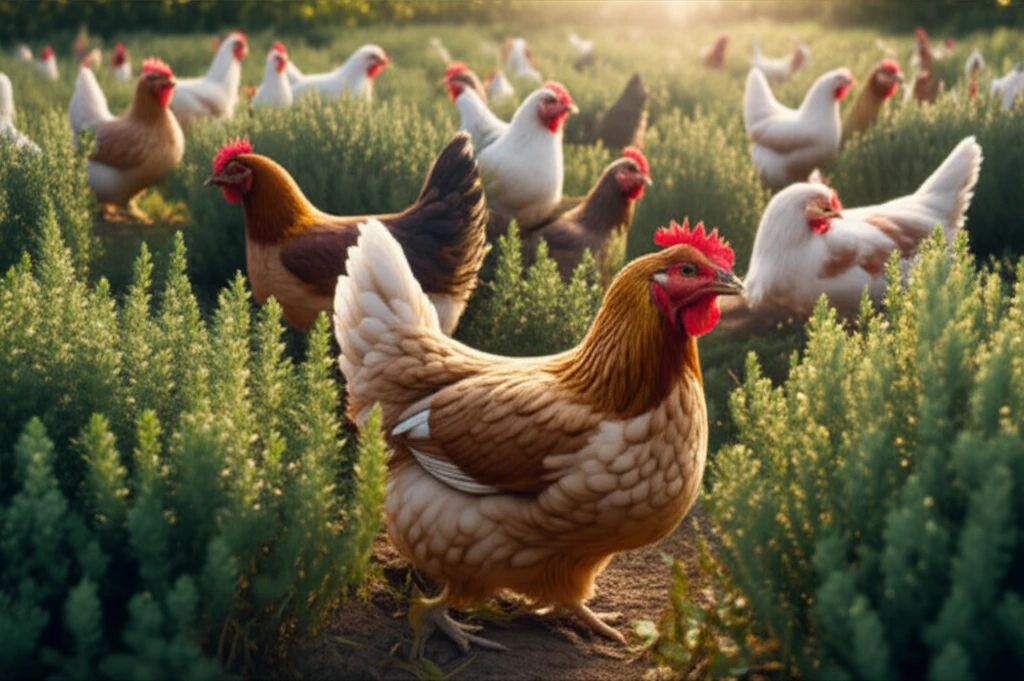
Broilers grazing in an oregano field, symbolizing natural health and improved meat quality.

Spice Up Your Broiler Game: Mexican Oregano Oil for Healthier, Tastier Chicken?

"Discover how adding Mexican oregano oil to your broiler feed can boost performance, improve meat quality, and offer a natural alternative to antibiotics."


In today's poultry industry, there's a growing need for natural alternatives to antibiotics, especially as concerns about antibiotic resistance increase. Resistance of pathogenic bacteria to antibiotics used in broiler production is widely known. That's where oregano essential oils (OEO) come in. These oils, derived from plants like Mexican oregano, have shown promise in promoting growth, acting as natural antibiotics, and even enhancing meat quality.

While European oregano species like Origanum are well-known, Mexican oregano, specifically Lippia and Poliomintha, offers a unique alternative. These species, native to arid regions of Central and North America, contain essential oils with potent properties. The most popular forms under the common name Mexican oregano are Lippia berlandieri Schauer and Poliomintha longiflora Gray, and in addition to being used as condiments for flavour, they also have medicinal properties for respiratory ailments.

This article dives into the exciting research exploring the effects of two types of Mexican oregano oil—Lippia berlandieri Schauer (LBS) and Poliomintha longiflora Gray (PLG)—on broiler chickens. We'll explore how these oils impact performance, blood profiles, carcass characteristics, and overall meat quality, offering insights for both commercial producers and backyard poultry enthusiasts looking to optimize their flock's health and productivity.

Oregano Oil: A Natural Boost for Broilers

Broilers grazing in an oregano field, symbolizing natural health and improved meat quality.

A recent study investigated the impact of adding Mexican oregano essential oil (MOO) extracts from Lippia berlandieri Schauer (LBS) and Poliomintha longiflora Gray (PLG) to broiler diets. Researchers closely examined various factors, including broiler performance, blood profiles, carcass traits, and meat composition.

The study involved 360 one-day-old Ross broilers, divided into four groups: a control group receiving a standard diet, a group receiving the standard diet plus 0.40 g of LBS/kg of feed, a group receiving the standard diet plus 0.40 g of PLG/kg of feed, and a group receiving the standard diet plus a combination of 0.40 g of LBS/kg and 0.40 g of PLG/kg of feed. The experiment ran for 42 days, with researchers meticulously tracking key indicators. Key parameters included weekly body weight (BW), feed intake (FI), water intake (WI), average daily gain (ADG), and feed conversion ratio (FCR) were determined at 7, 14, 21, 28, 35, and 42 days.

  • Growth Performance: Broilers treated with LBS and PLG maintained body weight without increased feed or water intake.
  • Blood Profile: LBS+PLG and PLG increased leukocytes, lymphocytes, and low-density lipoprotein levels.
  • Carcass Yield: LBS+PLG and PLG improved hot carcass yields.
  • Meat Composition: PLG and LBS+PLG showed similar breast protein content to the control group.
The results clearly indicate that incorporating these two Mexican oregano essential oils can positively influence broiler performance, blood profiles, carcass traits, and meat composition. These MOOs show great promise as feed supplements, acting as growth promoters and enhancing meat quality in broiler production. These findings are consistent with previous studies highlighting the benefits of oregano oil and other plant extracts in broiler diets. Notably, the study suggests that oregano oil and its fractions can be viable alternatives to synthetic antioxidants commonly used in foods and animal feed.

The Future of Poultry: Natural Solutions for Better Meat

The research highlights the potential of Mexican oregano oils as a natural way to enhance broiler health and meat quality. By incorporating these oils into feed, producers can potentially reduce their reliance on synthetic additives and antibiotics, aligning with consumer demand for more natural and sustainable practices.

Further studies are needed to optimize the dosage and application methods of Mexican oregano oils in broiler diets. Investigating the specific mechanisms by which these oils exert their beneficial effects will also be crucial for maximizing their potential.

Ultimately, Mexican oregano oil offers a promising avenue for improving broiler production, promoting healthier chickens, and delivering higher-quality meat. As the industry continues to seek sustainable and natural solutions, expect to see more research and application of these valuable plant extracts in poultry farming.

About this Article -

This article was crafted using a human-AI hybrid and collaborative approach. AI assisted our team with initial drafting, research insights, identifying key questions, and image generation. Our human editors guided topic selection, defined the angle, structured the content, ensured factual accuracy and relevance, refined the tone, and conducted thorough editing to deliver helpful, high-quality information.See our About page for more information.

This article is based on research published under:

DOI-LINK: 10.1590/rbz4720170198, Alternate LINK

Title: Effects Of Two Sources Of Mexican Oregano Oil On Performance, Blood Profile, Carcass Variables, And Meat Of Broilers

Subject: Animal Science and Zoology

Journal: Revista Brasileira de Zootecnia

Publisher: FapUNIFESP (SciELO)

Authors: Ramón Silva-Vázquez, Lorenzo Antonio Duran-Meléndez, Carlos Alberto Hernández-Martínez, Juanita Guadalupe Gutiérrez-Soto, Michael E. Hume, Gerardo Méndez-Zamora

Published: 2018-07-16

Everything You Need To Know

1

What is Mexican oregano oil, and what specific types are discussed?

Mexican oregano oil (MOO) refers to essential oils extracted from specific species of Mexican oregano, specifically Lippia berlandieri Schauer (LBS) and Poliomintha longiflora Gray (PLG). These oils are used as a feed supplement for broiler chickens. They are derived from plants native to arid regions of Central and North America. Unlike the more commonly known European oregano (Origanum), MOO offers a unique alternative with potent properties.

2

What was the primary focus of the study on Mexican oregano oil?

The study explored the effects of adding MOO extracts, specifically LBS and PLG, to broiler diets. The focus was on observing the impact on broiler performance, blood profiles, carcass characteristics, and meat composition. The experiment involved 360 Ross broilers, divided into four groups: a control group, an LBS group, a PLG group, and an LBS+PLG group. Key parameters like body weight, feed intake, and feed conversion ratio were tracked for 42 days to assess the benefits of MOO.

3

What were the main findings regarding the use of Mexican oregano oil (MOO) in broiler diets?

The study found that adding MOO, specifically LBS and PLG, to broiler diets had several positive effects. The broilers maintained body weight without increased feed or water intake. The blood profiles of chickens fed LBS+PLG and PLG showed increased leukocytes, lymphocytes, and low-density lipoprotein levels. Furthermore, the carcass yield was improved with LBS+PLG and PLG. The breast protein content was similar to the control group when using PLG and LBS+PLG.

4

Why is the use of LBS and PLG significant in the context of broiler production?

The use of LBS and PLG is significant because they offer a natural alternative to antibiotics and synthetic additives in broiler production. This aligns with the growing consumer demand for sustainable and natural practices in the poultry industry. The MOOs act as growth promoters and enhance meat quality. This research shows that they can be a viable option to address antibiotic resistance, a rising concern in broiler production. The findings indicate the potential to move away from reliance on synthetic additives.

5

What are the broader implications of incorporating Mexican oregano oil, like LBS and PLG, into broiler feed?

The implications of using LBS and PLG are far-reaching. It can lead to healthier chickens, improved meat quality, and reduced reliance on synthetic antibiotics. The research suggests a pathway towards more sustainable poultry farming practices. By incorporating these oils into feed, producers can address consumer demand for more natural and sustainable practices. These findings encourage the use of LBS and PLG as feed supplements in the poultry industry.

Newsletter Subscribe

Subscribe to get the latest articles and insights directly in your inbox.