
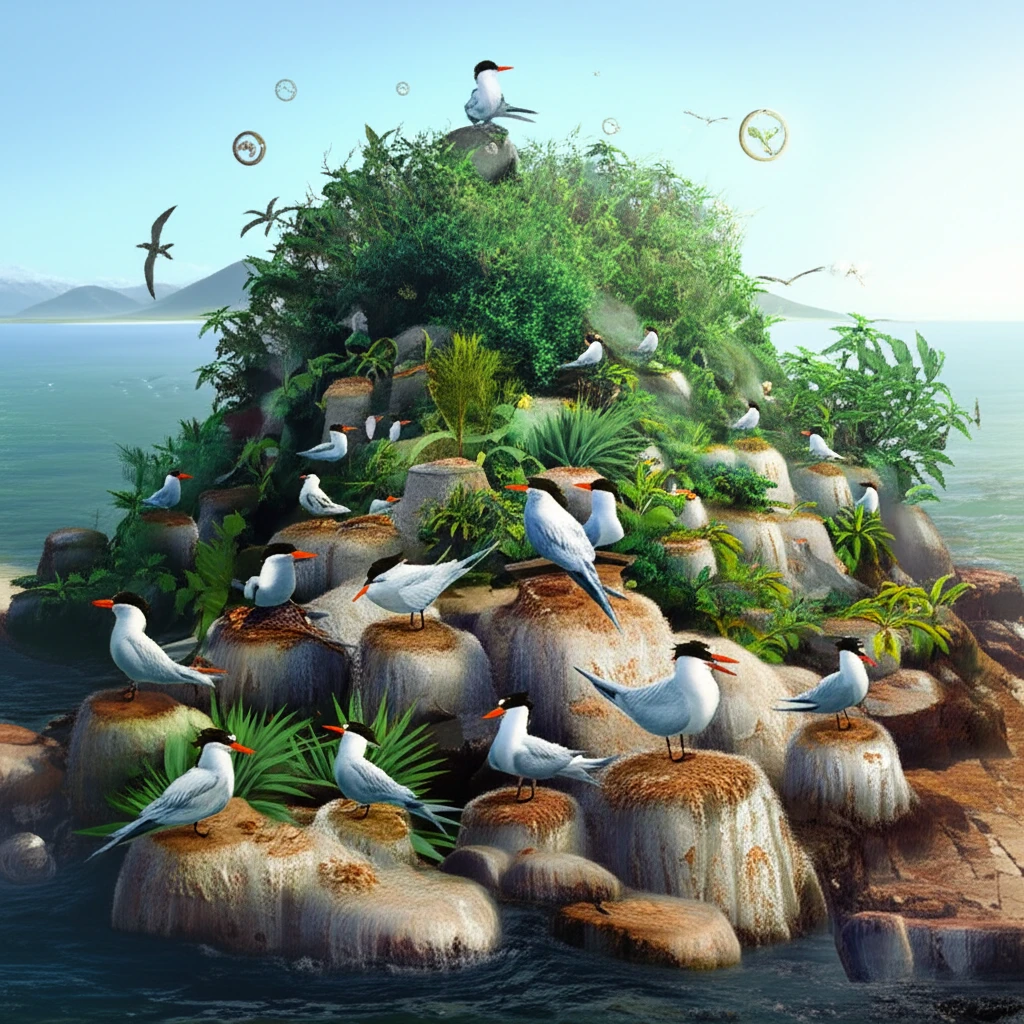
South American Terns: Unveiling the Secrets of Their Coastal Breeding Success

"Discover how strategic nesting sites and low predator pressure contribute to the reproductive success of South American Terns in Brazil."
The reproductive success of coastal seabirds is a delicate balance, influenced by climate, food availability, predation, and human impact. Marine terns, often more specialized than other coastal species, face unique vulnerabilities in their breeding and foraging grounds.
While the breeding biology of terns in the northern hemisphere is well-documented, less is known about their southern counterparts. The South American Tern (Sterna hirundinacea), a migratory seabird inhabiting the Pacific and Atlantic coasts of South America, offers a fascinating case study.
This article delves into the reproductive success of South American Terns on Cardos Island, Florianópolis, Brazil, drawing from research conducted over three breeding seasons (2003, 2005, and 2006) to shed light on the factors that contribute to their survival.
Cardos Island: A Haven for South American Terns
Cardos Island, located in Santa Catarina, Brazil, provides a unique environment for South American Terns. The island's thick vegetation and rocky terrain offer nesting sites, while its surrounding waters provide feeding grounds. Researchers conducted daily observations on the island during the breeding seasons of 2003, 2005, and 2006.
- Colony Formation: Colonies typically formed in mid-May in 2003 and early April in subsequent years.
- Nest Numbers: The total number of nests varied, ranging from 1,852 in 2006 to 2,486 in 2005.
- Hatching Success: Hatching success was highest in 2006 (76.39%) but significantly lower in 2005 (41.1%), likely due to increased predation.
Conservation Implications and Future Directions
The consistent use of Cardos Island as a breeding site underscores its importance for the conservation of South American Terns. Understanding the factors that contribute to their reproductive success is crucial for developing effective conservation strategies.
Further research is needed to explore the long-term trends in tern populations, the impact of climate change on their breeding habitats, and the effectiveness of different conservation interventions. Continuous monitoring of breeding colonies and predator populations is essential for ensuring the long-term survival of these fascinating seabirds.
By protecting key breeding sites like Cardos Island and mitigating threats such as predation and human disturbance, we can help safeguard the future of South American Terns and maintain the biodiversity of coastal ecosystems.