
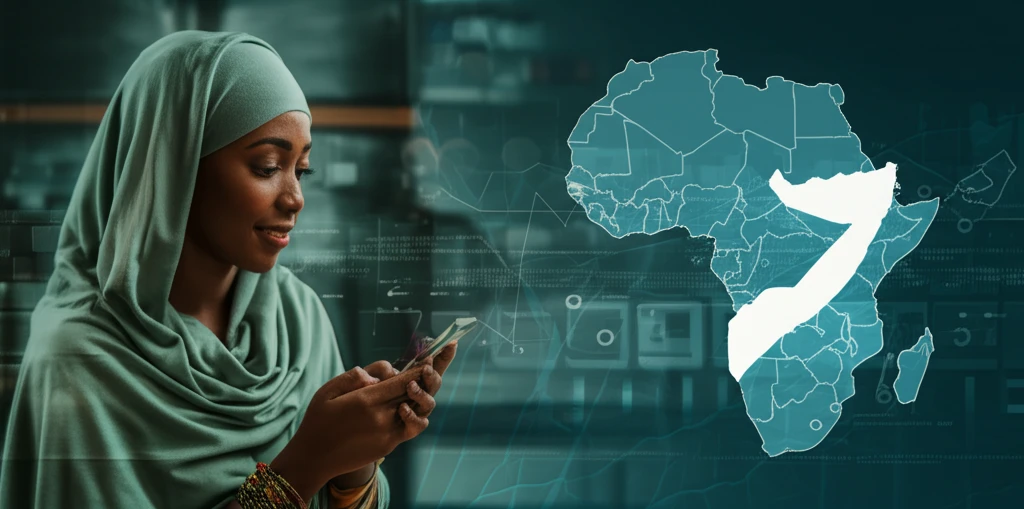
Somalia's Mobile Money Revolution: A Model for African Growth?

"Despite challenges, Somalia's booming mobile money market offers vital lessons for financial inclusion and economic resilience across Africa."
Somalia, a nation often associated with fragility and underdevelopment, is quietly leading a financial revolution powered by mobile money. According to the World Bank's Somalia Economic Update (SEU), the country's economy is projected to grow at an annual rate of 3-4%, largely fueled by its exceptionally active mobile money market. This growth is particularly noteworthy given the backdrop of recurring droughts and institutional challenges.
The SEU report, titled 'Rapid Growth in Mobile Money: Stability or Vulnerability?', highlights the transformative impact of mobile money in Somalia. With over 70% of adult Somalis regularly using mobile money services, the country has leapfrogged traditional banking systems, creating a unique financial ecosystem. This widespread adoption offers valuable insights for other African nations striving for greater financial inclusion and economic stability.
This economic narrative contrasts sharply with the difficulties Somalia has faced. In recent years, severe droughts have decimated livestock and crop production, significantly impacting the nation's exports. The volume of live animal exports, which account for more than 70% of Somalia's export earnings, declined dramatically, underscoring the economy's vulnerability to climate-related shocks.
A Small but Urbanized Nation at the Horn of Africa
Somalia, officially the Federal Republic of Somalia, is the easternmost country in continental Africa, stretching across the Horn of Africa and bordering Ethiopia to the west, Djibouti to the northwest, Kenya to the southwest, the Gulf of Aden to the north, and the Indian Ocean to the east. Recent data indicates that 54.6% of the Somali population resides in urban areas, making Somalia more urbanized than many of its neighbors in Eastern Africa. The country is also known for the Horn of Africa and for having the longest coastline in mainland Africa, according to population tracking services. Demographic resources such as Statista additionally compile long-run indicators for the country, including mortality rates per 1,000 inhabitants from 1960 to 2024.
Standards, Inspection, and the Road to Codex Adoption
Somalia's approach to product standards centers on the Somali Bureau of Standards (SOBS), which is responsible for ensuring that imported products meet required standards for quality and safety. The organization operates offices at the seaport and the airport, where it inspects goods entering the country. Standards themselves are formal documents, generally developed by consensus, that define the requirements a product, process, or service should comply with. In a notable step, the 1st National Codex Committee for Somalia resolved to adopt 81 Codex standards within the next year through SOBS, while engaging other national stakeholders in the work of the committee.
From Ancient Kingdoms to a Written Language
Somalia's recorded heritage reaches back to ancient civilizations, including the Land of Punt and the Ajuran Sultanate, whose legacies are central to Somali heritage and identity. Because of the country's colonial history, many Somalis also speak English and Italian, while Swahili is spoken in the south. In 1973 Somalia adopted a Latin alphabet-based orthography, making Somali a written language. These foundational milestones are documented by Britannica as part of the country's broader historical record.
The Rise of Mobile Money in Somalia
Somalia's mobile money market is not just active; it's a global leader. With approximately 155 million transactions worth $2.7 billion recorded each month, it surpasses many other African countries. This widespread use has effectively replaced cash transactions for the majority of Somalis, offering a secure and efficient way to conduct daily business. This digital transformation presents both exciting opportunities and potential vulnerabilities.
- Ubiquitous Access: Mobile money is accessible even in remote areas, bridging the gap where traditional banks are absent.
- Reduced Risk: It offers a safer alternative to carrying cash, reducing the risk of theft and loss.
- Efficiency: Transactions are quick and easy, saving time and resources for both individuals and businesses.
- Financial Inclusion: It brings financial services to a large segment of the population previously excluded from the formal banking system.
Security Research and Continuous News Coverage
Ongoing coverage of Somalia spans scientific outlets like Phys.org, which track the latest research developments and breakthroughs in the country, alongside aggregators such as NewsNow that follow Mogadishu, security, politics, and humanitarian developments. In 2025, the European Union Agency for Asylum (EUAA) published a country of origin information report on the security situation in Somalia, jointly drafted with the Austrian Centre for Country of Origin and Asylum Research and Documentation (ACCORD). The report provides researchers and policymakers with an updated assessment of Somalia's security landscape. Google News separately aggregates a constant stream of articles on the Somalia topic for international readers.
State Fragility and Humanitarian Crisis
Somalia has often been described as the archetypal failed state, a nation so fractured that for about 20 years no central authority was able to control more than a few square kilometers of the capital. Historical defeats, including the war over the Ogaden, refocused criticism on then-leader Siad Barre, prompting the Ogaden Clan to break from the government and the ruling MOD alliance to begin to unravel. More recently, a survey of people displaced in Baidoa found that every second child is malnourished, a crisis one commentator called a clear example of dangerous indifference and a wake-up call for the international community. Together these episodes illustrate the human and institutional costs of state weakness.
Somaliland vs. Somalia: Security and Politics in Contrast
Comparisons between Somalia and the self-declared Republic of Somaliland highlight stark security differences: as one geography discussion puts it, Somaliland does not host any terror groups, while Somalia contends with Al-Shabaab, ISIS, and other armed groups. Somaliland was set for its fourth direct presidential election since 2003 on November 13, 2024, underscoring its distinct political trajectory. Freedom House's 2024 country report on Somalia notes the presence of parallel justice structures, including courts run by Al-Shabaab that serve as alternatives to the formal system. The sovereignty of Somalia over Somaliland remains a deeply contested issue.
Lessons for Africa
Somalia's experience with mobile money offers valuable lessons for other African nations seeking to promote financial inclusion and drive economic growth. By embracing digital financial technologies and developing appropriate regulatory frameworks, countries can unlock new opportunities for their citizens and build more resilient economies. The Somali model, while not without its challenges, demonstrates the transformative potential of mobile money in even the most challenging environments.
Expert Perspectives Across Law, Policy, and Security
Expert analysis of Somalia comes from multiple institutional sources: organizations such as Arab Center Washington DC publish policy analyses covering the country's regional relations and geopolitics. Legal researchers turn to independent expert witness reports for asylum cases from Somalia and other East African states, as well as to databases like ecoi.net that compile country of origin information, including EUAA guidance on governance, refugee status, subsidiary protection, and exclusion. Rashid Abdi, a Somalia expert, has addressed what comes next for the country, including the expiry of the African Union Mission in Somalia's mandate. Together these materials provide layered expert perspectives on Somalia's security, legal, and political landscape.
Famine Risks, Security Trajectories, and Digital Threats
Future assessments of Somalia are decidedly mixed. As early as 2006, a worst-case scenario placed parts of Southern Somalia, particularly Gedo Region and areas of Middle Juba, Lower Juba, Bay, and Bakool, at high risk of famine and humanitarian catastrophe. More recent analysis from the Hiraal Institute outlines the security landscape, including Al-Shabaab's tactical evolution, allied counter-terrorism operations, and Puntland's independent campaign against ISIS-Somalia. On the digital frontier, cyber threats are evolving, but limited resources hamper investment in cybersecurity infrastructure and training. One economic overview concludes that economic progress depends on the reestablishment of peace, security, and stability, and that the future status of Somaliland and Puntland will eventually need to be addressed.
Politics, Health, and the Question of Systems
Somalia's broader systemic challenges are visible across multiple sectors. As its election season approaches, the political landscape is shifting, with widespread concern that the electoral process could be vulnerable to manipulation and undue influence. In healthcare, practitioners working with the Private Sector Partnerships in Health (PSPH) programme in Somalia and Somaliland confront a pointed question: how do you create systemic impact where there is no system. Regional neighbors face parallel struggles, with Kenya's health system, for example, reportedly suffering from a lack of political will and wavering commitment to its improvement.
Broken by the Numbers, Determined in Person
Accounts of daily life in Somalia diverge sharply. The country ranks among the lowest in the world on UNDP's Human Development Index, which might make it seem left out of the loop of global markets, technologies, politics, and cultures. Yet a visitor who ignored Western media portrayals and went to Mogadishu reports that the media does not show the artists, the innovators, or the younger population pulling together amid hardship, concluding that the real Somalia is anything but broken. Humanitarian assessments offer a counterpoint: a real-time evaluation of the 2006 emergency response documented a severe water deficit and its impacts on child malnutrition amid ongoing political crises.