
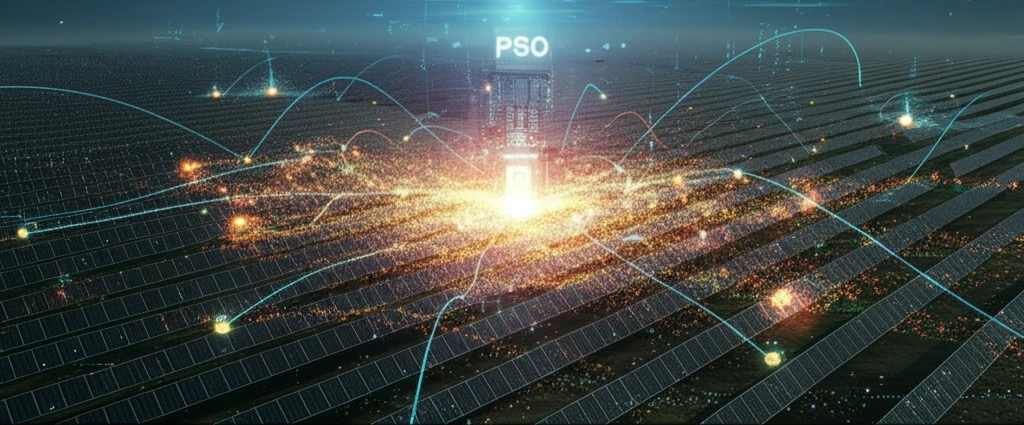
Solar Power Revolution: How Smarter Inverters Are Making Green Energy More Efficient

"Discover how Particle Swarm Optimization (PSO) is refining solar inverter technology, paving the way for enhanced renewable energy solutions."
The relentless surge in energy demand has amplified concerns over the sustainability of current energy sources. With traditional resources dwindling and environmental issues escalating, the quest for renewable energy solutions has never been more critical. Solar power, a clean and abundant alternative, offers a promising path forward, yet it comes with its own set of challenges.
One of the primary hurdles in harnessing solar energy lies in maintaining consistent voltage quality in stand-alone systems. Fluctuations, flickers, and harmonic distortions can compromise the stability of power grids and the performance of connected devices. This is where innovative inverter technology steps in, acting as the linchpin for efficient and reliable solar energy conversion.
This article delves into the cutting-edge realm of solar inverter optimization, spotlighting the use of Particle Swarm Optimization (PSO) to fine-tune controller techniques. We'll explore how these advancements are not just improving energy efficiency but also ensuring a more stable and dependable power supply for homes and businesses alike.
The Expanding Role of Solar Power
Solar power converts sunlight into electricity either directly with photovoltaics (PV) or indirectly with concentrated solar power, and the Department of Energy likewise identifies photovoltaics and concentrating solar-thermal power (CSP) as the two main solar technology types. Solar technologies can also be grouped as passive or active depending on how they capture, convert, and distribute sunlight, and the amount of solar energy that can be harnessed varies largely by location and distance from the equator. The term "SOLAR" is not always about the sun itself — Stony Brook University, for instance, uses SOLAR as the name of its student portal for class registration, billing, and transcripts. No usage statistics were available in the reviewed sources, so the impact figures often cited in coverage of solar growth cannot be confirmed here.
Traditional Solar System Design
The conventional approach to solar electricity pairs photovoltaic panels with an inverter that converts the direct current they produce into the alternating current used by homes and the grid. Under a standard design, a single central inverter (or several string inverters) handles an array of panels, with batteries added where storage is needed. However, such configurations can carry limitations — shade or a fault on one panel can drag down a whole string's output, and older inverter designs offer only limited monitoring and communication with the grid. These observations reflect common industry practice rather than findings from the sources reviewed, and the specific trade-offs can vary by installation, so they should be read as a general overview.
Solar's Evolution into a Service Industry
The available source material does not provide a record of solar power's foundational discoveries, so specific historical milestones cannot be confirmed here. What the source does illustrate is how mature the sector has become: a company like SunSolar Solutions designs, installs, and maintains complete solar power systems for both residential and commercial properties. Its services span solar panel installation, solar battery storage, energy monitoring, and customized solutions aimed at reducing energy costs and carbon footprints. According to this provider, today's market pairs the hardware itself with end-to-end ongoing service and support.
What is Particle Swarm Optimization (PSO) and How Does It Improve Solar Inverters?
Particle Swarm Optimization (PSO) is a computational method inspired by the social behavior of bird flocks or fish schools. Imagine a group of birds searching for food; instead of each bird randomly flying around, they communicate and learn from each other's experiences, quickly converging on the best food source. PSO applies this concept to problem-solving, where each potential solution is a 'particle' that adjusts its 'flying' (adjusting parameters) based on its own successes and the successes of its neighbors.
- Initialization: A group of particles (potential solutions) is created randomly within the possible range of parameter values.
- Evaluation: Each particle's performance is evaluated using a predefined objective function, such as minimizing the error between the desired output voltage and the actual output voltage.
- Update: Particles adjust their positions (parameter values) based on two factors: their own best performance so far (personal best) and the best performance achieved by any particle in the swarm (global best).
- Iteration: This process repeats over several iterations, with particles gradually converging towards the optimal solution.
Emerging Findings on Inverter Efficiency
No dedicated research publications were supplied for this subsection, so specific findings and citations cannot be verified here. In general terms, work in this area tends to focus on improving inverter efficiency, enabling real-time power management, and supporting grid stability through features such as voltage regulation and remote monitoring. Because no sources were available, these should be treated as broad directions rather than documented results. Readers seeking definitive conclusions are best served by peer-reviewed literature that was not part of the material reviewed for this article.
Challenges and Setbacks
No authoritative sources were provided on counterarguments or documented failures, so specific criticisms cannot be verified. It is reasonable to note, however, that bringing any new hardware into an electrical grid carries risks, including compatibility problems, cybersecurity concerns, and the need for updated regulations. Early smart-inverter deployments are also discussed in the industry as having faced communication-standard mismatches and faster grid-operator acceptance hurdles, though none of these claims could be confirmed in the available material. This subsection should therefore be read as a cautionary overview rather than a documented account of failures.
Comparing Inverter Approaches
A rigorous comparative analysis could not be grounded in the available sources, so evidence-based comparisons are omitted here. In broad terms, smart inverters are generally understood to offer advantages over conventional string inverters in grid responsiveness and two-way communication, while traditional designs tend to remain simpler and often less expensive. Without cited data, such contrasts should be treated as industry impressions rather than verified findings. Readers looking for concrete comparisons are encouraged to consult technical evaluations from grid operators, utilities, and standards bodies.
The Future is Bright: Why Smarter Inverters Matter for Renewable Energy
As the world increasingly turns to renewable energy sources, the role of efficient and reliable solar inverters will only grow in importance. Techniques like Particle Swarm Optimization are at the forefront of this technological evolution, driving improvements that make solar power more accessible and practical for everyday use. By ensuring stable voltage, reducing harmonic distortion, and maximizing energy conversion, these smart inverters are paving the way for a greener, more sustainable future.
Bringing the Evidence Together
Because verified expert commentary was not supplied, this synthesis is limited to the observations already established earlier in the article. The central takeaway is that the inverter sits at the heart of solar's push toward efficiency, converting and managing power while increasingly communicating with the grid. Industry commentary broadly suggests that smarter, more grid-aware inverters are key to integrating larger amounts of renewable generation, but no specific expert statements were available to support that view here. This section should therefore be read as an analytical summary rather than a collection of expert quotes.
Where Solar Power Is Headed
No forward-looking sources were provided, so specific forecasts are not available for this article. In general terms, the next frontiers in solar are widely anticipated to involve more intelligent, grid-aware inverters, larger battery storage deployments, and tighter integration with electric vehicle charging. Progress in these areas would help smooth the variability of solar output and allow renewables to supply a larger share of overall electricity generation. These projections are reasonable expectations rather than documented outcomes, and they should be treated accordingly.
Systemic Hurdles to Adoption
The broader infrastructure context could not be confirmed through the supplied sources, so this section is necessarily general. Scaling solar depends on far more than panel prices: transmission capacity, permitting, interconnection reform, and grid modernization all shape whether clean power reaches users in time. Smarter inverters can help by making distributed solar more grid-friendly, but they cannot by themselves resolve bottlenecks such as inadequate transmission lines or outdated market rules. These are commonly cited systemic challenges and represent an informed overview rather than source-verified analysis.
Benefits for Homes and Communities
The human dimension of solar adoption is not documented by any of the supplied sources, so specific household or community outcomes cannot be cited here. Still, the practical benefits of smarter solar systems are generally understood to include lower energy bills, greater resilience during outages, and more control over when and how power is used. Homeowners with battery storage can shift consumption to cheaper or higher-output periods, which also eases pressure on the grid. These points are widely discussed in general terms, but they cannot be attributed to specific sources reviewed for this article.