
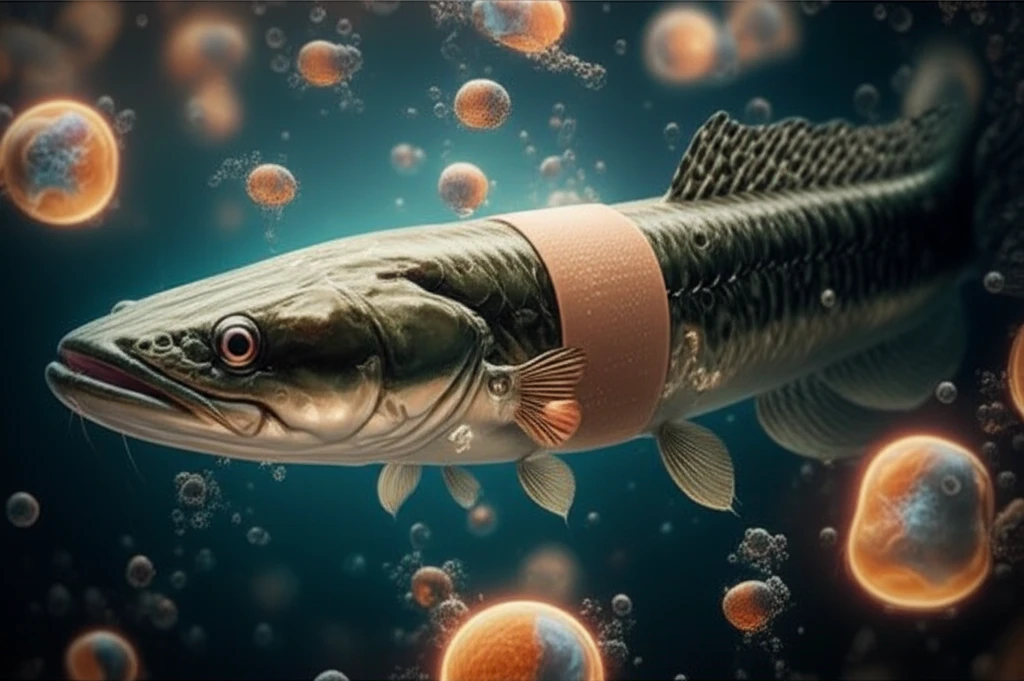
Channa striatus fish transforming into a healing bandage.

Snakehead Fish: Unlocking the Secrets of Natural Wound Healing

"Discover how the proteomic profile of Channa striatus reveals its potential as a natural remedy for tissue repair and recovery."


Our bodies have an incredible ability to heal, but sometimes they need a little extra help. When injuries occur, the body's demand for proteins surges, prompting a breakdown of fat and muscle tissue to fuel the repair process. This is where the nutritional power of fish comes into play, offering a complete protein source packed with essential amino acids.

Interestingly, studies suggest that wounds in fish tend to heal more rapidly than in humans, hinting at a unique connection between fish proteins and tissue regeneration. Among these promising species is Channa striatus, a freshwater snakehead fish, commonly known as 'Haruan' in Malaysia, that has been a traditional remedy for wound healing.

For generations, locals have recommended Channa striatus to patients recovering from surgery or childbirth, believing its meat possesses medicinal properties that accelerate recovery. Now, modern science is beginning to unravel the mysteries behind this age-old practice, with researchers delving into the proteomic profile of Channa striatus to identify the specific biomolecules responsible for its wound-healing prowess.

Decoding the Proteomic Puzzle of Channa Striatus

Channa striatus fish transforming into a healing bandage.

Recent research has harnessed advanced proteomic techniques to analyze the protein composition of Channa striatus meat, aiming to pinpoint the key players involved in wound healing. By employing high-sensitivity liquid chromatography tandem mass spectrometry and PEAKS Studio 7 software, scientists have identified a wealth of proteins and post-translational modifications (PTMs) that contribute to the fish's therapeutic effects.

To maximize protein detection, researchers utilized a Gelfree fractionation system, which separates proteins based on molecular weight without trapping them in a gel matrix. This approach proved remarkably effective, revealing a more diverse protein profile than traditional methods. In fact, 75 proteins were identified in the Gelfree fractions, compared to just 42 in whole samples.

  • Structural proteins: Essential for muscle tissue formation and wound closure, including actin, myosin, and tropomyosin.
  • Enzymes: Facilitate various biochemical reactions involved in tissue repair, with trypsin playing a crucial role in protein digestion and fibrocyte differentiation.
  • Calcium-related proteins: Regulate calcium signaling and intracellular trafficking, essential for keratinocyte maturation and wound recovery. Calmodulin and parvalbumin stand out as key proteins in this category.
  • Collagen: Provides structural support and promotes cell adhesion, angiogenesis, and tissue remodeling. The abundance of collagen in Channa striatus contributes to its wound-healing properties.
These findings shed light on the complex interplay of proteins within Channa striatus and their potential roles in promoting tissue regeneration. By categorizing the detected proteins and highlighting key PTMs, researchers have laid the groundwork for future investigations into the specific mechanisms underlying the fish's wound-healing capabilities.

The Future of Fish-Based Therapies

The discovery of these biomolecules has the potential to revolutionize wound care, opening doors for innovative therapies derived from natural sources. As research progresses, scientists aim to isolate and extract these proteins for use in advanced wound dressings, ointments, and regenerative medicine applications.

While further studies are needed to fully elucidate the wound-healing pathway, the evidence suggests that Channa striatus may offer a promising avenue for accelerating tissue repair and improving patient outcomes. Its rich protein content, coupled with beneficial post-translational modifications, makes it a valuable candidate for future exploration.

In a world increasingly focused on natural and sustainable healthcare solutions, Channa striatus stands out as a testament to the healing power of nature. With continued research and development, this humble snakehead fish could pave the way for a new era of effective and accessible wound care.

About this Article -

This article was crafted using a human-AI hybrid and collaborative approach. AI assisted our team with initial drafting, research insights, identifying key questions, and image generation. Our human editors guided topic selection, defined the angle, structured the content, ensured factual accuracy and relevance, refined the tone, and conducted thorough editing to deliver helpful, high-quality information.See our About page for more information.

This article is based on research published under:

DOI-LINK: 10.2174/1570164613666160413123846, Alternate LINK

Title: Profiling Of Proteins And Post Translational Modifications Of Channa Striatus Dried Meat

Subject: Molecular Biology

Journal: Current Proteomics

Publisher: Bentham Science Publishers Ltd.

Authors: Soon Hong Kwan, Saringat Baie, Mohd Nazri Ismail

Published: 2016-04-20

Everything You Need To Know

1

What is Channa striatus, and what is its significance in the context of wound healing?

Channa striatus, also known as the freshwater snakehead fish, is a species recognized for its remarkable wound-healing properties. It has been a traditional remedy for generations, particularly in Malaysia where it's known as 'Haruan'. The fish's meat is believed to possess medicinal qualities that accelerate the recovery process for those recovering from surgery or childbirth. Modern science is now exploring the proteomic profile of Channa striatus to uncover the specific biomolecules responsible for its effectiveness.

2

How are proteomic techniques used to study Channa striatus?

Proteomic techniques are used to analyze the protein composition of Channa striatus. These techniques involve advanced methods such as high-sensitivity liquid chromatography tandem mass spectrometry and PEAKS Studio 7 software. This analysis helps to identify the specific proteins and post-translational modifications (PTMs) within the fish that contribute to its wound-healing abilities. The goal is to pinpoint the key biomolecules involved in tissue repair and regeneration.

3

What types of proteins have been identified in Channa striatus, and what are their functions?

The analysis of Channa striatus has identified various key protein categories. These include structural proteins like actin, myosin, and tropomyosin, essential for muscle tissue formation and wound closure. Enzymes such as trypsin facilitate biochemical reactions crucial for tissue repair and fibrocyte differentiation. Calcium-related proteins, like calmodulin and parvalbumin, regulate calcium signaling and intracellular trafficking vital for keratinocyte maturation and wound recovery. Furthermore, the abundance of collagen supports cell adhesion, angiogenesis, and tissue remodeling, all contributing to the fish's healing properties.

4

How could the findings related to Channa striatus impact wound care treatments?

The proteins and post-translational modifications (PTMs) found in Channa striatus have the potential to significantly impact wound care. By understanding the specific roles of these biomolecules, scientists aim to develop innovative therapies. This includes the potential to isolate and extract these proteins for use in advanced wound dressings, ointments, and regenerative medicine applications. This approach offers the possibility of creating natural, effective treatments to improve wound healing.

5

Why is Channa striatus considered to be effective in wound healing?

The significance of Channa striatus in wound healing lies in its ability to provide a rich source of proteins and biomolecules essential for tissue repair. When injuries occur, the body's demand for proteins increases, prompting the breakdown of fat and muscle tissue. Channa striatus offers a complete protein source with essential amino acids, which aid in the healing process. The fish's proteins, including structural proteins, enzymes, calcium-related proteins, and collagen, play crucial roles in various stages of wound healing, such as tissue formation, biochemical reactions, cell signaling, and tissue remodeling. This makes Channa striatus a promising candidate for developing natural remedies to accelerate recovery.

Newsletter Subscribe

Subscribe to get the latest articles and insights directly in your inbox.