
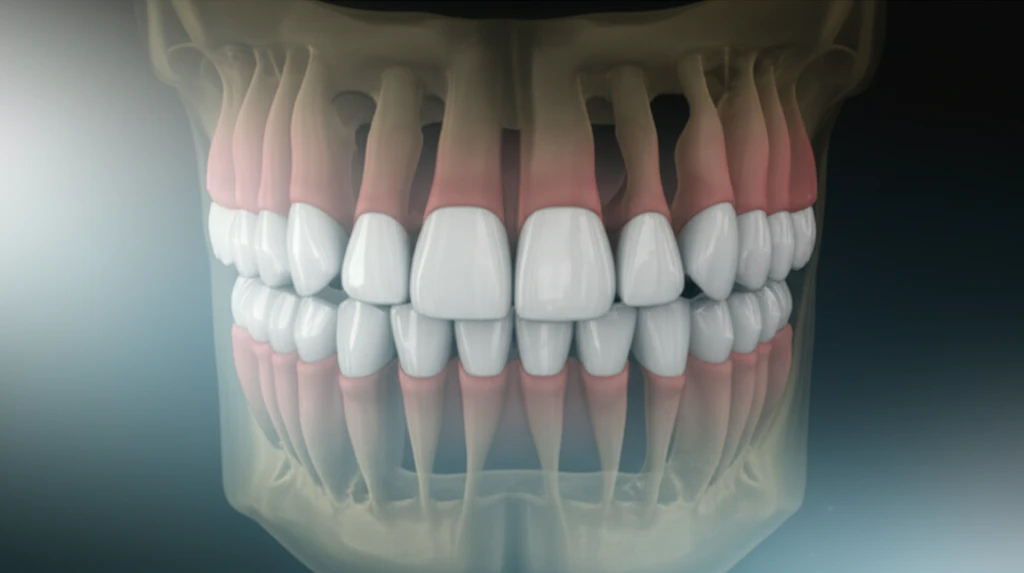
Illustration of incisors being gently retracted during orthodontic treatment, showcasing healthy bone and a future-focused aesthetic.

Smile Transformation: What Happens to Your Teeth When Orthodontics Retracts Your Incisors?

"Unveiling the Science Behind Incisor Retraction: How Orthodontics Can Reshape Your Smile Without Sacrificing Tooth Health"


Ever gazed in the mirror and wished for a straighter, more radiant smile? You're not alone. Orthodontics, the art of straightening teeth, has transformed countless smiles. But beyond the cosmetic appeal lies a complex science, particularly when it comes to retracting incisors—those prominent front teeth that define our smiles. This article explores the fascinating process of incisor retraction, examining how orthodontists carefully guide these teeth backward, and what effects this movement has on the teeth and the bone that supports them.

The journey to a perfect smile often involves moving teeth, and incisor retraction is a key technique. This involves carefully moving the front teeth backward to correct overbites, crowding, or other alignment issues. However, moving teeth isn't just about aesthetics; it's about understanding the biological responses within your mouth. The teeth are embedded in bone, and the process of retraction can affect the length of your teeth and the thickness of the bone around them.

This article sheds light on a preliminary study that sought to understand these changes. We'll look at how researchers assessed tooth length and alveolar bone thickness during incisor retraction. The goal? To ensure that while achieving a stunning smile, the health and integrity of your teeth and supporting structures are maintained.

The Science of Incisor Retraction: A Closer Look

Illustration of incisors being gently retracted during orthodontic treatment, showcasing healthy bone and a future-focused aesthetic.

The primary goal of incisor retraction is to reposition the front teeth to achieve an ideal bite and a more aesthetically pleasing smile. This is often a crucial part of comprehensive orthodontic treatment, addressing issues like excessive protrusion (where the front teeth stick out too far) or crowding. The process involves applying gentle, controlled forces to move the teeth gradually. This movement doesn't just shift teeth; it influences the relationship between the teeth and the bone that surrounds them.

The study's methods involved using cone-beam computed tomography (CBCT) scans, a sophisticated imaging technique, to measure tooth length and alveolar bone thickness. These scans provided detailed, three-dimensional images of the teeth and the bone. The researchers took measurements at two different time points: before retraction and after the retraction phase was complete. This allowed them to track any changes that occurred during the process.

  • The study focused on a group of patients undergoing orthodontic treatment.
  • CBCT scans were used to measure tooth length and bone thickness.
  • Measurements were taken before and after incisor retraction.
  • The goal was to assess how incisor retraction affects the teeth and supporting bone.
The results of the study revealed that the incisor retraction process did not cause significant changes in the length of the incisors or the thickness of the alveolar bone. This is encouraging news for those considering orthodontic treatment. It suggests that the forces used in incisor retraction, when carefully managed, do not negatively impact the teeth or the bone that supports them. This finding underscores the importance of precision and control in orthodontic treatments, emphasizing the careful balance between achieving a beautiful smile and preserving oral health.

The Future of Orthodontics: Precision and Patient-Centered Care

This study serves as a valuable step in understanding the effects of incisor retraction. As orthodontics advances, the focus remains on refining techniques to ensure optimal outcomes for patients. This includes not only achieving straighter teeth but also preserving the health and integrity of the teeth and the surrounding structures. With ongoing research and technological advancements, the future of orthodontics promises even more precise, patient-centered care, ensuring that everyone can achieve a smile that is both beautiful and healthy.

About this Article -

This article was crafted using a human-AI hybrid and collaborative approach. AI assisted our team with initial drafting, research insights, identifying key questions, and image generation. Our human editors guided topic selection, defined the angle, structured the content, ensured factual accuracy and relevance, refined the tone, and conducted thorough editing to deliver helpful, high-quality information.See our About page for more information.

Everything You Need To Know

1

What is incisor retraction in orthodontics and why is it performed?

Incisor retraction is a key orthodontic technique that involves carefully moving the incisors—the front teeth—backward. It is performed to correct overbites, crowding, or other alignment issues, aiming to achieve an ideal bite and a more aesthetically pleasing smile. This process is often a crucial part of comprehensive orthodontic treatment. The goal extends beyond aesthetics, focusing on the biological responses within the mouth and the relationship between the teeth and the bone that surrounds them.

2

How do orthodontists assess the effects of incisor retraction on teeth and surrounding bone?

Orthodontists use cone-beam computed tomography (CBCT) scans, a sophisticated imaging technique, to measure tooth length and alveolar bone thickness. These scans provide detailed, three-dimensional images of the teeth and the bone. Measurements are taken at different time points: before retraction and after the retraction phase is complete. This allows them to track any changes that occur during the process and ensure the health and integrity of the teeth and supporting structures are maintained.

3

Does incisor retraction significantly alter the length of incisors or the thickness of the alveolar bone?

According to a preliminary study, the incisor retraction process did not cause significant changes in the length of the incisors or the thickness of the alveolar bone. This suggests that the forces used in incisor retraction, when carefully managed, do not negatively impact the teeth or the bone that supports them. This finding underscores the importance of precision and control in orthodontic treatments, emphasizing the careful balance between achieving a beautiful smile and preserving oral health.

4

What are the implications of using CBCT scans in orthodontic treatments like incisor retraction?

The use of cone-beam computed tomography (CBCT) scans in orthodontic treatments like incisor retraction allows for detailed, three-dimensional imaging of the teeth and surrounding bone structure. This sophisticated imaging technique enables orthodontists to precisely measure tooth length and alveolar bone thickness before, during, and after the retraction process. By tracking changes over time, CBCT scans help ensure that the orthodontic treatment maintains the health and integrity of the teeth and supporting structures, leading to more predictable and successful outcomes. This technology exemplifies the advancement of precision and patient-centered care in modern orthodontics.

5

How does incisor retraction address issues like excessive protrusion and what is the primary goal?

Incisor retraction is specifically designed to address issues like excessive protrusion, where the front teeth stick out too far, or crowding. The primary goal of this process is to reposition the incisors to achieve an ideal bite and a more aesthetically pleasing smile, making it a crucial aspect of comprehensive orthodontic treatment. By applying gentle, controlled forces, orthodontists gradually move the teeth backward, influencing the relationship between the teeth and the surrounding bone, ultimately improving both the functionality and appearance of the smile.

Newsletter Subscribe

Subscribe to get the latest articles and insights directly in your inbox.