
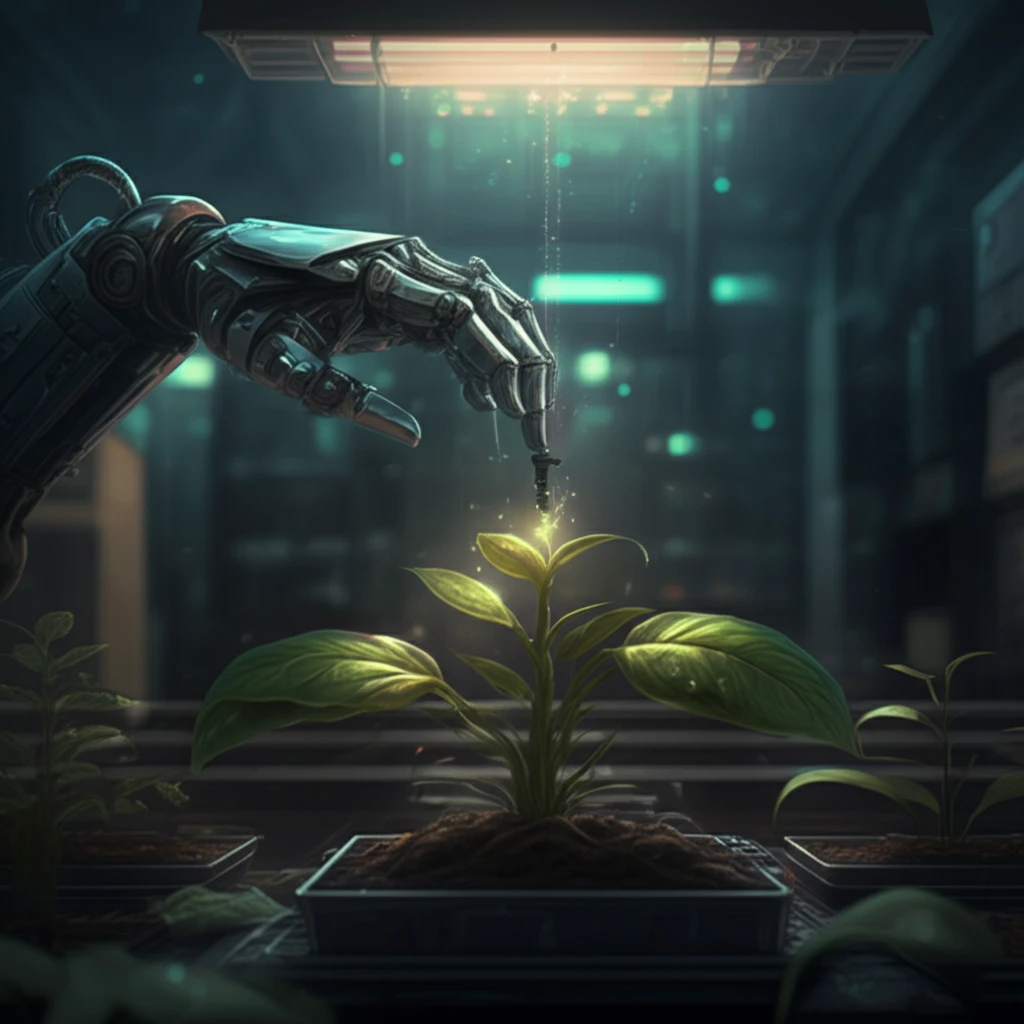
Smarter Watering: How Robots are Revolutionizing Indoor Plant Care

"Discover how automated systems using the Toyota HSR robot can precisely adjust drip irrigation for healthier indoor plants and reduced water waste."
Indoor plants, gracing homes and commercial spaces, thrive with meticulous care. Precision irrigation—supplying the right amount of water—is key to vigorous growth and water conservation. Traditional methods often fall short; manual adjustments of drip emitters are imprecise, and active irrigation valves prove costly. But what if a robot could step in to automate this crucial task?
Enter the Toyota HSR (Human Support Robot), equipped with innovative technology to autonomously adjust low-cost, passive drip emitters. This mobile manipulator boasts a custom-designed Emitter Localization Device (ELD), featuring cameras and LEDs. The ELD allows for accurate gripper alignment, ensuring emitters are perfectly adjusted for optimal water delivery. This approach not only promises healthier plants, but also significantly reduces water consumption.
This system utilizes a two-phase procedure: first, the robot's base aligns using its built-in hand camera. Next, the ELD aligns the gripper axis with the emitter axis. The result? Highly precise adjustments with a 95% success rate in approximately 20 seconds. Let’s explore the future of indoor plant care, one automated adjustment at a time.
The Data-Driven Shift in Irrigation
Precision irrigation systems rely on real-time data collection about crop water and nutrient requirements to create optimized irrigation schedules. These systems require accurate spatiotemporal data of soil and crop conditions to apply appropriate irrigation amounts. The economic case for AI in precision agriculture is now supported by empirical benchmarks from independent agricultural research bodies. Studies on precision irrigation have increased as researchers focus on optimizing water use through data-driven approaches.
Traditional vs. Precision Methods
Traditional irrigation methods such as sprinklers or flood irrigation are highly inefficient, with significant water loss due to evaporation and runoff. Precision drip irrigation uses up to 50% less water compared to these conventional methods. Many irrigators still follow calendar-based schedules or simply copy their neighbors rather than using scientifically-based irrigation scheduling. Precision agriculture techniques can improve water use efficiency and decrease the water footprint in irrigated agriculture.
From Ancient Methods to Modern Savings
Irrigation is the artificial application of water to soil, historically used in dry areas and during rainfall shortfalls to support crop growth. The ancient history of irrigation and agriculture shows how fundamental water management has been to human civilization. Modern precision irrigation using soil moisture sensors and IoT technology now enables farmers to reduce water use by 20–30% by irrigating only when soil is dry. Companies like Netafim have been driving precision irrigation innovation for decades across global agricultural regions.
The Science Behind Automated Irrigation
Drip irrigation is a widely used agricultural method where water is delivered directly to plant roots through a network of tubes. Adjusting the flow rate of drip irrigation emitters allows for tailored water delivery to meet each plant's specific needs. This precision is especially crucial indoors, where environmental conditions can vary dramatically, even among plants in close proximity. Factors such as morphology, lighting, airflow, and drainage can all influence a plant's water requirements.
- Cost-Effective: Adjustable passive flow-rate drip irrigation emitters cost under $0.30.
- Autonomous Adjustment: Robots can position themselves, grasp emitters, and rotate the cap to the desired angle.
- Custom Sensing: The Emitter Localization Device (ELD) is a custom sensing and lighting system mounted on a manipulator.
- Vision and Control Algorithms: Algorithms enable robots to autonomously reach and grasp emitters.
Current Research Directions
Precision irrigation combines advanced management technologies with remote sensing and simulation to manage spatial and temporal water delivery to individual plants. Smart irrigation systems increasingly integrate IoT and AI technologies to enhance efficiency and minimize waste. Research spans multiple application areas including row crops, orchards, vineyards, greenhouse cultivation, and specialized use cases. These systems optimize resource use and reduce environmental impacts through precision agriculture techniques.
Technical Challenges and Limitations
Despite progress, precision irrigation still requires strategic planning for implementation, with national and international studies evaluating actual usage and adoption. Inadequate programmer configuration or valve malfunctions can compound operational issues in these systems. Gradual pressure drops may signal underlying problems like emitter blockages or pump wear that affect performance. Clogging is the number one problem in drip irrigation, with narrow tubing and emitters often trapping mineral deposits, organic matter, and microbial growth.
Technology Comparisons and Design Goals
The goal of precision irrigation system designers is to achieve the most uniform water application pattern possible across entire field lengths. Variable Rate Irrigation (VRI) technology enables varying water application rates to match specific soil and plant needs using GPS for precise control. IoT sensor networks are key components in modern variable rate irrigation systems. When comparing irrigation components like nozzles, material choice should be evaluated as part of the whole system rather than as a standalone feature.
The Future of Robotic Plant Care
With a 95% success rate in approximately 20 seconds per emitter, this technology has significant promise for improving indoor plant care. The use of stereo cameras and LED lighting, combined with visual servoing algorithms, allows for precise and reliable emitter adjustments. Future work will explore more plant types and larger setups.
Industry Perspectives on Precision Irrigation
Companies like Rivulis position themselves as future-ready micro irrigation visionaries with extensive product offerings and global infrastructure. Netafim's precision irrigation systems demonstrate how targeted water delivery can improve crop yield and quality in various agricultural applications. Advanced systems like Zimmatic's Precision VRI allow for variable water application rates using GPS technology. The integration of digital tools with traditional irrigation infrastructure represents a significant advancement in agricultural water management.
Market Growth and Technological Integration
The global micro irrigation system market is projected to reach USD 33.0 billion by 2036, indicating significant growth potential. Smart irrigation systems are increasingly integrating with AI, machine learning, and data analytics as key trends in the market. The irrigation system installation services market is estimated to reach USD 12.5 billion by 2035 with a 3.3% CAGR. Key trends include IoT integration, smart technology adoption, and increasing focus on water-use efficiency across agricultural sectors.
Remote Control and AI Integration
Precision irrigation systems can be activated remotely and combined with automation capabilities for enhanced control. Digital tools such as ground sensors and plant sensors can be added to optimize yields and resource use. AI-driven irrigation systems go beyond traditional timers or manual controls by using data, sensors, and predictive models to ensure optimal watering. These technologies enable crops to receive exactly the right amount of water at the right time, improving both efficiency and outcomes.
Global Water Distribution Challenges
While 70% of the world's water goes to agriculture, it's used to irrigate only 24% of arable land. This significant disparity highlights the critical need for more efficient irrigation technologies and practices worldwide. Precision irrigation offers a pathway to better utilize water resources and expand irrigation coverage to more agricultural land. The gap between water consumption and land irrigation efficiency represents both a challenge and an opportunity for technological innovation in this sector.