
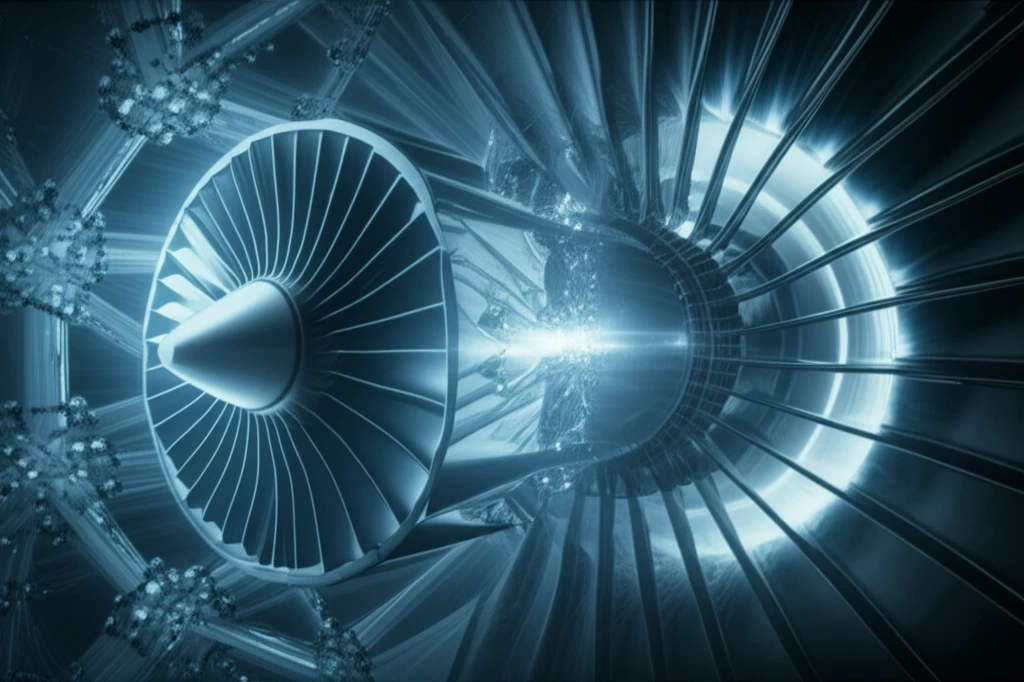
Turbine blade with crystalline structure

Smarter Superalloys: How 'Seed' Crystals Could Revolutionize Turbine Blades

"A groundbreaking new method uses un-melted seed crystals to precisely control the orientation of superalloys, making them stronger and more durable for extreme conditions."


Nickel-based superalloys are the unsung heroes powering aircraft and energy generation. Their ability to withstand extreme temperatures makes them perfect for turbine blades. However, these materials have a quirk: their mechanical properties differ based on their crystal orientation. Ideally, engineers want the (001) direction – offering maximum low-cycle fatigue life – aligned with the load direction during operation.

Traditionally, achieving this alignment involves two main methods: grain selection and seeding. Grain selection allows crystals with the desired orientation to outcompete others, but it lacks precision. Seeding uses pre-fabricated crystals, ensuring accuracy, but it's costly and prone to defects where the seed meets the new material.

Now, researchers have pioneered a novel approach that blends the best of both worlds: grain selection assisted by un-melted reused seed crystals. This method promises better control over crystal orientation while keeping production costs down. Let’s dive into how this innovative technique works and what it could mean for the future of high-performance materials.

The Magic of 'Un-Melted' Seeds: How Does it Work?

Turbine blade with crystalline structure

The core of this new method lies in using a short, un-melted seed crystal with the desired orientation. Unlike traditional seeding, this seed isn't fully melted into the superalloy. Instead, it acts as a template, guiding the growth of the new crystal structure. Here’s the step-by-step process:

A cylinder-shaped seed crystal with a specific (001) orientation is carefully prepared. The surface is polished and etched to reveal its microstructure.

  • This seed is then plugged into a mold within a Bridgman furnace, ensuring the seed's orientation aligns with the desired orientation of the final component.
  • The furnace is evacuated to a partial vacuum, and the mold is preheated.
  • Molten superalloy is poured into the mold and held to stabilize.
  • Finally, the mold is slowly withdrawn from the furnace, allowing the superalloy to directionally solidify, guided by the seed crystal.
The researchers discovered that using a short seed crystal minimizes the formation of a 'melt-back mush zone' – a common problem in traditional seeding where unwanted crystals can form. While some stray grains might still appear due to oxide particles acting as nucleation sites, the crystal with the desired orientation tends to dominate.

Stronger, Cheaper, and More Precise: The Future of Superalloys

This innovative method offers a compelling combination of benefits. The resulting superalloy components exhibit well-controlled crystal orientations with minimal deviation (around 2.1°). But the advantages don't stop there.

A key element of this technique is the reusability of the seed crystals. A thin layer of oxide particles on the seed's surface allows for easy separation from the solidified component. This means the seed can be polished, etched, and used again, significantly reducing production costs. The researchers note that this separation occurs naturally without needing any extra force.

By merging grain selection with seed crystal techniques, this method paves the way for producing high-performance superalloys that are not only stronger and more durable but also more cost-effective. This could lead to significant advancements in aerospace, power generation, and other industries where materials are pushed to their limits.

About this Article -

This article was crafted using a human-AI hybrid and collaborative approach. AI assisted our team with initial drafting, research insights, identifying key questions, and image generation. Our human editors guided topic selection, defined the angle, structured the content, ensured factual accuracy and relevance, refined the tone, and conducted thorough editing to deliver helpful, high-quality information.See our About page for more information.

This article is based on research published under:

DOI-LINK: 10.1016/j.jmrt.2018.10.005, Alternate LINK

Title: Orientation Controlling Of Ni-Based Single-Crystal Superalloy By A Novel Method: Grain Selection Assisted By Un-Melted Reused Seed

Subject: Metals and Alloys

Journal: Journal of Materials Research and Technology

Publisher: Elsevier BV

Authors: Wenchao Yang, Songsong Hu, Miao Huo, Dejian Sun, Jun Zhang, Lin Liu

Published: 2019-01-01

Everything You Need To Know

1

What are 'nickel-based superalloys' and why are they important?

The groundbreaking method utilizes 'seed' crystals to precisely control the orientation of 'nickel-based superalloys'. These superalloys are crucial in high-stress environments like aircraft engines and power turbines. This innovative technique offers a way to create stronger and more durable components by aligning the (001) crystal direction with the load direction, maximizing the material's lifespan.

2

Why is crystal orientation so important in 'nickel-based superalloys'?

Crystal orientation is very important because 'nickel-based superalloys' have varying mechanical properties depending on their crystal structure. The (001) direction offers the greatest resistance to low-cycle fatigue, which is essential for components subjected to repeated stress, as seen in turbine blades. Controlling the crystal orientation directly impacts the performance and longevity of these components.

3

How does this new method using 'seed' crystals work?

The new technique works by using a short, un-melted 'seed crystal' with the desired (001) orientation. This 'seed' acts as a template, guiding the growth of the new crystal structure during the directional solidification of the molten 'nickel-based superalloy'. Unlike traditional seeding, the 'seed' is not fully melted, minimizing defects and promoting the desired crystal alignment. The process involves careful preparation of the 'seed', its placement in a mold, and the controlled pouring and solidification of the superalloy within a specialized Bridgman furnace.

4

What are the main benefits of using un-melted 'seed crystals'?

The use of un-melted 'seed crystals' offers several key advantages. First, it enhances the precision of crystal orientation, ensuring the (001) direction is optimally aligned. Second, it minimizes the formation of defects like the 'melt-back mush zone' that can occur in traditional seeding. Finally, the method promises to lower production costs while maintaining high performance, leading to stronger, more reliable components and potentially improving the efficiency of aircraft engines and power turbines.

5

How does this new method compare to traditional methods like grain selection and seeding?

Grain selection and seeding are both traditional methods used to control crystal orientation in 'nickel-based superalloys'. Grain selection allows crystals with the desired orientation to outcompete others, but it lacks precision. Seeding uses pre-fabricated crystals to ensure accurate alignment, but it can be expensive and prone to defects. The new method combines the benefits of both approaches by using un-melted 'seed crystals' to guide crystal growth with greater precision and reduced production issues, making it a significant advancement over these older techniques.

Newsletter Subscribe

Subscribe to get the latest articles and insights directly in your inbox.