
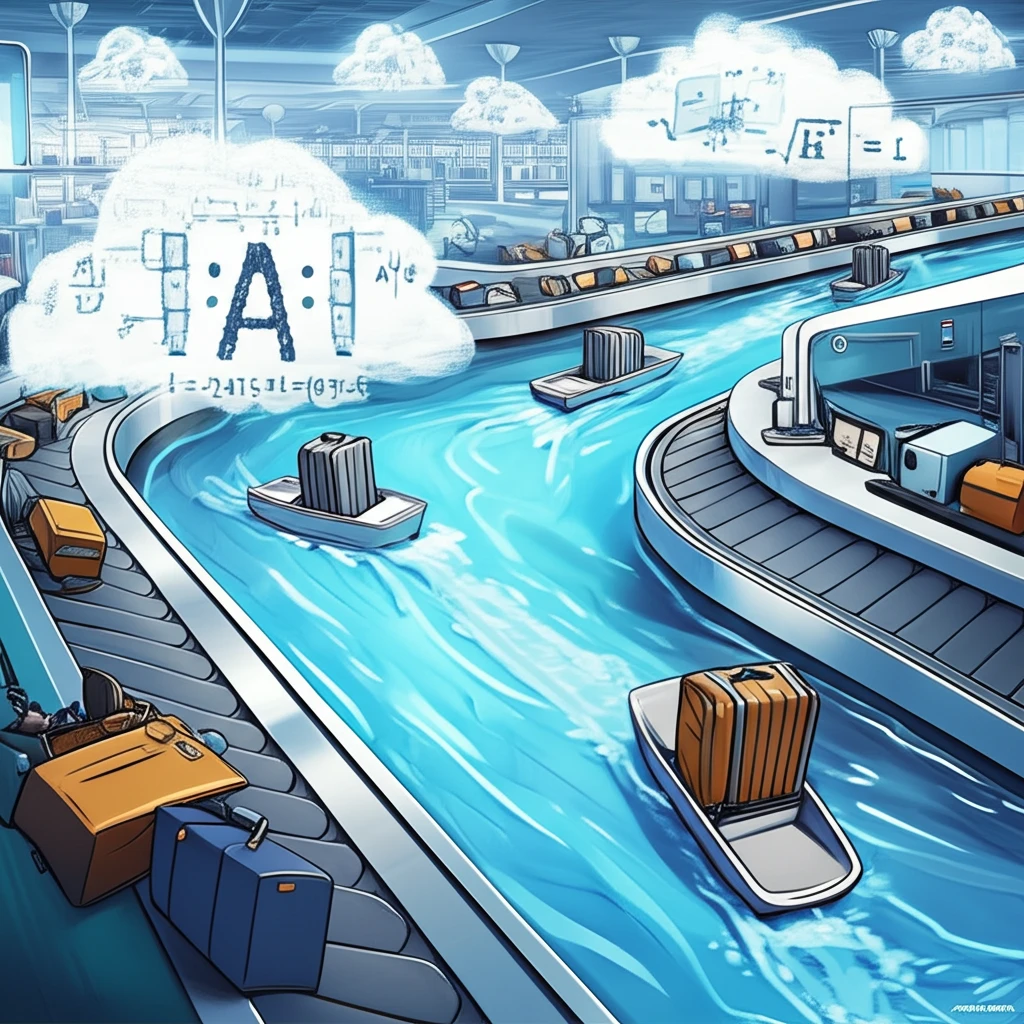
AI-powered baggage handling: Suitcases flow smoothly like boats on a river, symbolizing efficient airport operations.

Smarter Airports: How AI and Teamwork are Revolutionizing Baggage Handling

"Discover how a cutting-edge approach optimizing team formation and real-time routing is making airport baggage handling faster, more reliable, and less stressful."


Airports are a complex web of interconnected operations, and one of the most crucial, yet often overlooked, is baggage handling. Ensuring that your luggage makes it from check-in to the correct aircraft (and back to you at your destination) requires a coordinated effort from dedicated personnel. Optimizing this process is key to efficient airport operations and happy travelers.

Traditional baggage handling is riddled with potential snags. Teams of workers need to be assembled based on the skills required for the task at hand, and tasks like loading and unloading must be assigned efficiently. Each task operates within a specific time window, and any violations can result in significant financial penalties for the airport operator. Furthermore, unpredictable travel times across the airport apron add another layer of complexity.

But what if artificial intelligence could step in to orchestrate this entire process? A new study introduces a 'Branch-Price-Cut-and-Switch' approach to tackle the challenges of airport baggage handling. By optimizing team formation and routing, and accounting for the uncertainties of travel times, this innovative system promises to make baggage handling faster, more reliable, and less prone to those dreaded delays.

The Branch-Price-Cut-and-Switch Approach: AI to the Rescue

AI-powered baggage handling: Suitcases flow smoothly like boats on a river, symbolizing efficient airport operations.

The core of this new system lies in its 'Branch-Price-Cut-and-Switch' approach. It's designed to solve two binary program formulations, switching dynamically between them to find the most effective solution. The system uses a sophisticated method to identify and eliminate inefficiencies, combined with branching rules based on task completion times, resulting in rapid and effective optimization.

The system was tested using real-world data from a major European airport, with scenarios that included up to two-hour planning horizons, 30 flights per hour, and different task execution modes. The results were striking: the AI-powered system significantly outperformed existing solution approaches.

  • Dynamic Optimization: The 'Branch-Price-Cut-and-Switch' methodology allows it to adapt to real-time conditions and make better decisions.
  • Exact Separation Methods: These provide a rigorous approach to eliminate inefficiencies and improve the quality of solutions.
  • Efficient Branching Rules: These rules help guide the search process, focusing on the most promising options and speeding up the optimization.
Importantly, the study also showed that explicitly considering stochastic travel times allows for better workforce utilization while maintaining a consistent service level. This means fewer delays and more reliable baggage delivery, ultimately making for happier passengers.

The Future of Baggage Handling: Less Stress, More Efficiency

This innovative approach to baggage handling represents a significant step forward in optimizing airport operations. By embracing AI and advanced optimization techniques, airports can improve efficiency, reduce delays, and enhance the overall travel experience. While there's still room for further refinement – such as exploring more advanced branching strategies and incorporating real-time data – the future of baggage handling is looking brighter, promising a smoother journey for passengers worldwide.

About this Article -

This article was crafted using a human-AI hybrid and collaborative approach. AI assisted our team with initial drafting, research insights, identifying key questions, and image generation. Our human editors guided topic selection, defined the angle, structured the content, ensured factual accuracy and relevance, refined the tone, and conducted thorough editing to deliver helpful, high-quality information.See our About page for more information.

Everything You Need To Know

1

What is the 'Branch-Price-Cut-and-Switch' approach and how does it work?

The 'Branch-Price-Cut-and-Switch' approach is an AI-powered system designed to optimize airport baggage handling. It functions by solving two binary program formulations and dynamically switching between them to find the most effective solution. This method uses exact separation methods to identify and eliminate inefficiencies, combined with branching rules based on task completion times, resulting in rapid and effective optimization. The system's ability to adapt to real-time conditions makes it a significant advancement in baggage handling.

2

How does the 'Branch-Price-Cut-and-Switch' approach improve baggage handling compared to traditional methods?

The 'Branch-Price-Cut-and-Switch' approach enhances baggage handling by optimizing team formation and routing, which leads to faster and more reliable handling. It also accounts for the uncertainties of travel times across the airport apron. Traditional methods often struggle with these complexities, leading to delays and inefficiencies. By dynamically optimizing operations and using exact separation methods, the AI system significantly outperforms existing approaches, reducing delays and improving workforce utilization.

3

What are the benefits of using 'Dynamic Optimization' in baggage handling?

Dynamic optimization, a key feature of the 'Branch-Price-Cut-and-Switch' methodology, enables the system to adapt to real-time conditions. This adaptability is crucial in the dynamic environment of an airport, where conditions can change frequently. By responding to immediate needs and making better decisions, dynamic optimization ensures that baggage handling remains efficient even when faced with unexpected delays or changes in flight schedules. This ultimately contributes to more reliable baggage delivery and a smoother travel experience for passengers.

4

How does considering stochastic travel times impact workforce utilization and service levels within the 'Branch-Price-Cut-and-Switch' system?

By explicitly considering stochastic travel times, the 'Branch-Price-Cut-and-Switch' approach enables better workforce utilization while maintaining a consistent service level. Stochastic travel times refer to the unpredictable nature of travel times across the airport apron. Accounting for this allows the system to make informed decisions about resource allocation, such as assigning the right teams and adjusting the task execution to account for potential delays. This leads to more efficient use of the workforce, ensuring tasks are completed on time, and ultimately, reducing the number of delays and improving baggage delivery reliability, resulting in more satisfied passengers.

5

What are the future prospects for the 'Branch-Price-Cut-and-Switch' approach and baggage handling in general?

The 'Branch-Price-Cut-and-Switch' approach represents a significant leap in optimizing airport operations. It promises to improve efficiency, reduce delays, and enhance the overall travel experience. Future improvements could include exploring more advanced branching strategies and incorporating real-time data to further refine the system. The ongoing development and refinement of such AI-powered systems highlight the potential for a future where baggage handling is significantly smoother, more reliable, and less stressful for passengers worldwide, leading to a more efficient and enjoyable travel experience.

Newsletter Subscribe

Subscribe to get the latest articles and insights directly in your inbox.