
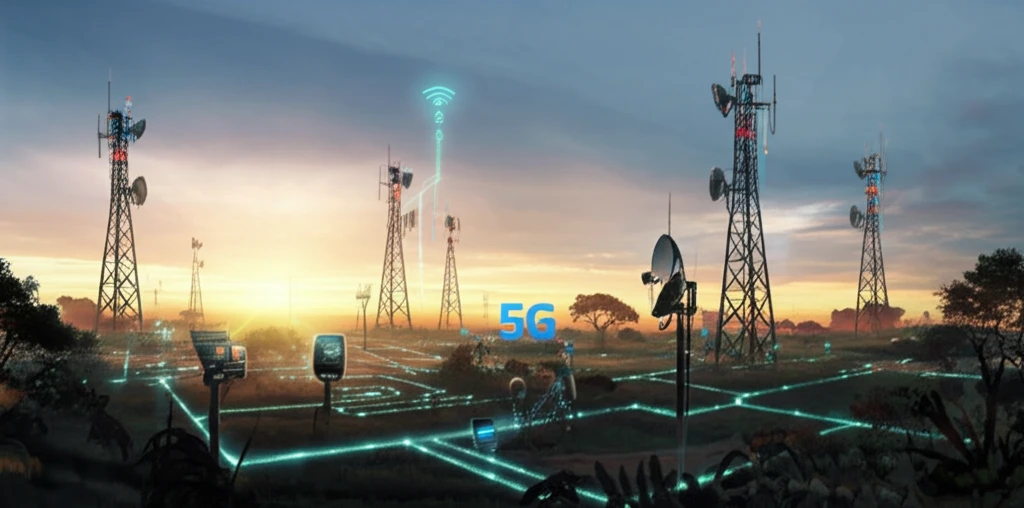
Smart Water Revolution: How 5G and NB-IoT Are Changing Africa

"Discover how the fusion of 5G and Narrowband IoT (NB-IoT) technologies is transforming smart water management across Africa, enhancing efficiency and sustainability."
The Internet of Things (IoT) is revolutionizing industries worldwide, and smart water management is no exception. In Africa, where water scarcity and efficient distribution are critical challenges, the integration of 5G and Narrowband IoT (NB-IoT) technologies is paving the way for transformative solutions. These advancements promise to enhance the monitoring, conservation, and overall management of water resources.
NB-IoT, a new radio interface technology designed for wireless IoT, is particularly suited for scenarios requiring low data rates, deep coverage, low power consumption, and massive connectivity. This makes it an ideal choice for deploying smart water management systems across vast and diverse landscapes.
The First Africa and Morocco NB-IoT Experimental Results highlight how these technologies are not just theoretical possibilities but practical, implementable solutions ready to address pressing water management issues. These innovative approaches are poised to accommodate new 5G and IoT performance standards, setting a precedent for future developments.
Design Metrics That Scale Connectivity
NB-IoT's impact begins with its engineering design: it operates on the narrowest bandwidth (200 kHz), supports 10+ year battery life, and penetrates deep indoor environments, though it cannot support mobility or voice. That combination has driven a market expected to grow significantly between 2026 and 2033, according to analysis of the NB-IoT platform service segment. The technology has matured to the point where operator networks expose NB-IoT-specific statistics, including fields for handover denials and path switch failures. Industry-wide IoT spending and projection roundups further situate NB-IoT within a broader connectivity growth story.
A Standard Built for Simple, Static Sensing
NB-IoT is a low-power wide-area (LPWAN) radio technology standard developed to efficiently enable a wide range of IoT devices and services. It was standardized by the 3rd Generation Partnership Project (3GPP) as a narrowband radio technology to meet the connectivity needs of the Internet of Things. In practice it focuses on low power consumption and low cost for simple field monitoring at sites without mains power, trading speed for better range, cheaper hardware, and longer battery life. Its accepted trade-off is that it suits devices that sit in one place and report small amounts of data on a set schedule, which is why real-time municipal water pipe networks more often default to 4G connectivity.
From IoT Foundations to the China Surge
The foundational concept is the Internet of Things itself: a system of connected physical objects that collect data and exchange it over a network. NB-IoT emerged from that idea as a cellular standard that smart devices use to connect, manage, and transmit data. The defining historical milestone has been China, which accounts for roughly ninety percent of the global NB-IoT market. That story worked for the technology and its users, but critics note that China moved too soon and too fast, and the market has since fragmented into offerings tailored to specific applications and industries.
Benefits and Application Scenarios of IoT in Water Management
NB-IoT offers numerous benefits that make it well-suited for smart water management. Its ability to maximize spectrum utilization means it can support standalone, 5G guardband, and 5G in-band deployments, fully utilizing operator spectrum resources and increasing efficiency. This is particularly important in regions where spectrum resources are limited.
- Remote monitoring of water levels in reservoirs and tanks
- Smart meters that provide real-time data on water consumption
- Leak detection systems that can quickly identify and address water loss
- Automated irrigation systems that optimize water usage based on real-time weather data
Research Confirms NB-IoT's Leading Position
According to the latest research from Vodafone, NB-IoT remains the most popular Internet of Things technology. That popularity reflects its fit for intermittently communicating, lightweight, low-data devices that make up most IoT sensors, which by design do not require the serial-like connection found in LTE Cat M1. Real-world deployments illustrate the appeal, such as Telia Norway's use of NB-IoT to modernize street lighting. These reviews position NB-IoT less as an emerging option and more as the established default for large-scale sensing.
Coverage Dependence and Technical Bottlenecks
A key criticism is that NB-IoT is a cellular standard living in licensed spectrum: if a site lacks coverage, sensors cannot talk straight to the cloud without a gateway, unlike unlicensed alternatives. The technology's deep indoor penetration (with a roughly +20 dB link budget versus LTE) helps in plant halls, but that advantage only matters where carriers have actually deployed the network. Researchers have also had to tackle scheduling problems, proposing algorithms that minimize the number of NPDCCH periods needed to satisfy each device's data requirement. Deployment realities reinforce the dependence on carriers, as T-Mobile's first nationwide US NB-IoT network was delivered as a software update on the general 4G LTE network.
NB-IoT Versus Its LPWAN Rivals
NB-IoT is the cellular answer from network providers to growing IoT and M2M demands, added to LTE infrastructure specifically for indoor and outdoor low-bandwidth, low-power needs. Compared against LTE Cat 1 and LTE-M, it is positioned as a practical alternative to unlicensed LPWAN technologies such as Sigfox and LoRa, while enabling power-saving strategies such as PSM and eDRX. Side-by-side comparisons of NB-IoT, LoRa, and Sigfox emphasize that choosing the right technology can be the deciding factor in a project's success. Practical selection guides further weigh NB-IoT devices against 4G LTE gateways for remote meters, sensors, and industrial telemetry, where requirements differ sharply.
Conclusion: A Sustainable Future Through Smart Technology
The integration of 5G and NB-IoT technologies in smart water management represents a significant step forward in addressing water scarcity and improving resource management in Africa. The experimental results and deployment scenarios from Morocco offer a promising glimpse into the potential of these technologies to revolutionize how water resources are monitored, conserved, and distributed, paving the way for a more sustainable future.
What the Experts Emphasize
Experts point to NB-IoT as an emerging technology that supports cellular data connections for low-power devices over a wide area network, delivering efficient standby and long standby time for demanding network-connected devices. A key selling point repeated in technical commentary is endurance: devices operating on the NB-IoT standard can work for up to 10 years from a single ordinary battery. That endurance is the basis for guidance on designing efficient and reliable NB-IoT solutions, such as the expert work highlighted by the GSMA from Deutsche Telekom's IoT engineering team. In parallel, new AI-powered tools have appeared that aim to simplify device configuration, network optimization, and troubleshooting for NB-IoT deployments.
A 5G-Compatible Road Ahead
Market research projects the global Narrowband IoT market could create a total forecasting opportunity of USD 16.3 billion by 2035, with a key trend being the convergence of NB-IoT with AI-enabled edge analytics to accelerate predictive maintenance and operational efficiency. Because NB-IoT is already compatible with 5G networks, it is expected to benefit from improved performance and integration that will further accelerate the deployment of smart devices. That outlook builds on its foundation as a 3GPP-developed low-power wide-area network standard for connecting devices to established mobile networks. Near-term applications are concrete, with NB-IoT remote smart water meters using flow monitoring sensors to track consumption in real time and support shut-off valve control.
Scale, Coverage, and the Infrastructure Gap
The GSMA reported that NB-IoT passed 100 million connections in January on the back of a continuing surge in China, and was on track to catch LTE-M as the dominant IoT-dedicated cellular standard by 2022. That scale signals momentum, but it also exposes the systemic challenge at the heart of the technology: NB-IoT depends entirely on licensed cellular infrastructure being built out. Coverage planning is therefore a first-order concern, and free online calculators exist specifically to estimate how many base stations are needed to cover a given site. For markets like Africa, this makes network expansion, not device design, the binding constraint on NB-IoT adoption.
Deployments That Change Outcomes
Field deployments consistently validate what NB-IoT promises: in one well-documented urban distribution network study, IoT-based monitoring detected up to 17 contamination events that biweekly manual sampling had missed entirely. Companies are also working to lower adoption barriers, with one manufacturer pairing NB-IoT devices with QR-code access so sensor data can be reached effortlessly. On the engineering side, a real customer case study showed a maker turning a roughly $20 LoRa board into a low-power HVAC sensor node drawing about 38.19 microamps with roughly 107 months of battery life. Together these stories illustrate how the technology shifts from connectivity statistics to measurable operational and human outcomes.