
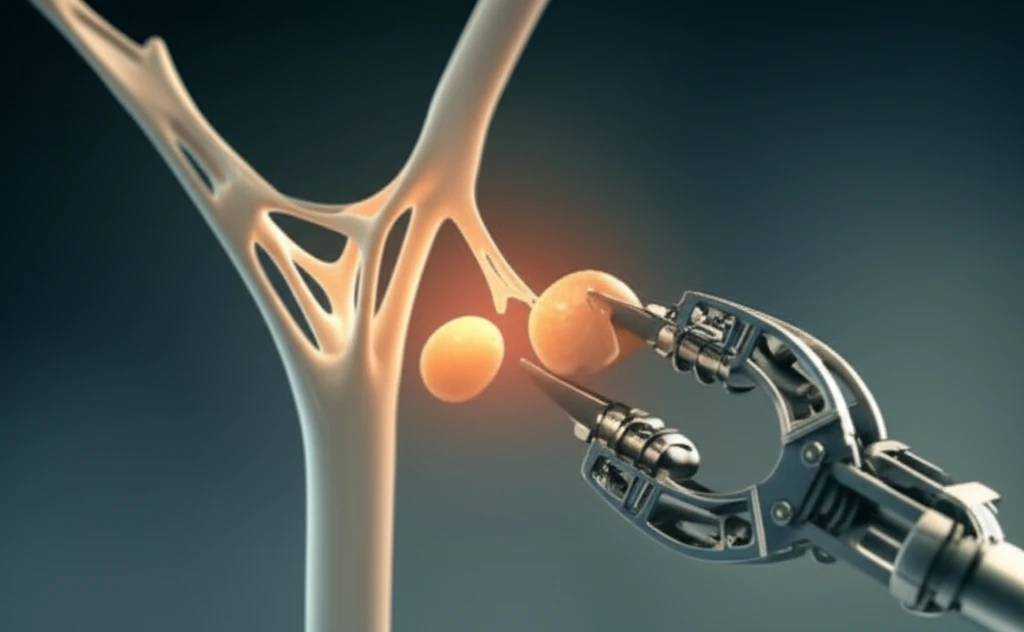
Squeezing device transforming parathyroid glands into healthy bone structures.

Small Device, Big Impact: A New Hope for Hyperparathyroidism?

"A novel approach to parathyroid autotransplantation offers a simpler, faster way to manage secondary hyperparathyroidism, improving outcomes for hemodialysis patients."


Secondary hyperparathyroidism (sHPT) is a serious complication for individuals undergoing long-term hemodialysis. This condition leads to metabolic bone diseases, severe atherosclerosis, and an increased risk of cardiovascular events. While medical treatments exist, a significant percentage of patients still require surgical intervention in the form of parathyroidectomy.

Parathyroidectomy, the surgical removal of the parathyroid glands, can be performed in different ways. Subtotal parathyroidectomy (removing most, but not all, of the glands) and total parathyroidectomy (removing all glands) are two common approaches, often combined with autotransplantation – transplanting parathyroid tissue to another location in the body.

This article explores a novel device designed to simplify parathyroid autotransplantation, potentially improving outcomes for patients with sHPT. We will delve into how this device works, its benefits, and the results observed in a recent case series.

The Squeezing Device: A Simpler Autotransplantation Method

Squeezing device transforming parathyroid glands into healthy bone structures.

The key innovation discussed in this study is a novel squeezing device designed to prepare parathyroid tissue for autotransplantation more efficiently. Traditionally, parathyroid tissue needs to be carefully sliced into small, suitable sizes for injection. This process can be time-consuming. The stainless steel squeezing device, invented by Jianping Huang, aims to shorten preparation time.

The device itself is simple in design: a metal sleeve consisting of two parts. The outer part is a hollow tube with multiple holes, while the inner part is a solid core. Here’s how it's used:

  • Parathyroid fragments are diced roughly and placed into the metal sleeve.
  • The tissue is squeezed within the sleeve using a syringe.
  • The squeezed parathyroid tissue is then mixed with saline and injected into the brachioradialis muscle of the forearm.
This method aims to reduce the time needed to prepare the tissue for transplantation while ensuring the parathyroid cells remain active and viable.

A Promising Step Forward

The results of this case series suggest that the squeezing device offers a safe, effective, and economical approach to parathyroid autotransplantation in patients with secondary hyperparathyroidism. The device significantly reduces tissue preparation time, and postoperative results indicate improvements in symptoms and biochemical markers of sHPT.

While these findings are promising, the authors acknowledge the limitations of the study, including a small sample size and a short follow-up period. Further research with larger cohorts and longer-term follow-up is needed to confirm these results and assess the long-term efficacy and safety of the device.

Despite these limitations, the squeezing device represents a valuable step forward in the surgical management of secondary hyperparathyroidism, potentially improving the quality of life for patients undergoing hemodialysis. As surgical techniques evolve, innovations like this device offer hope for less invasive, more efficient, and ultimately more effective treatments.

About this Article -

This article was crafted using a human-AI hybrid and collaborative approach. AI assisted our team with initial drafting, research insights, identifying key questions, and image generation. Our human editors guided topic selection, defined the angle, structured the content, ensured factual accuracy and relevance, refined the tone, and conducted thorough editing to deliver helpful, high-quality information.See our About page for more information.

This article is based on research published under:

DOI-LINK: 10.1016/j.amsu.2018.09.012, Alternate LINK

Title: A Novel Device In Parathyroid Autotransplantation For 6 Patients With Secondary Hyperparathyroidism - Case Series

Subject: General Medicine

Journal: Annals of Medicine and Surgery

Publisher: Elsevier BV

Authors: Xi Wei Zhang, Gang Liu, Xue Feng Tang, Hao Zhang, Jian Ping Huang, Lei Du

Published: 2018-11-01

Everything You Need To Know

1

What is secondary hyperparathyroidism (sHPT), and why is it a concern?

Secondary hyperparathyroidism (sHPT) is a complication that frequently affects individuals on long-term hemodialysis. It stems from the kidneys' inability to properly regulate calcium and phosphate levels, leading to the overproduction of parathyroid hormone (PTH). Elevated PTH levels cause the parathyroid glands to become overactive, resulting in metabolic bone disease, severe atherosclerosis, and an increased risk of cardiovascular events. Untreated sHPT can significantly diminish the quality of life and lead to life-threatening complications. Therefore, managing sHPT is crucial for the well-being of hemodialysis patients.

2

What is parathyroid autotransplantation and why is it done?

Parathyroid autotransplantation is a surgical procedure where parathyroid tissue is removed (parathyroidectomy), and then transplanted to another location in the patient's body. This is commonly performed in patients undergoing treatment for secondary hyperparathyroidism (sHPT) who require surgical removal of their overactive parathyroid glands. The procedure typically involves either subtotal or total parathyroidectomy. The transplanted tissue, often placed in the forearm, can then produce parathyroid hormone (PTH) in a more controlled manner, helping to manage the effects of sHPT. The aim is to avoid the complete absence of PTH and its related health problems.

3

How does the squeezing device work?

The squeezing device, invented by Jianping Huang, is a novel tool designed to simplify the preparation of parathyroid tissue for autotransplantation. It consists of a metal sleeve with two parts: an outer tube with holes and a solid inner core. Parathyroid fragments are placed inside the sleeve and squeezed using a syringe. This method helps to reduce the time required to prepare the parathyroid tissue for transplantation, making the procedure more efficient. The squeezed tissue is then mixed with saline and injected into the brachioradialis muscle of the forearm.

4

What are the advantages of using the squeezing device?

The use of the squeezing device offers several benefits. It streamlines the process of preparing parathyroid tissue for autotransplantation, making the procedure less time-consuming. Preliminary results suggest it is safe and effective in managing secondary hyperparathyroidism (sHPT). It also leads to improvements in symptoms and biochemical markers associated with sHPT, potentially leading to a better quality of life for patients undergoing hemodialysis. By improving efficiency and outcomes, it represents a positive step in the treatment of this condition.

5

What is the difference between subtotal and total parathyroidectomy?

Subtotal parathyroidectomy involves removing most, but not all, of the parathyroid glands, while total parathyroidectomy involves removing all of them. Both procedures can be combined with autotransplantation. These surgical approaches are used to treat secondary hyperparathyroidism (sHPT) in patients undergoing long-term hemodialysis. The choice between the procedures and the decision to perform autotransplantation depends on the severity of the patient's condition and the surgeon's clinical judgment. The primary aim is to manage the overproduction of parathyroid hormone (PTH) and its associated health problems.

Newsletter Subscribe

Subscribe to get the latest articles and insights directly in your inbox.