
Silk's Healing Touch: How Advanced Imaging is Revolutionizing Surgical Implants

"Discover how cutting-edge ultrasound techniques are transforming the way we monitor and improve the performance of silk fibroin implants, paving the way for safer and more effective surgical outcomes."
For centuries, silk has been more than just a luxurious fabric. In the world of medicine, it's a trusted biomaterial, especially when it comes to sutures. But silk's potential goes far beyond simple stitches. Scientists are now crafting silk fibroin into advanced structures like scaffolds, films, and hydrogels, opening doors to a variety of biomedical uses, from repairing damaged tissues to delivering targeted drugs.
The key to silk's success lies in its ability to be customized for different applications. Think of it like tailoring a suit – an optimal biomaterial should be designed for a specific purpose, taking into account factors like inflammation and vascularization (the growth of new blood vessels). Understanding how these implants break down over time and how new blood vessels form around them is crucial for improving their design and ensuring they work effectively.
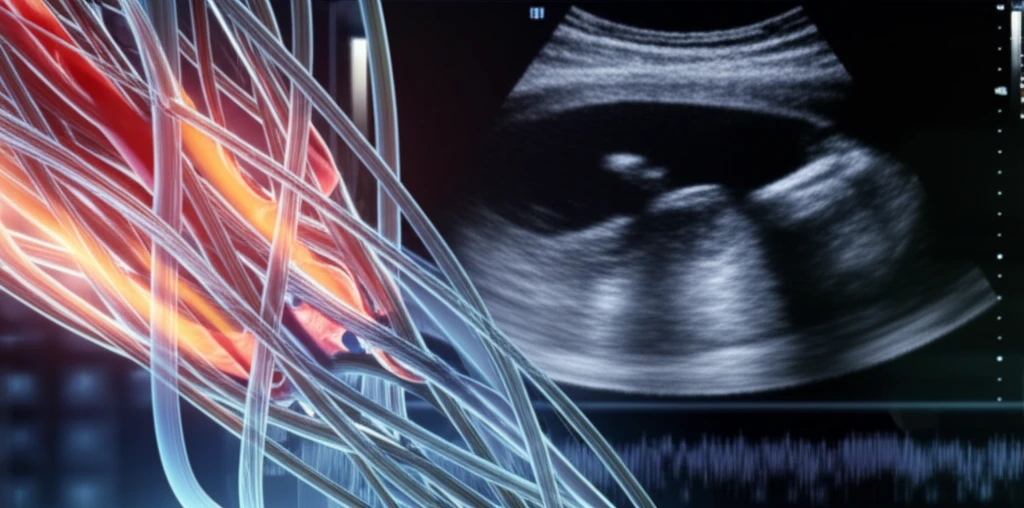
Now, innovative imaging techniques are stepping up to address this challenge. A new study investigates how multiple modes of ultrasound imaging can be used to monitor silk fibroin implants in real-time. This includes two-dimensional, three-dimensional, and contrast-enhanced ultrasound, all working together to provide a comprehensive view of what's happening inside the body.
Multiple Modes Ultrasound Monitoring
In a recent study, researchers delved into the non-destructive assessment of biomaterials using multiple modes ultrasound. The traditional methods often involve excising the explants and following up with histology, the use of traditional two-dimensional ultrasound (2D US) has been reported to investigate biomaterial degradation. However, there have been few studies reported on using CEUS in nondestructive biomaterial assessment so far. Combining 2D and 3D US with CEUS could provide more detailed information on material degradation and tissue regeneration, making ultrasound a more useful technique for biomaterial-based tissue engineering.
- Two-Dimensional Ultrasound (2D US): This provided a basic view of the implant's shape and how its echo intensity (brightness) changed over time.
- Three-Dimensional Ultrasound (3D US): This allowed researchers to measure the implant's volume accurately, giving a better understanding of its degradation.
- Contrast-Enhanced Ultrasound (CEUS): This technique used microbubbles to highlight blood vessels, revealing how new blood vessels were forming around the implant (neovascularization).
Looking Ahead: The Future of Silk and Surgical Implants
This study suggests that multiple modes ultrasound imaging could become a valuable tool for evaluating biomaterial implants in vivo. By providing a non-invasive way to monitor degradation and neovascularization, this technique could help researchers design better implants and personalize treatments for patients. As silk fibroin continues to find new applications in surgery, advanced imaging techniques will play a crucial role in unlocking its full potential.