
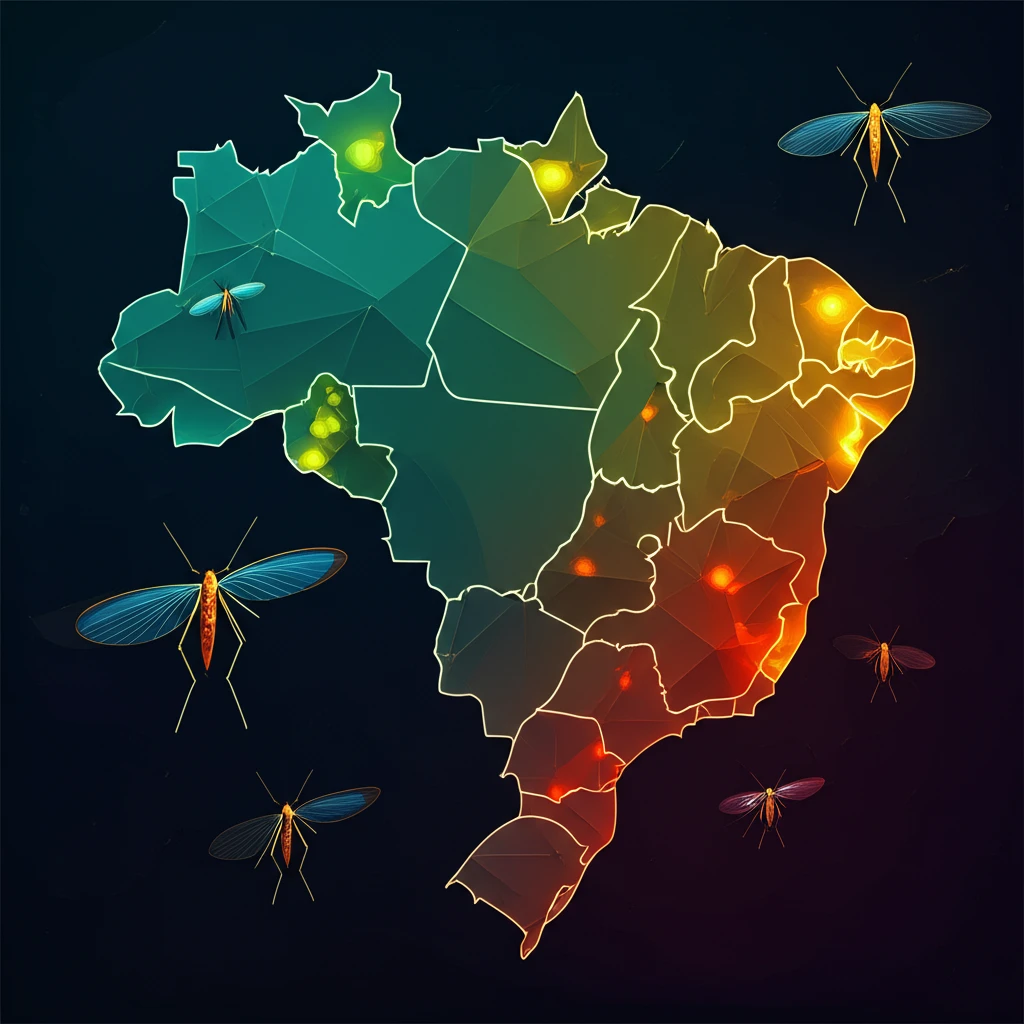
Silent Spreaders: Mapping the Risk of Leishmaniasis in Brazil

"New research unveils the distribution of sand flies carrying Leishmania, offering insights for targeted prevention and control in high-risk areas."
Leishmaniases are a group of diseases caused by protozoan parasites transmitted through the bite of infected phlebotomine sand flies. Visceral leishmaniasis (VL), the most severe form, is particularly concerning due to its potential fatality if left untreated. Brazil faces a significant burden of VL, especially in urban centers.
Understanding the distribution of these sand fly vectors is crucial for effective disease control. With approximately 270 sand fly species identified in Brazil, their presence is closely tied to specific ecosystems and ecological niches. Some species, like Lutzomyia longipalpis, are widespread and adaptable, while others, such as Lutzomyia cruzi, have a more restricted geographical range. Both are key vectors of Leishmania infantum, the parasite responsible for VL in Brazil.
To better understand and predict the spread of VL, researchers combined data from various sources, including sand fly collections, scientific literature, and disease surveillance systems. Using ecological niche modeling, they created occurrence probability maps for Lu. longipalpis and Lu. cruzi, identifying areas where these vectors are most likely to be present. This information is vital for implementing targeted surveillance and control measures.
Unveiling Sand Fly Hotspots: Data and Methods
The study compiled occurrence records for Lu. longipalpis and Lu. cruzi from multiple sources:
- The sand fly collection of the Oswaldo Cruz Foundation (FIOCRUZ-COLFLEB).
- The SpeciesLink database.
- Systematic reviews of scientific articles, theses, and communications.
Implications for Disease Control
The study found Lu. longipalpis present in 229 Brazilian municipalities and Lu. cruzi in 27, with co-occurrence in 16 municipalities in the Central-West region. The widespread distribution of Lu. longipalpis aligns with the high number of VL cases reported in Brazil.
The predictive maps highlight areas where Lu. longipalpis and Lu. cruzi are likely to be present, even in regions where they haven't been explicitly recorded. This information is critical for guiding surveillance efforts and implementing targeted control measures, such as insecticide spraying or environmental management.
By identifying high-risk areas, public health officials can allocate resources more effectively, focusing on regions where interventions will have the greatest impact. The study provides a valuable tool for proactive disease management, contributing to the reduction of VL incidence in Brazil.