
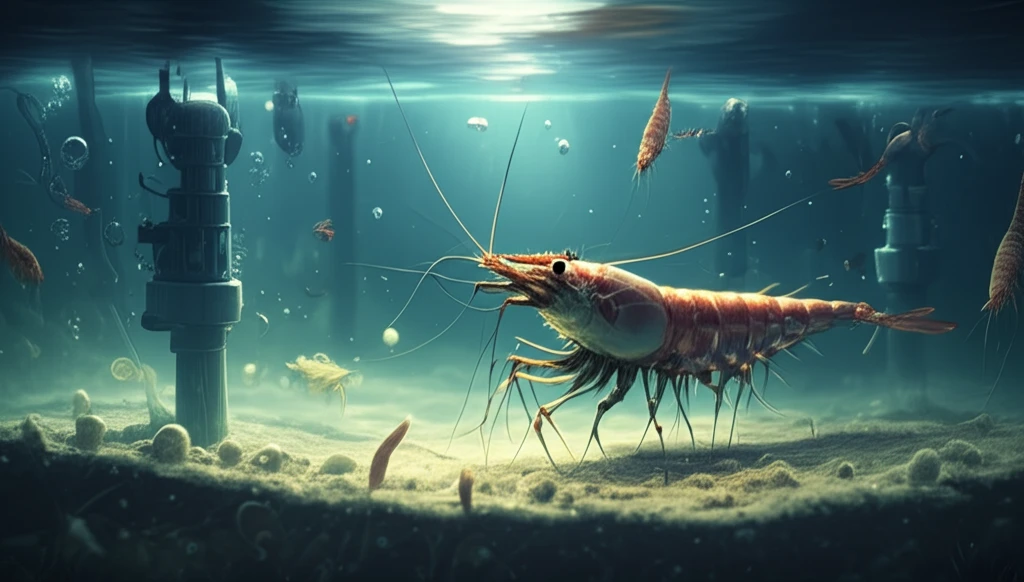
Shrimp Farming Revolution: How Smart Feeding Strategies Boost Yields and Protect Our Waters

"Discover how advanced feeding techniques in shrimp aquaculture, focusing on C/N ratios and biofloc systems, are key to sustainable and profitable farming."
Aquaculture, particularly shrimp farming, faces the ongoing challenge of balancing productivity with environmental responsibility. As global demand for seafood rises, intensive farming practices often lead to water pollution, disease outbreaks, and habitat degradation. But what if we could revolutionize shrimp farming to be both highly productive and environmentally sustainable? Recent research points to innovative feeding strategies as a key solution.
The Pacific white shrimp (Litopenaeus vannamei) is a cornerstone of the aquaculture industry, cultivated worldwide. Traditional intensive farming methods, however, strain ecosystems through high water exchange and effluent discharge. Biofloc technology (BFT), which creates a natural, self-sustaining ecosystem within the farming tanks, offers a promising alternative. This approach reduces water usage and minimizes waste, but it requires a precise understanding of nutrient management, especially concerning carbon to nitrogen (C/N) ratios.
This article delves into groundbreaking research exploring the impact of different commercial feeds and C/N ratios on water quality and shrimp performance in biofloc-based systems. By understanding and implementing these advanced feeding strategies, farmers can achieve higher yields, healthier shrimp, and a significantly reduced environmental footprint.
High-Tech Farming's Growing Footprint
High-tech whiteleg shrimp farming in Vietnam's Vĩnh Long province has expanded to 6,325 hectares, producing more than 88,000 tonnes, demonstrating the effectiveness of intensive, technology-based production systems. Shrimp farming provides livelihoods for millions of people in coastal communities across India, Southeast Asia, and Latin America, supporting local economies and creating employment. The sector plays an important role in global food supply, yet its environmental record remains a point of debate.
Why Feed Is the Hidden Leak
Feed is one of the biggest costs in shrimp farming, and traditional feeding methods routinely waste a large share of it. Some shrimp farmers are losing profit even while working day and night, because the real loss is hidden in wasted feed rather than low market prices or high feed company rates. In some ponds, that hidden feed waste can amount to as much as ₹50,000 per acre in losses.
From Pond to Precision
Aquaculture - the breeding, rearing, and harvesting of fish, shellfish, algae, and other organisms in all types of water environments - has long been central to seafood production. Shrimp farming boomed in many coastal regions, but in some cases that boom carried unintended consequences, turning what was meant to be a solution into a problem. Modern systems have since evolved toward intensive, technology-based production in an effort to control those outcomes.
Optimizing Carbon to Nitrogen (C/N) Ratios for Thriving Bioflocs
The heart of sustainable shrimp farming lies in maintaining a balanced ecosystem within the biofloc. Bioflocs are complex communities of microorganisms, algae, and organic matter that naturally develop in aquaculture systems. These communities not only purify the water by consuming waste products like ammonia and nitrite but also serve as a supplemental food source for the shrimp. The key to a thriving biofloc is the carbon to nitrogen (C/N) ratio. This ratio determines the balance between heterotrophic bacteria, which consume organic carbon and nitrogen, and autotrophic organisms, which use inorganic carbon.
Feeding Only When Hungry
Smart feeding delivers feed only when shrimp are actively feeding, which reduces waste and improves efficiency while achieving optimum feed conversion ratios (FCR). Even feed distribution and real-time control help enhance water quality in the pond. The approach gives farmers a powerful tool to manage one of their biggest costs - feed - more efficiently.
When the Boom Backfired
Not every shrimp farming expansion has been a success story. Research shows that land use change and shrimp farming activities have negative effects on biodiversity, and climate change significantly exacerbates those impacts. In Bangladesh's southwest region, a shrimp farming boom produced unintended consequences as a solution that became a problem while the country struggled to protect itself from the climate crisis.
Traditional Waste Versus Precision Control
Traditional feeding methods deliver feed on fixed schedules regardless of shrimp appetite, contributing to waste and degraded water quality, while smart feeding responds in real time to shrimp activity for better feed conversion and pond conditions. The contrast is visible in outcomes: Vĩnh Long's high-tech intensive systems now produce more than 88,000 tonnes, further demonstrating the effectiveness of technology-based production. Meanwhile, analysts point to practices that aim to operate in harmony with mangroves as a way to improve shrimp farming's environmental reputation.
- Enhanced Water Quality: A balanced C/N ratio promotes the efficient conversion of waste, leading to cleaner water.
- Improved Shrimp Performance: Optimal C/N ratios support better growth rates and overall health.
- Cost-Effective Solutions: Strategic adjustments to C/N ratios can reduce input costs, such as molasses and sodium bicarbonate.
The Future of Shrimp Farming: Sustainable, Profitable, and Environmentally Conscious
The research clearly demonstrates that optimizing feeding strategies, particularly C/N ratios, is crucial for the future of sustainable shrimp farming. By adopting biofloc technology and carefully managing nutrient inputs, farmers can significantly reduce their environmental impact while improving productivity and profitability. While more research is needed to evaluate the practicality of SI-35 feed and HI-35 feed for Litopenaeus vannamei grow-out in biofloc-based, zero-exchange systems, this study provides a pathway toward a more sustainable and responsible aquaculture industry.
Profitability Meets Stewardship
Shrimp farming innovations that combine profitability with environmental stewardship are emerging as the sector's most promising direction. Experts argue that shrimp farming can simultaneously improve its environmental reputation and tackle climate change. Smart feeding is central to that shift because it lets farmers manage feed - the biggest cost - efficiently while reducing waste and protecting pond water quality.
Restoring What Was Abandoned
The next frontier for shrimp farming lies in restoring abandoned ponds and adopting practices that operate in harmony with mangroves, which could help mitigate climate change. High-tech production continues to expand, as seen in Vĩnh Long's growth to 6,325 hectares of intensive whiteleg shrimp farming. Combining smart feeding with mangrove-friendly restoration points toward a future where production and conservation reinforce each other.
Biodiversity Under Pressure
Shrimp farming operates within a larger system where land use change and climate change interact, with research showing negative effects on biodiversity that climate change significantly exacerbates. Sustainable seafood production depends on addressing these systemic pressures rather than treating the pond in isolation. Aquaculture's importance in sustainable food production grows only if it can resolve these tensions.
Farmers at the Center
Shrimp farming provides livelihoods for millions of people in coastal communities across India, Southeast Asia, and Latin America, supporting local economies and creating employment. Yet many farmers work day and night and still lose profit, with feed waste costing up to ₹50,000 per acre in some ponds. Smart feeding technologies aim to put control back in farmers' hands, turning their biggest cost into their best-managed input.