
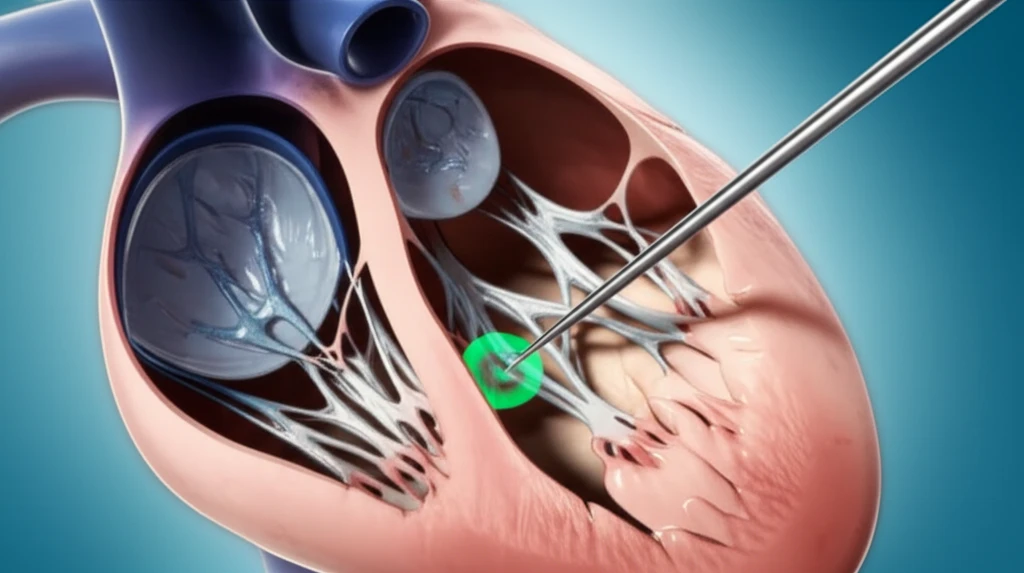
Shoulder Point Fitting: A Simpler Way to Repair Tricuspid Valves?

"New surgical method offers a universal approach to tricuspid valve annuloplasty, potentially reducing complications and improving patient outcomes."
Tricuspid valve repair is gaining more and more attention. The term 'tricuspid' suggests that the tricuspid valve (i.e., the right-sided atrioventricular valve) has three leaflets. However, about half of all tricuspid valves consist of three leaflets and that the remaining half consist of four or more leaflets. The complexity of tricuspid valve anatomy, especially in cases with multiple leaflets, poses a significant challenge during valve repair surgeries.
A recent study published in The Annals of Thoracic Surgery introduces a novel technique called the 'shoulder point fitting method' for tricuspid annuloplasty. This method aims to simplify the procedure and improve outcomes by providing a universal landmark for surgeons to use during the repair process.
This article breaks down the 'shoulder point fitting method,' its benefits, and why it could become a game-changer in tricuspid valve repair.
What is the 'Shoulder Point Fitting' Method?
The 'shoulder point fitting method' focuses on identifying a consistent anatomical landmark on both the tricuspid valve annulus and the annuloplasty ring. This 'shoulder point' serves as a guide for positioning and securing the annuloplasty ring, which is used to reshape and stabilize the valve.
- Defining the Shoulder Point: The shoulder point is located on a diagonal line extending from the commissure (the point where valve leaflets meet) between the anterior and septal leaflets.
- Locating the Shoulder Point: Imagine the valve as a clock face. If the commissure between the septal and posterior leaflets is at 3 o'clock, the shoulder point is approximately at 2 o'clock.
- Adapting to Valve Variations: In valves with multiple leaflets, the shoulder point may be located on the annulus of the posterior leaflet.
Why This Method Matters
The 'shoulder point fitting method' offers several potential advantages over traditional techniques. It simplifies the procedure, making it more accessible to a wider range of surgeons. It also provides a more reliable and consistent approach, regardless of the complexity of the valve anatomy. Finally, it could lead to better patient outcomes by reducing the risk of complications and improving the long-term durability of the repair.
The study authors suggest that this method can be applied to any tricuspid valve morphology, making it a truly universal solution. They also emphasize the importance of using the shoulder point as a guide to avoid distorting the valve during the repair process.
While further research is needed to confirm these benefits, the 'shoulder point fitting method' represents a promising step forward in the field of tricuspid valve repair. For patients with tricuspid valve disease, this new technique could offer a simpler, safer, and more effective path to recovery.