
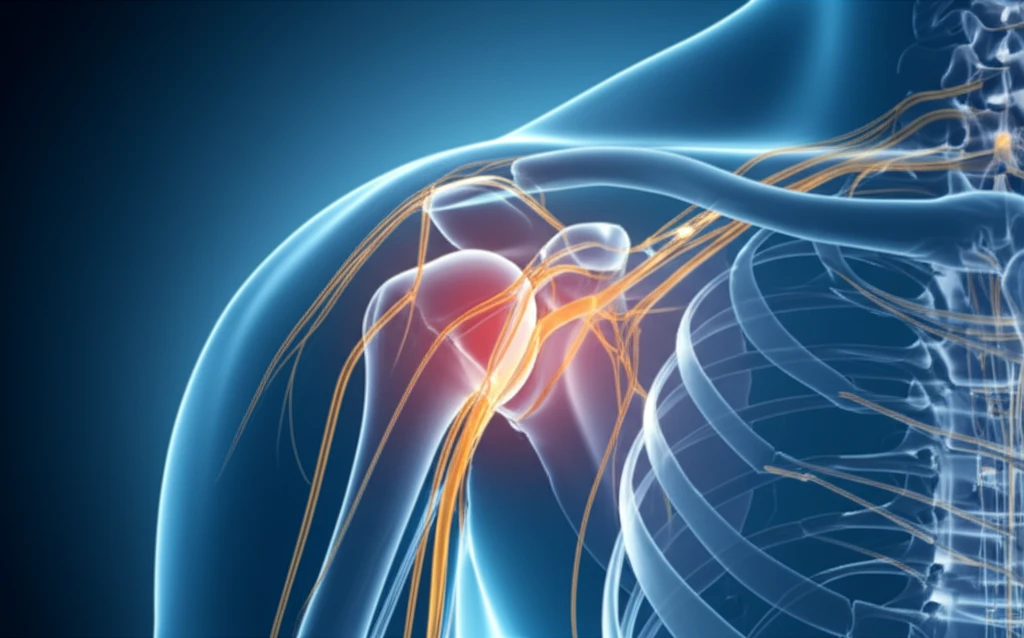
Surreal illustration of a protected shoulder joint with glowing neural pathways, symbolizing safe pain management through the dry catheter technique.

Shoulder Arthroplasty: Is a 'Dry Catheter' the Key to Safer Pain Management?

"Explore how the innovative 'dry catheter' technique in shoulder arthroplasty is revolutionizing postoperative pain control and neurological safety."


Total shoulder arthroplasty (TSA) aims to restore function and alleviate pain in individuals with severe shoulder joint damage. Effective pain management after surgery is crucial as it supports early mobility, accelerates recovery, reduces complications, and enhances patient satisfaction. Delays in pain relief can trigger physiological stress responses, hinder movement, increase the risk of deep vein thrombosis, prolong hospital stays, and diminish overall satisfaction.

Traditionally, brachial plexus blocks, using an interscalene approach with a peripheral nerve catheter, have been standard for managing perioperative pain. However, this method isn't without risks, with complication rates reported as high as 11.2%. These complications prompted the development of a 'dry catheter' technique, designed to mitigate neurological issues observed when combining general anesthesia with interscalene regional anesthesia.

The 'dry catheter' technique allows clinicians to conduct a thorough neurological examination immediately post-surgery, before administering any drugs through the catheter. This helps in differentiating between complications arising from the surgery itself versus those related to the regional anesthesia. A recent study aimed to evaluate the effectiveness of this dry catheter block in identifying neurological deficits linked to regional anesthesia.

The 'Dry Catheter' Technique: How Does It Work?

Surreal illustration of a protected shoulder joint with glowing neural pathways, symbolizing safe pain management through the dry catheter technique.

The study, conducted between September 2011 and January 2014, involved 125 patients undergoing shoulder arthroplasty. All patients received an interscalene catheter, but unlike traditional methods, the catheter wasn't immediately activated. Instead, after the surgery, each patient underwent a detailed neurovascular examination.

If the examination revealed no neurological deficits, a local anesthetic (ropivacaine 0.5%) was administered through the catheter in the recovery unit, followed by a continuous infusion of ropivacaine (0.2%) at 5 to 6 mL/h. The infusion was adjusted to ensure adequate pain control, and patients were monitored throughout their hospital stay. Pain levels were consistently measured using a 0 to 10 scale.

  • Pre-operative Assessment: Patients were carefully assessed and placed under standard ASA monitoring before any intervention.
  • Catheter Placement: A 17-gauge Tuohy needle was inserted under ultrasound guidance, and a 19-gauge wire-reinforced catheter was advanced without an initial local anesthetic bolus.
  • Post-operative Examination: A neurovascular examination was performed immediately after surgery to identify any deficits before activating the catheter.
  • Pain Management: If no deficits were found, ropivacaine was administered through the catheter, with adjustments made as needed by the acute pain service team.
If neurological abnormalities were detected post-surgery, the regional catheter was promptly removed, and pain management was handled with alternative methods such as patient-controlled analgesia using hydromorphone. This approach allowed the medical team to accurately attribute any nerve-related issues to either the surgical procedure or the regional anesthesia.

Key Takeaways and Future Directions

The study found that the 'dry catheter' technique offers a valuable method for distinguishing between surgical complications and those related to regional anesthesia. Although interscalene anesthesia effectively managed early postoperative pain, the complication rate led the authors to discontinue its use. This technique ensures any nerve-related issues are quickly identified and addressed, improving patient outcomes.

About this Article -

This article was crafted using a human-AI hybrid and collaborative approach. AI assisted our team with initial drafting, research insights, identifying key questions, and image generation. Our human editors guided topic selection, defined the angle, structured the content, ensured factual accuracy and relevance, refined the tone, and conducted thorough editing to deliver helpful, high-quality information.See our About page for more information.

Everything You Need To Know

1

What is the 'dry catheter' technique in shoulder arthroplasty, and how does it improve patient safety?

The 'dry catheter' technique in shoulder arthroplasty is an innovative method designed to enhance patient safety by improving the management of postoperative pain while minimizing neurological complications. Unlike traditional methods, the 'dry catheter' technique involves inserting an interscalene catheter without initially administering any local anesthetic. This allows clinicians to perform a thorough neurovascular examination immediately after surgery. If no neurological deficits are found, a local anesthetic, such as ropivacaine, is then administered through the catheter. This approach helps in differentiating between surgical complications and those related to regional anesthesia, ensuring that any nerve-related issues are promptly identified and addressed, thus leading to safer and more effective patient outcomes.

2

What are the primary risks associated with traditional brachial plexus blocks in shoulder arthroplasty, and how does the 'dry catheter' technique mitigate these?

Traditional brachial plexus blocks, utilizing an interscalene approach with a peripheral nerve catheter, carry several risks, with complication rates potentially as high as 11.2%. These complications often involve neurological issues. The 'dry catheter' technique mitigates these risks by enabling a detailed neurovascular examination immediately after the surgery, before any anesthetic is administered through the catheter. This examination helps determine if any neurological deficits are due to the surgery itself or the regional anesthesia. If deficits are detected, the catheter is removed, and alternative pain management methods are used. This approach allows for accurate identification and management of complications, reducing the likelihood of long-term neurological damage and improving overall patient safety.

3

How does the 'dry catheter' technique impact pain management and patient recovery following a total shoulder arthroplasty (TSA)?

The 'dry catheter' technique significantly influences pain management and patient recovery after a Total Shoulder Arthroplasty (TSA). By ensuring effective pain control through the use of ropivacaine, administered via the catheter when no neurological deficits are present, the technique supports early mobility and accelerates recovery. Effective pain management reduces the physiological stress response, decreases the risk of deep vein thrombosis, and shortens hospital stays. Moreover, it enhances patient satisfaction. The ability to quickly identify and address any nerve-related complications also contributes to a smoother recovery process, allowing patients to regain function and alleviate pain more efficiently.

4

What steps are involved in the 'dry catheter' technique, from pre-operative assessment to post-operative pain management?

The 'dry catheter' technique involves a series of carefully orchestrated steps. First, patients undergo a pre-operative assessment and standard ASA monitoring. Next, a 17-gauge Tuohy needle is inserted under ultrasound guidance, followed by the advancement of a 19-gauge wire-reinforced catheter without an initial local anesthetic bolus. Immediately post-surgery, a detailed neurovascular examination is performed to identify any neurological deficits. If no abnormalities are detected, ropivacaine is administered through the catheter, with adjustments made by the acute pain service team. However, if neurological deficits are found, the regional catheter is removed, and pain management is handled using alternative methods, such as patient-controlled analgesia using hydromorphone.

5

What were the key findings of the study on the 'dry catheter' technique, and what implications do these findings have for the future of pain management in shoulder arthroplasty?

The study on the 'dry catheter' technique found that it offers a valuable method for differentiating between surgical complications and those related to regional anesthesia. This technique ensures that nerve-related issues are quickly identified and addressed, thereby improving patient outcomes. A significant implication is that it allows for safer and more effective pain management protocols in the future, with a lower risk of neurological complications associated with traditional methods. The 'dry catheter' technique provides a more nuanced and patient-centered approach to postoperative pain management, potentially leading to wider adoption and further advancements in shoulder arthroplasty procedures.

Newsletter Subscribe

Subscribe to get the latest articles and insights directly in your inbox.