
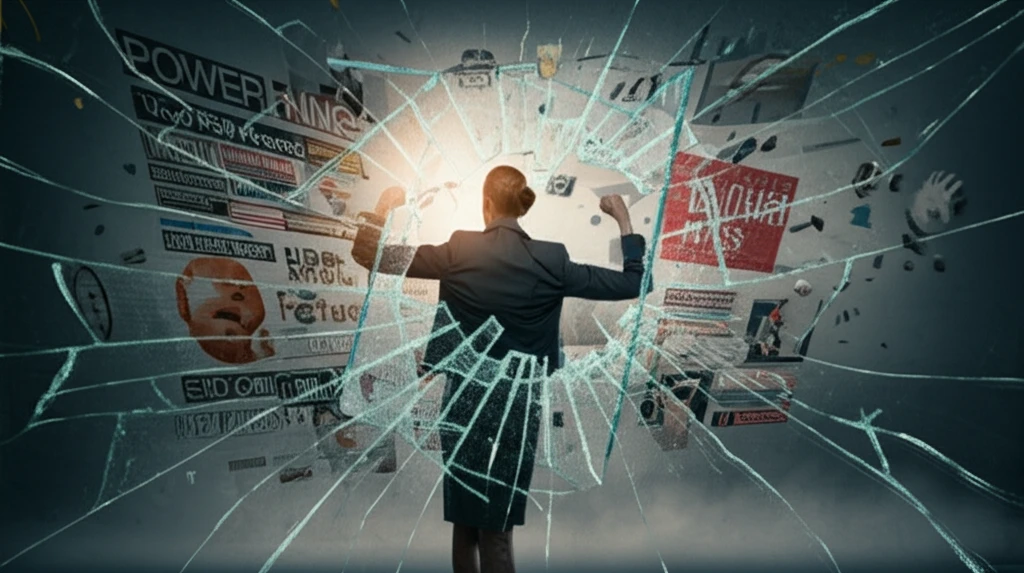
Shattering the Glass Screen: How Media Shapes Women's Leadership Journeys

"Uncover the hidden power of media in sculpting perceptions of female leaders and how to challenge ingrained biases."
In today's hyper-connected world, media isn't just a source of entertainment; it's a powerful educator, subtly shaping our understanding of everything, including leadership. But what happens when those lessons reinforce outdated stereotypes, particularly around gender? Groundbreaking research reveals how media representations, specifically lists that rank 'powerful women,' often perpetuate limiting beliefs about women in leadership roles, hindering their progress and perpetuating inequality.
This article dives deep into the concept of 'public pedagogy' – how culture itself acts as a classroom, teaching us about social norms and values. We'll examine how media, through seemingly innocuous rankings and success stories, subtly reinforces expectations and biases that box women into narrow definitions of leadership. Understanding these hidden influences is the first step to dismantling them.
Get ready to challenge the narratives you thought you knew. This isn't just about criticizing media; it's about empowering women to break free from limiting stereotypes, redefine leadership on their own terms, and create a more equitable future for all.
The Leadership Gap in Numbers
Women continue to be underrepresented in leadership positions across industries and around the world, though precise figures vary by sector and region. Research consistently shows that this gap persists despite growing evidence that diverse leadership teams can drive better organizational outcomes. The challenge of achieving gender parity in leadership remains a significant issue in contemporary discourse on equality and representation.
The Fragmented Landscape of Research
A substantial body of research across management, psychology, women's studies, political science, and economics has examined factors influencing female leadership emergence and effectiveness, yet the field remains fragmented in its approach. Studies consistently demonstrate that media profoundly shapes both the public's perception of women leaders and women's own leadership ambitions, making media a critical variable in understanding leadership trajectories. However, the media's power to influence these perceptions continues to be heavily shaped by gender bias, serving as both a tool for influence and a source of vulnerability for women in leadership. This tension between media as an enabler and media as an obstacle represents a significant methodological challenge in the field.
Pioneers of Women's Media
The creation of women-led magazines marked a turning point in media history, broadening conversations to include politics, culture, identity, and empowerment rather than limiting women to fashion or domestic advice. During the late 19th and early 20th centuries, women in many countries established their own magazines, newspapers, and book publishing houses in response to the exclusion and bias they faced in mainstream media. These efforts laid the groundwork for future generations of women to challenge traditional power structures and redefine what leadership looks like in media.
The Media's Hidden Curriculum: How 'Power Lists' Reinforce Gender Bias
Academic researchers have long highlighted how media representations of women leaders are frequently fraught with contradictions. Women are often praised for traits like collaboration and empathy, yet these same qualities can be dismissed as weakness when displayed in traditionally male-dominated environments. Media outlets frequently perpetuate the myth of the 'ideal' leader as assertive, decisive, and even ruthless – qualities often associated with masculinity. This creates a double bind for women, who are either seen as 'not tough enough' or criticized for being 'too aggressive.'
- Prioritize traditionally 'masculine' metrics: Rankings often focus on financial power, media visibility, and political influence – areas where women have historically faced systemic barriers.
- Reinforce the 'have it all' myth: Women are often lauded for their ability to juggle demanding careers with family responsibilities, perpetuating the unrealistic expectation that women must excel in all areas of life to be considered successful.
- Promote an individualistic narrative: Power lists tend to focus on individual achievements, downplaying the importance of collective action and systemic change. This can create a sense that women's success depends solely on their own efforts, ignoring the pervasive impact of gender bias.
Emerging Findings on Media and Leadership
Recent scholarship continues to explore how media representation intersects with women's leadership trajectories, though comprehensive reviews suggest the field still lacks integrated frameworks. Early-stage research indicates that digital storytelling and 24-hour news cycles have intensified both the opportunities and pressures facing women leaders. As the media landscape evolves, researchers are increasingly examining how platform-specific dynamics shape public perceptions of women in power.
When Representation Backfires
Research on girls' experiences with leadership and women in the public eye reveals that media visibility can create complex challenges for aspiring women leaders. Women leaders often face intense scrutiny, conflicting expectations, and online harassment, while the media perpetuates stereotypes, biases, and double standards that can undermine their authority. These pressures can lead girls and young women to distance themselves from leadership identities, even when they admire women in public roles.
Contextual Differences Across Regions
Comparative analysis of women's leadership in media reveals significant variation across countries, shaped by cultural norms, policy environments, and the maturity of gender equality movements. While some regions have made notable strides in placing women in editorial and executive roles, others continue to face deeply entrenched structural barriers. These differences highlight the importance of context-specific strategies rather than one-size-fits-all approaches to advancing women's leadership.
Reclaiming the Narrative: Empowering Women to Redefine Leadership
The good news is that we don't have to passively accept these limiting media narratives. By understanding how media shapes our perceptions of women's leadership, we can actively challenge these biases and create a more equitable landscape for future generations. Leadership development programs can play a crucial role by: <b>Encouraging critical media literacy:</b> Teaching women to analyze media representations with a discerning eye, questioning the underlying assumptions and biases. <b>Promoting diverse role models:</b> Showcasing women leaders from a variety of backgrounds and industries, who embody different leadership styles and values. <b>Creating spaces for dialogue and reflection:</b> Providing opportunities for women to share their experiences, challenge stereotypes, and redefine leadership on their own terms. <b>Advocating for systemic change:</b> Working to dismantle the structural barriers that prevent women from reaching their full potential in leadership roles. It's time to move beyond the limiting narratives of power lists and embrace a more inclusive and empowering vision of women's leadership. By challenging media biases and creating supportive environments, we can help women break through the glass screen and lead with authenticity, confidence, and impact.
The State of Leadership in News Media
A 2025 Reuters Institute study examining gender diversity at the highest level of editorial leadership across major news outlets in 12 markets found persistent underrepresentation of women in top editorial positions. Earlier data from WAN-IFRA's Women in News initiative showed women held just 21% of business and editorial leadership roles across major media organisations in 17 countries. These findings underscore the systemic nature of the challenge and the need for sustained intervention.
Trends Shaping Tomorrow's Leadership
As organizations increasingly recognize the value women leaders bring, the corporate landscape is evolving toward greater gender equality and empowerment. The integration of gender diversity initiatives into leadership development is expected to continue accelerating, with growing evidence linking women's participation to improved business outcomes. These trends suggest a future where women's leadership is not just an aspiration but a central component of organizational success.
Systemic Barriers Beyond Media
While media representation plays a crucial role, women's leadership journeys are shaped by broader systemic factors including education, economic opportunity, legal frameworks, and cultural norms. Persistent pay gaps, limited access to professional networks, and uneven distribution of domestic responsibilities continue to constrain women's advancement across sectors. Addressing these intersecting barriers requires coordinated action across institutions, industries, and communities.
Learning from Women Leaders
Research from Harvard Business School has examined the gender gap in business case studies, finding that only a fraction of these teaching tools feature women executives, which shapes how future leaders understand leadership itself. Analysis of women leadership case studies reveals how leaders blend strategic vision, technological acumen, and human-centric decision-making to create meaningful impact across industries. These case studies demonstrate that women's leadership transforms organizational cultures and outcomes, yet the scarcity of such examples in business education limits how future leaders understand diverse leadership.