
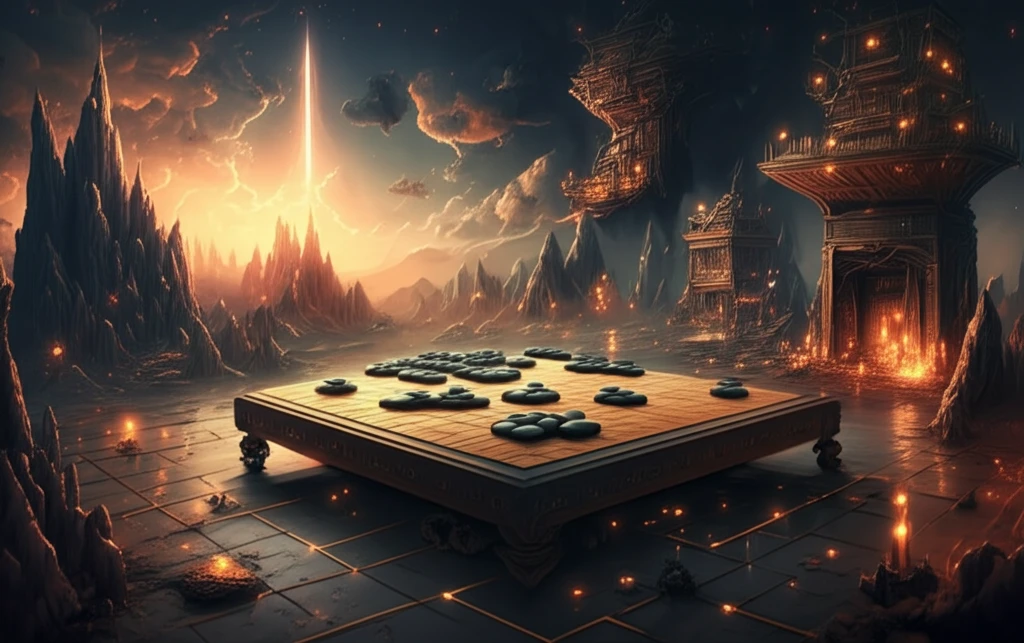
Sharpen Your Mind: How Mastering Go Can Boost Your Brainpower

"Unlocking Visuospatial and Pattern Recognition Skills Through the Ancient Game of Go"
Go, often hailed as the most complex board game in the world, is more than just a pastime; it's a mental workout. This ancient game, played on a grid where players strategically place black and white stones to surround territory, has long been associated with intellect and strategic prowess. But could mastering Go actually enhance your cognitive abilities beyond the game board?
Recent research suggests that Go experts exhibit higher levels of visuospatial skills and pattern recognition compared to novices. These cognitive abilities are crucial not only in the game but also in various aspects of daily life, from navigating complex environments to making informed decisions. The fascinating aspect of this research is exploring how expertise in a specific domain, like Go, can transfer to broader cognitive improvements.
This article delves into the science behind Go's cognitive benefits, exploring how it hones visuospatial abilities and pattern recognition. Whether you're a seasoned Go player or simply curious about brain-training methods, understanding these connections can provide valuable insights into optimizing your mental performance.
Simple Exercises for Mental Clarity and Memory
Videos and guides on social platforms promote simple brain exercises that are said to unlock greater mental clarity and memory and sharpen concentration. Meanwhile, collections of brain-boosting activities, word search puzzle books, and mental acuity exercises are shared widely as practical tools for memory improvement. Physical health is emphasized as a key influence on brain power, with moving the body, resting well, and eating smart listed as core daily habits.
Habits and Visualization as Core Methods
A common approach centers on simple daily habits that strengthen both body and mind, such as regular movement, adequate rest, and sensible eating. Another accepted technique is visualization, in which people spend a few minutes each day picturing their goals and how they will achieve them. These methods are presented as straightforward, but their effects are described in general terms and depend on consistent daily practice rather than a single intervention.
The Ancient Game of Go in Modern Education
The mind game Go has a long history as an intellectual pursuit, summed up in the phrase "five minutes to learn, a lifetime to master." It is now taught as an elective course at Hacettepe University in Turkey and is offered in secondary education, showing how traditional strategy games have been folded into formal learning. Similar games such as Dara are shared as family math night activities, continuing a tradition of games as mental training.
The Cognitive Edge: Visuospatial Skills and Pattern Recognition
Visuospatial abilities are essential for processing and interpreting information about objects in space and their relationships to one another. These skills allow us to mentally rotate objects, transform them in our minds, and create internal representations of the world around us. Imagine packing a suitcase, navigating a new city, or even assembling furniture – all these tasks rely heavily on visuospatial skills.
- Enhanced Spatial Reasoning: Improves the ability to understand and manipulate spatial relationships.
- Improved Strategic Thinking: Sharpens the mind for long-term planning and foresight.
- Increased Focus and Concentration: Requires sustained attention, which builds mental stamina.
- Better Problem-Solving Skills: Encourages analytical thinking and creative solutions.
Reports on Visuospatial Abilities
Research reports describe visuospatial ability as the capacity to picture items, build global shapes by locating minute components, and recognize the contrasts and similarities between objects. These abilities underpin everyday tasks such as drawing, buttoning a shirt, making a bed, or planning a route. Studies also investigate gender differences in visuospatial abilities, indicating the field remains an active area of academic review.
Productive Struggle and Unresolved Differences
Educational commentary notes that genuinely valuable mind-training games involve "productive struggle," meaning learners must work through difficulty rather than expect effortless gains. Research on gender differences in visuospatial abilities remains contested and does not settle into simple conclusions. This suggests that no single exercise or game uniformly boosts brainpower for every learner.
Puzzles, Games, and Visualization Compared
Word search puzzle books and mental acuity exercises focus on vocabulary and pattern recognition, while strategy games such as Go and Dara demand long-term planning and spatial reasoning. Visualization techniques target goal-oriented mental rehearsal rather than logic or memory drills. Brain-boosting collections on platforms like Pinterest bundle many of these options, implying that different cognitive strengths may call for different tools.
Unlocking Your Potential: Go as a Tool for Cognitive Growth
The research clearly suggests that Go offers a unique and engaging way to enhance visuospatial and pattern recognition abilities. By consistently challenging the brain with complex spatial and strategic problems, Go can potentially improve cognitive functions applicable to various aspects of life. Whether you're looking to boost your career prospects, improve your problem-solving skills, or simply keep your mind sharp, exploring the world of Go might be a rewarding endeavor. So, why not pick up a Go board and start training your brain today? The benefits could be more profound than you think.
A Lifetime to Master
Expert commentary on strategy games often centers on the idea that games like Go are "five minutes to learn, a lifetime to master," pointing to sustained challenge as a route to mental development. Training in such games has moved from hobby circles into university electives and secondary schools. Combined with daily habits and simple exercises, these activities suggest that consistent, layered engagement, not a single trick, supports brainpower.
AI-Assisted Tools and Game Development
Free, open-source game engines such as GDevelop now let people learn 2D, 3D, and multiplayer game development with tutorials and AI assistance. These tools lower the barrier to building custom mental-training games, allowing learners to create the kinds of challenges that sharpen their own thinking. AI-assisted learning is presented as a way to learn and build faster, which could expand who can participate in cognitive game design.
Bringing Mind Games Into Schools
Countries such as Turkey have begun integrating the game of Go into secondary education and university electives, yet such programs remain far from universal. Making cognitive training broadly available depends on institutional decisions and teacher training, which vary widely by region. Digital education platforms that offer learning materials are among the channels that could widen access to these approaches.
Skills for Everyday Life
Visuospatial abilities extend beyond abstract tests into real-world actions such as drawing, buttoning a shirt, making a bed, or planning a route. Games, puzzles, and visualization exercises aim to strengthen exactly these everyday capabilities. Because these skills touch ordinary tasks, even modest improvements in mental acuity can translate into tangible, practical benefits in daily life.