
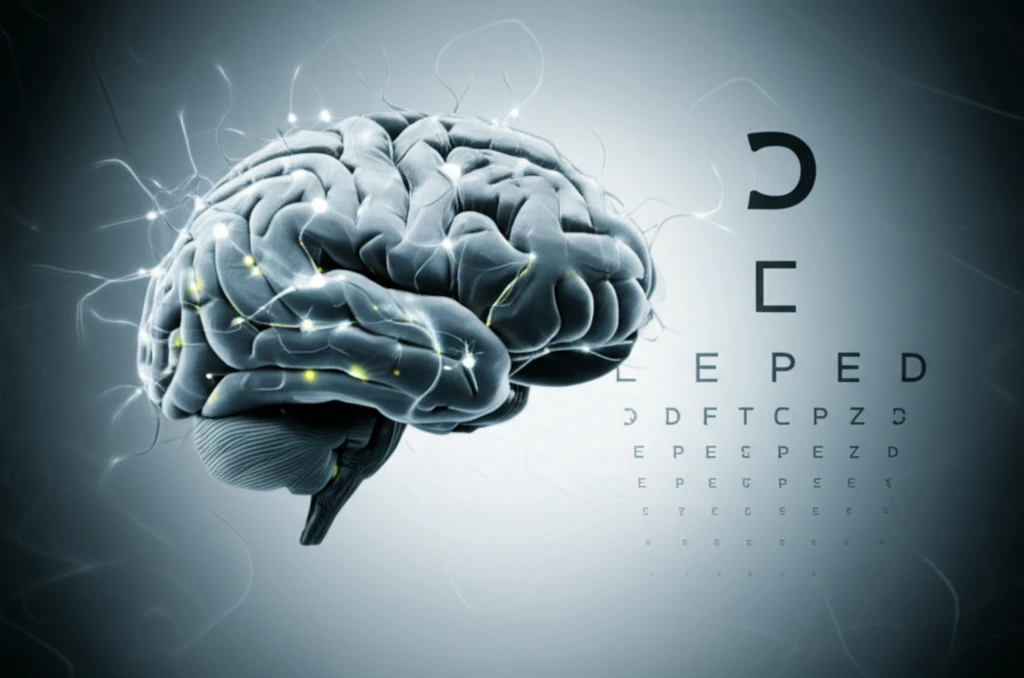
Seeing Clearly: Revolutionizing Eye Exams with Cutting-Edge Neuroscience

"Beyond the Snellen Chart: How Brainwave Technology is Transforming Vision Tests for a Clearer Future"
Eye exams are a routine part of healthcare, a quick check to ensure we're seeing the world clearly. But for some, traditional methods like the Snellen chart can be challenging. Whether due to age, cognitive differences, or other factors, the subjective nature of these tests can sometimes hinder accurate assessments. Now, a groundbreaking approach using brainwave technology promises to change the game.
Imagine a world where vision tests are more objective, relying on the brain's response to visual stimuli rather than subjective answers. This is the promise of event-related potentials (ERPs), which measure brain activity in response to specific events. Researchers are using ERPs to develop new methods for assessing visual acuity, potentially making eye exams more accessible and accurate for everyone.
This article delves into the fascinating world of visual neuroscience, exploring how scientists are using ERPs, specifically the P300 component, to revolutionize eye exams. We'll explore the science behind this innovative approach, its potential benefits, and how it could reshape the future of vision care.
Unlocking the Secrets of Vision: How ERPs and P300 Work
To understand how ERPs and P300 are transforming eye exams, it's helpful to take a closer look at the science behind them. ERPs are electrical signals in the brain that are triggered by specific events, such as the presentation of a visual stimulus. These signals can be measured using electroencephalography (EEG), a non-invasive technique that involves placing electrodes on the scalp.
- Event-Related Potentials (ERPs): Electrical signals in the brain triggered by specific events.
- EEG: A non-invasive technique to measure brain activity using electrodes on the scalp.
- P300: A specific ERP component linked to attention and cognitive processes.
- Visual Acuity Assessment: Analyzing P300 responses to estimate how clearly someone sees.
A Clearer Vision for the Future
The integration of brainwave technology into vision care represents a significant step forward, offering the potential for more accessible, accurate, and personalized eye exams. As research continues to refine these techniques, the future of vision care looks brighter than ever. By embracing these advancements, we can ensure that everyone has the opportunity to see the world with clarity.