
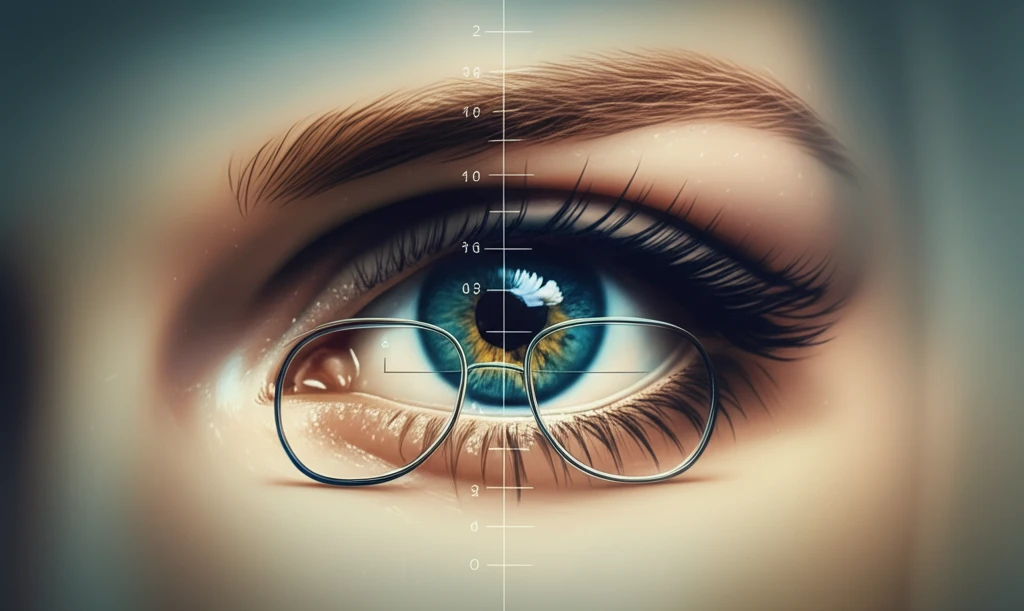
Seeing Clearly: A Simple Guide to Vertex Distance and Your Vision

"Understanding Vertex Distance: How it Affects Your Eyeglass Prescription and Visual Clarity"
Ever wondered why your new glasses don't feel quite right, even though the prescription is correct? The answer might lie in a little-known factor called vertex distance. Vertex distance is the space between the front surface of your eye and the back surface of your eyeglass lens. While it might seem insignificant, this distance plays a crucial role in the effective power of your prescription, especially for those with stronger corrections.
Imagine your eye as a camera and your glasses as the lens. For the image to be perfectly focused on the sensor (your retina), the distance between the lenses needs to be precise. When eyeglasses sit too far or too close to your eyes, the light rays don't converge correctly, potentially causing blurred vision, headaches, or even eye strain. This effect is more pronounced for people with high prescriptions, where even a small change in vertex distance can significantly alter the perceived power of the lens.
In this article, we'll break down the concept of vertex distance, explain why it matters, and provide you with practical insights to ensure your next pair of glasses provides the clearest, most comfortable vision possible. Whether you're a seasoned glasses wearer or new to the world of corrective lenses, understanding vertex distance empowers you to take control of your eye health and optimize your visual experience.
The Small Measurement With Big Vision Impact
Vertex distance is the distance between the back surface of a corrective lens, such as a pair of glasses or contact lens, and the front of the cornea. The American Academy of Ophthalmology highlights the importance of vertex distance specifically in the correction of high refractive errors, where even small changes in this distance noticeably alter how a lens performs.
How Vertex Distance Is Measured and Its Limits
The standard approach is to measure the distance between the back surface of the corrective lens and the front of the cornea, since increasing or decreasing that distance changes the effective power of the lens. A key limitation is that a vertex distance issue can be easily mistaken for a wrong prescription: if the lenses become clear when you push them closer to your face or pull them slightly away, the prescription itself is likely correct and the fit is the problem.
Foundations of Corrective Lens Optics
The foundational principle underlying vertex distance is straightforward: a corrective lens sits a measurable distance in front of the cornea, and that spacing directly influences the lens's optical properties. Because every pair of glasses depends on this relationship between lens position and the eye, understanding it has long been essential for creating lenses that correct vision accurately.
The Importance of Vertex Distance Correction
The power of a lens is measured in diopters (D), and this measurement is calibrated assuming a specific distance from the eye. The further away from the eye, the less effective the prescription, and vice-versa. For lower prescriptions, this difference may be unnoticeable. However, for prescriptions above +/- 4.00D, even a small change in vertex distance can lead to a noticeable difference in vision. This is where vertex distance correction comes in – a process of adjusting the prescribed lens power to compensate for the actual distance at which the glasses sit from your eyes.
- Accurate Vision: Correcting for vertex distance ensures that you're seeing with the intended lens power, minimizing blur and distortion.
- Reduced Eye Strain: By optimizing the lens power, your eyes don't have to work as hard to focus, reducing eye strain and fatigue.
- Improved Comfort: When your glasses are properly calibrated, they feel more comfortable to wear, reducing headaches and other vision-related discomforts.
- Better Overall Visual Experience: Vertex distance correction contributes to a more natural and effortless visual experience, enhancing your overall quality of life.
Modern Tools for Precision Lens Power
Recent practical resources treat vertex distance as a calculated input rather than an afterthought: the effective lens power is derived from the vertex distance, and any discrepancies are adjusted for when finalizing a contact lens prescription. Digital vertex calculators walk users step by step through this adjustment, making the process of compensating for vertex distance more accessible.
Vertex Distance or Simply the Wrong Prescription?
One of the most common failures is confusing a vertex distance problem with a wrong prescription, and the two are not always easy to tell apart. A useful diagnostic is that when lenses are clear after pushing them closer to the face or pulling them slightly away, the prescription is likely correct and the issue lies in the distance between the lens and the eye.
Glasses Versus Contact Lenses: Distance Makes the Difference
Glasses and contact lenses are both considered corrective lenses, but the vertex distance differs dramatically between them because contact lenses sit directly on the cornea while spectacle lenses are positioned away from the eye. Because the back surface of a corrective lens and the front of the cornea are so close together with contacts, their effective power must be recalculated from the vertex distance used for glasses.
Take Control of Your Vision
Understanding vertex distance is a simple yet effective way to enhance your vision and overall comfort. Don't hesitate to discuss this important factor with your eye care professional during your next exam. By ensuring that your glasses are properly calibrated for your unique needs, you can unlock the clearest, most comfortable vision possible and experience the world in all its sharp, vibrant detail. Prioritizing your eye health contributes significantly to your overall well-being, and knowledge about vertex distance is a valuable step in that journey.
Experts Agree: Distance Shapes Power
Across professional guidance, the consensus is consistent: increasing or decreasing the vertex distance changes the effective power of a lens, and the American Academy of Ophthalmology emphasizes this point most strongly in the correction of high refractive errors. Recognizing when a pair of glasses sits at the wrong distance helps prevent unnecessary prescription changes when the real culprit is fit.
Digital Tools Streamline the Adjustment
The growing availability of online calculators reflects a shift toward making vertex distance adjustments routine and precise, with tools that use the vertex distance to compute effective lens power before finalizing a contact lens prescription. As these digital aids become more common, patients may find it easier to understand how small changes in lens position affect what they see.
Making Prescriptions Make Sense
Eyeglass prescriptions rely on abbreviations and numbers that describe the strength of the vision correction and the shape of the eyes, and a working understanding of them helps patients interpret what their prescription means. Within this larger picture, vertex distance is one more variable that must be accounted for so that the printed prescription and the physical frame produce the intended result.
Everyday Clarity for High-Rx Wearers
For people with high prescriptions, a small adjustment in how close glasses sit to the face can mean the difference between sharp and blurry vision. The simple real-world test of pushing lenses closer or pulling them slightly away gives wearers a hands-on way to understand whether their vision problem stems from vertex distance or from a prescription that genuinely needs updating.