
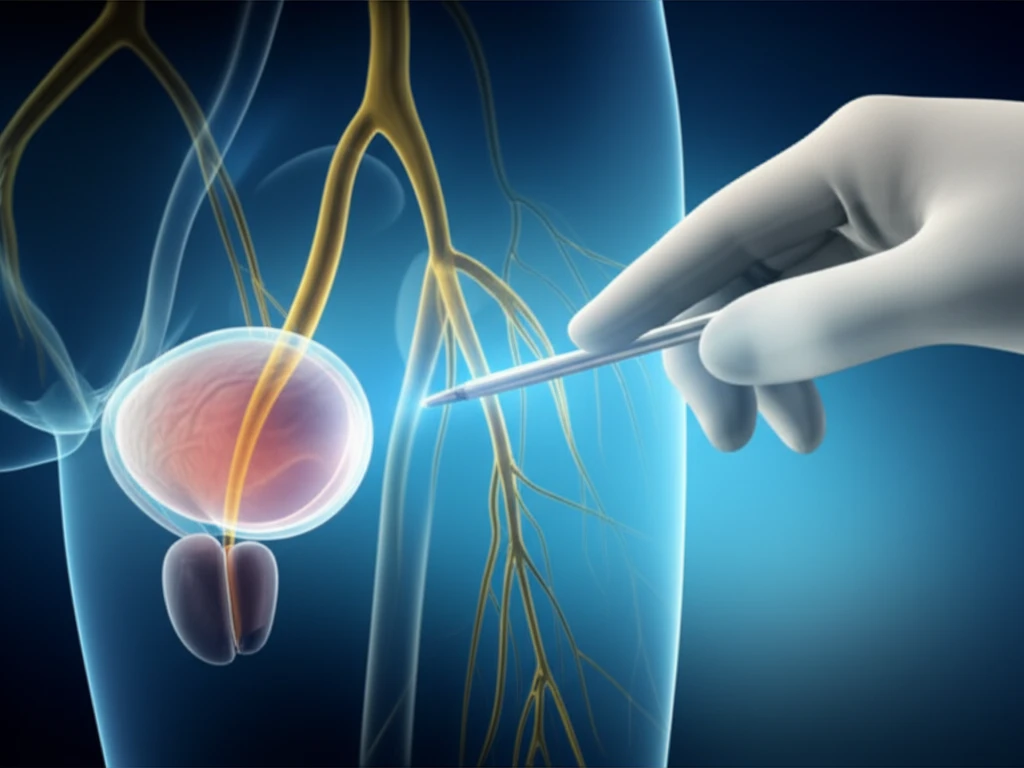
Surgical technique using nerve pathway to protect prostate gland during rectal cancer surgery.

Securing Rectal Cancer Surgery: How a Nerve Landmark Can Prevent Urethral Injury

"A novel surgical technique uses the autonomic nerve to identify the prostate gland during transanal total mesorectal excision, minimizing the risk of urethral damage."


In rectal cancer surgery, protecting the autonomic nerve while achieving complete tumor removal is paramount. This ensures both oncological control and preservation of crucial bodily functions. Laparoscopic surgery, while beneficial, can pose challenges, especially in male patients with obesity or a narrow pelvis, due to limited visibility within the deep pelvic region. This can increase the risk of incomplete mesorectal excision and less favorable oncological outcomes.

Transanal total mesorectal excision (taTME) has emerged as a promising technique to overcome these limitations, offering improved access and visualization. However, it also carries an inherent risk of iatrogenic urethral injury in men, with reported frequencies ranging from 0% to 6.7% in single-center studies and 0.7% in the Low Rectal Cancer Development program.

Urethral injury typically occurs during anterior dissection near the preprostatic urethra, often because surgeons lack sufficient awareness of the intricate anatomy involving the neurovascular bundle of Walsh, the prostate gland, and the rectourethral muscle. Addressing this critical challenge is essential for improving patient outcomes in rectal cancer surgery.

Autonomic Nerve as a Guide: A Step-by-Step Surgical Technique

Surgical technique using nerve pathway to protect prostate gland during rectal cancer surgery.

To address the risk of urethral injury, a novel surgical technique has been developed that uses the autonomic nerve as a landmark to identify the prostate gland and ensure safe dissection of the male rectourethral muscle. This approach aims to enhance precision and minimize the potential for damage during taTME.

The technique involves a systematic approach to rectal dissection:

  • Initial Dissection: Circumferential rectal dissection begins at the anorectal ring, proceeding posteriorly and cranially within the avascular presacral plane.
  • Nerve Identification: Dissection from the posterior wall towards the left side facilitates recognition of the rise of the fourth pelvic splanchnic nerve (S4). This nerve serves as a critical landmark.
  • Prostate Identification: By tracing the autonomic nerves anteriorly while carefully identifying S4 and the neurovascular bundle, the prostate gland can be accurately located before dissecting the rectourethral muscle.
  • Safe Muscle Dissection: Using this nerve-guided approach, the rectourethral muscle can be safely cut while clearly visualizing the prostate gland, thus avoiding urethral injury. This also allows for precise selection of the cutoff line of the rectourethral muscle based on individual patient anatomy.
This technique is illustrated in detail in the video article available at http://links.lww.com/DCR/A647, offering a visual guide to the procedure.

Reducing Risks, Improving Outcomes

By adopting this surgical technique, surgeons can significantly reduce the risk of urethral injury during taTME, a critical step towards improving patient safety and outcomes in rectal cancer surgery.

The key lies in using the autonomic nerve as a reliable landmark to guide dissection and accurately identify the prostate gland. This approach enhances precision and control, minimizing the potential for iatrogenic damage.

Further research and widespread adoption of this technique could lead to a new standard of care in rectal cancer surgery, ensuring both effective tumor removal and preservation of vital anatomical structures.

About this Article -

This article was crafted using a human-AI hybrid and collaborative approach. AI assisted our team with initial drafting, research insights, identifying key questions, and image generation. Our human editors guided topic selection, defined the angle, structured the content, ensured factual accuracy and relevance, refined the tone, and conducted thorough editing to deliver helpful, high-quality information.See our About page for more information.

This article is based on research published under:

DOI-LINK: 10.1097/dcr.0000000000001138, Alternate LINK

Title: Surgical Techniques For Identification Of The Prostate Gland Using The Autonomic Nerve As A Landmark During Transanal Total Mesorectal Excision: Secure Dissection Of The Male Rectourethral Muscle

Subject: Gastroenterology

Journal: Diseases of the Colon & Rectum

Publisher: Ovid Technologies (Wolters Kluwer Health)

Authors: Jun Watanabe, Atsushi Ishibe, Yusuke Suwa, Hirokazu Suwa, Masashi Momiyama, Mitsuyoshi Ota, Itaru Endo

Published: 2018-08-01

Everything You Need To Know

1

What is transanal total mesorectal excision (taTME), and what are the potential risks associated with it?

Transanal total mesorectal excision (taTME) is a surgical technique used to treat rectal cancer. It improves access and visualization during the procedure, which can be limited with laparoscopic surgery, especially in patients with obesity or a narrow pelvis. The goal is to completely remove the rectal tumor while protecting the autonomic nerve to preserve bodily functions. However, taTME carries a risk of urethral injury in men because of the difficulty in identifying the prostate gland and surrounding structures.

2

How does using the autonomic nerve as a landmark help prevent urethral injuries during rectal cancer surgery?

Surgeons can minimize the risk of urethral injury during transanal total mesorectal excision (taTME) by using the autonomic nerve as a landmark to accurately identify the prostate gland before dissecting the rectourethral muscle. This technique involves tracing the fourth pelvic splanchnic nerve (S4) and the neurovascular bundle to locate the prostate, allowing for safer cutting of the rectourethral muscle. The approach is intended to improve precision and safety, reducing the potential for damage.

3

What is the significance of the fourth pelvic splanchnic nerve (S4) in this surgical technique?

The fourth pelvic splanchnic nerve (S4) is a branch of the autonomic nervous system and is used as a key landmark during transanal total mesorectal excision (taTME). By identifying the rise of S4 and tracing it anteriorly along with the neurovascular bundle, surgeons can accurately locate the prostate gland. This allows for precise dissection of the rectourethral muscle while minimizing the risk of urethral injury. The technique aims to improve the precision and safety during taTME.

4

In what ways does this novel technique improve the precision of rectal cancer surgery?

The novel technique enhances precision during transanal total mesorectal excision (taTME) by providing surgeons with a clear anatomical guide – the autonomic nerve. Identifying key structures like the fourth pelvic splanchnic nerve (S4) and tracing the neurovascular bundle allows for precise prostate gland location. This is particularly important for avoiding urethral injury during dissection of the rectourethral muscle. This nerve-guided approach enables surgeons to tailor the cutoff line of the rectourethral muscle based on the individual patient's anatomy, resulting in improved precision and reduced risks.

5

Besides preventing urethral injury, what other aspects of patient health and recovery need to be considered when using this new surgical technique, and what further research is needed?

While the focus is on preventing urethral injury during rectal cancer surgery via transanal total mesorectal excision (taTME) by utilizing the autonomic nerve, specifically the fourth pelvic splanchnic nerve (S4), and the neurovascular bundle as landmarks for prostate gland identification, this method's long-term impact on other pelvic functions, like urinary and sexual function, requires further investigation. The success of this technique relies on careful dissection and preservation of the autonomic nerve, which plays a crucial role in these functions. Follow-up studies are needed to assess the long-term functional outcomes and to determine if this technique leads to an overall improvement in quality of life for patients undergoing rectal cancer surgery.

Newsletter Subscribe

Subscribe to get the latest articles and insights directly in your inbox.