
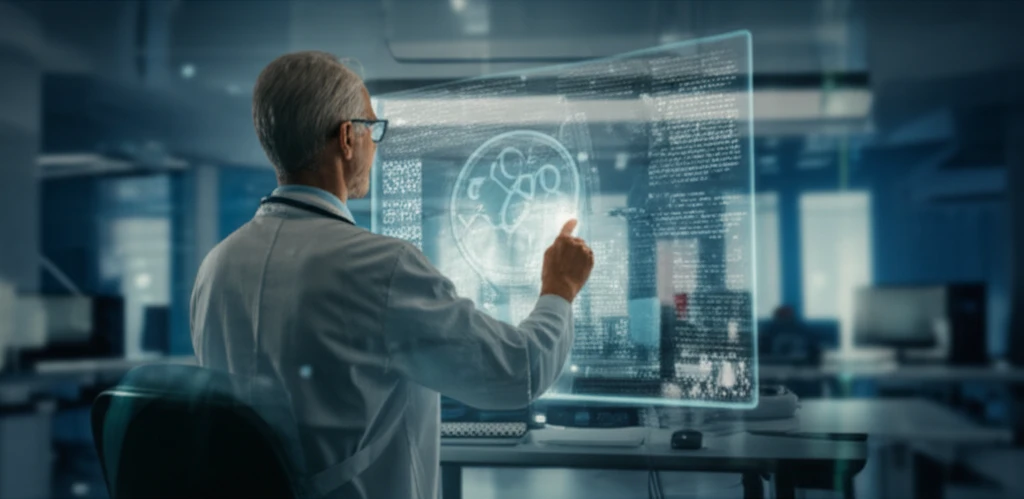
Encrypted medical image in telemedicine

Secure Telemedicine: How Advanced Image Encryption is Protecting Your Medical Data

"Discover the innovative techniques safeguarding sensitive medical images in telemedicine, ensuring privacy and reliability for remote healthcare."


The rise of computers and high-speed communication has greatly improved remote medical consultations. However, laws now require hospitals to encrypt patient data, including images, before it's sent over networks. This makes good encryption methods very important for today's medicine.

This article looks at a new way to encrypt digital images, using chaotic mapping. This method takes advantage of the unique properties of chaotic sequences to create image chaos and pixel averaging. This helps encrypt the image and improves data security, making both data and images safer.

Telemedicine, which includes remote imaging, diagnoses, and consultations, has been growing worldwide for about 40 years. It's only recently started being studied in China, where laws require encrypted image data. This article introduces a new algorithm that combines traditional image encryption and image hiding with chaos theory. This technique can encrypt an image and then retrieve the original image from the encrypted version, providing a more reliable method for sharing encrypted images, which could boost Telemedicine in China.

Understanding the Image Encryption Algorithm

Encrypted medical image in telemedicine

Due to its extensive use, chaos theory has become a primary focus in digital encryption. Traditional algorithms typically use confusion and diffusion: confusion rearranges pixels, while diffusion alters them. Logistic chaotic mapping is defined by the formula Xn+1 = μ(1 − xn), where μ ∈ (0,1).

The logistic chaotic sequence is highly sensitive to the initial value, meaning even a small change can produce a significantly different output. This sensitivity helps ensure that the key needed to decrypt the image is unique, enhancing security.

The traditional encryption algorithm consists of several steps:
  • Step 1: Transform the plain-image into a matrix of M × N. Generate a chaotic sequence L using logistic mapping, and select M × N numbers to create a chaotic sequence L = [l1, l2, l3... lM×N]. Arrange these numbers in order to use them for image encryption. Obtain the sequence H = [h1, h2, h3 ... hM×N] with the values listed in order. Convert the plain-image into a one-dimensional array and relocate its pixel locations according to sequence H to produce the chaotic image C.
  • Step 2: Determine the key sequence in the diffusion process. This process turns decimals into integers using the equation: L'(i) = mod(round(10000 × L'(i)), 256).
  • Step 3: Determine the final cipher-image using the XOR operation, as shown in the equation: D(i) = L'(i) + C(i).
  • Step 4: Output the cipher-image.
To enhance security further, this paper introduces an image-hiding algorithm based on image transfer. The image is encrypted into a carrier image, which enhances the effect of image hiding and makes unauthorized decryption more difficult.

The Future of Secure Medical Imaging

This article introduces a new algorithm that combines image encryption and hiding, offering a potentially valuable tool for telemedicine. By setting a new starting point during confusion, the algorithm expands the secret key space and uses multiple iteration operations. Additionally, it uses pixel values to execute XOR, which improves the average pixel value after diffusion.

The encrypted image is loaded into a carrier image, further enhancing the security of the plain image and compensating for the limitations of single encryption methods. This multi-layered approach ensures that medical images are protected against unauthorized access, maintaining patient privacy and data integrity.

Future studies will focus on refining image encryption algorithm keys and exploring other relevant topics in telemedicine. As technology advances, ensuring the security and privacy of medical data will remain a critical area of research and development.

About this Article -

This article was crafted using a human-AI hybrid and collaborative approach. AI assisted our team with initial drafting, research insights, identifying key questions, and image generation. Our human editors guided topic selection, defined the angle, structured the content, ensured factual accuracy and relevance, refined the tone, and conducted thorough editing to deliver helpful, high-quality information.See our About page for more information.

This article is based on research published under:

DOI-LINK: 10.3233/thc-161166, Alternate LINK

Title: Research On Medical Image Encryption In Telemedicine Systems

Subject: Health Informatics

Journal: Technology and Health Care

Publisher: IOS Press

Authors: Yin Dai, Huanzhen Wang, Zixia Zhou, Ziyi Jin

Published: 2016-06-13

Everything You Need To Know

1

Why is image encryption so important in telemedicine?

Telemedicine relies on secure data transmission, especially for sensitive medical images. Legal requirements mandate encryption of patient data, including images, before they are transmitted. Therefore, effective encryption methods, such as those leveraging chaotic mapping, are critical. These methods ensure that patient information remains confidential and compliant with healthcare regulations during remote consultations and diagnoses.

2

Could you explain the image encryption algorithm step by step?

The image encryption algorithm transforms a plain-image into a matrix, generates a chaotic sequence L using logistic mapping, and selects numbers to create a chaotic sequence. This sequence is arranged, and the plain-image is converted into a one-dimensional array. Pixel locations are then relocated according to sequence H to produce the chaotic image C. A key sequence is determined using an equation to turn decimals into integers. The final cipher-image is produced using the XOR operation, and then the cipher-image is outputted.

3

What is logistic chaotic mapping, and how does it enhance security?

Logistic chaotic mapping is defined by the formula Xn+1 = μ(1 − xn), where μ ∈ (0,1). This mapping is highly sensitive to its initial value. Even minor changes can result in significantly different outputs. This sensitivity ensures that the key required to decrypt the image is unique, which substantially enhances security. This is crucial for protecting sensitive medical data during transmission in telemedicine.

4

How does the new image encryption algorithm improve security for medical images?

The new image encryption algorithm enhances security by combining traditional image encryption and hiding. It sets a new starting point during confusion, expanding the secret key space, and uses multiple iteration operations. By using pixel values to execute XOR, it improves the average pixel value after diffusion. This makes unauthorized decryption more difficult, providing a more reliable method for sharing encrypted images in telemedicine and protecting patient data.

5

How do traditional encryption algorithms compare to the methods discussed here?

Traditional encryption algorithms use confusion and diffusion. Confusion rearranges the pixels, while diffusion alters the pixel values. This article enhances these techniques by using chaotic mapping. By integrating the chaos theory and an image-hiding algorithm based on image transfer, traditional methods are improved, providing better security for medical images in telemedicine.

Newsletter Subscribe

Subscribe to get the latest articles and insights directly in your inbox.