
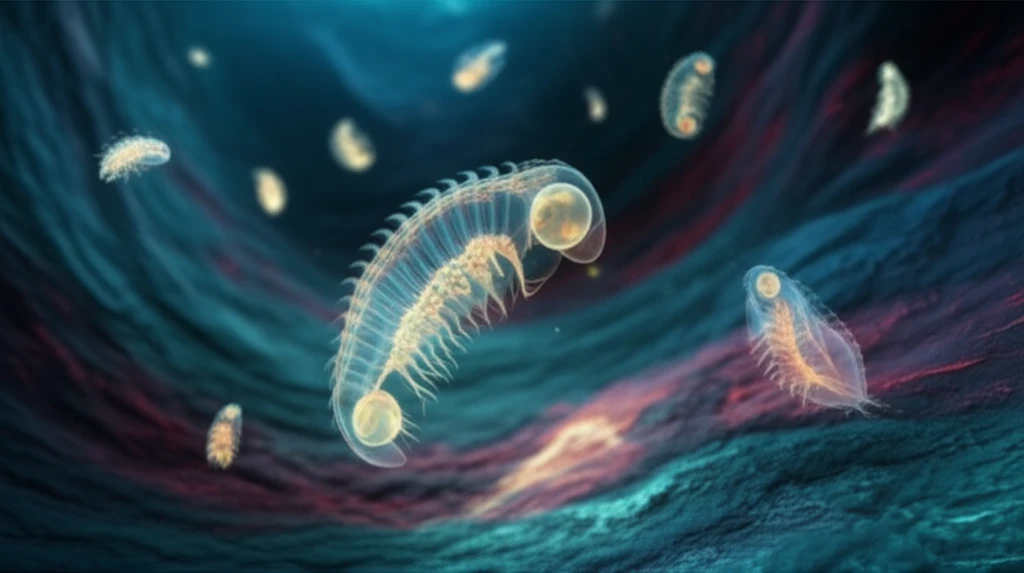
Microscopic sea urchin larvae drifting in ocean currents, showing different survival strategies.

Sea Urchin Larvae: How Growth Strategies Impact Ocean Dispersal

"Discover how different larval forms of sea urchins, like Strongylocentrotus purpuratus and Centrostephanus coronatus, adapt their growth to influence their survival and spread across the oceans."


Marine invertebrate larvae, though small, play a huge role in the health and diversity of our oceans. Many of these larvae are planktotrophic, meaning they need to eat food to grow and develop into juveniles. This larval stage is a critical time for them to spread out and find new homes on the seafloor.

Echinoderms, like sea urchins, are particularly interesting to scientists who study how different development strategies can affect a species' success. Echinoid larvae come in a variety of shapes, which scientists believe affects their ability to grow, develop, and eventually transform into adult sea urchins. Most echinoids start as a pluteus larva, characterized by a body with multiple arms used for movement and food capture. How these arms vary can change how well a larva swims and feeds.

This article dives into a new study comparing two distinct types of echinoid larvae: the typical echinopluteus of Strongylocentrotus purpuratus and the less common echinopluteus transversus of Centrostephanus coronatus. By examining their growth physiology, we will uncover how their unique forms impact their survival strategies and dispersal potential.

Form vs. Function: Understanding Larval Growth

Microscopic sea urchin larvae drifting in ocean currents, showing different survival strategies.

Researchers at California State University Long Beach compared the larval growth of two sea urchin species in a controlled environment, closely monitoring their physical development and physiological processes. The larvae were raised at a temperature of 16°C and fed a consistent diet of 20,000 algal cells per milliliter.

The team tracked several key factors during the larval development of both species:

  • Morphology: They measured features like ciliary band length, midline body length, and stomach size to understand structural growth.
  • Protein Growth: Protein growth rate indicated how efficiently larvae converted food into biomass.
  • Ingestion Rates: Daily algae consumption was monitored to assess feeding behavior.
  • Respiration Rates: Oxygen consumption was measured to gauge metabolic activity.
  • Growth and Digestive Efficiencies: Energetic models were constructed to assess digestive and overall growth efficiency.
Despite the similar rate of growth in total ciliary band length (structures which captures food) observed in both larvae, major differences emerged in body length and stomach size. The typical echinopluteus larvae of S. purpuratus showed notably higher rates of protein growth, daily ingestion of algae, and aerobic respiration compared to the echinopluteus transversus larvae of C. coronatus. Larvae of S. purpuratus also had digestive and growth efficiencies up to threefold higher than C. coronatus, highlighting fundamental differences in performance beyond observable physical traits.

Long-Term Implications

These observed physiological differences may explain differences in planktonic duration (PLD) and dispersal capabilities. Transversus larvae, with their slower growth and lower efficiency, may remain in the plankton longer, potentially drifting further from their origin.

Typical larvae, like those of S. purpuratus, are more adapted to capitalize on areas with seasonal algal blooms, supporting rapid growth and development. The differences in growth strategies reflect adaptations to different ecological niches: transversus larvae thrive in stable, nutrient-poor tropical waters, while typical larvae excel in temperate regions with fluctuating resources.

Understanding these variations can help forecast how marine species might adapt to changing ocean conditions and highlight the importance of biodiversity in ensuring ecosystem resilience. Further research is still required.

About this Article -

This article was crafted using a human-AI hybrid and collaborative approach. AI assisted our team with initial drafting, research insights, identifying key questions, and image generation. Our human editors guided topic selection, defined the angle, structured the content, ensured factual accuracy and relevance, refined the tone, and conducted thorough editing to deliver helpful, high-quality information.See our About page for more information.

This article is based on research published under:

DOI-LINK: 10.1111/ivb.12227, Alternate LINK

Title: Physiology Of Growth In Typical And Transversus Echinopluteus Larvae

Subject: Animal Science and Zoology

Journal: Invertebrate Biology

Publisher: Wiley

Authors: Annie Jean Rendleman, Douglas A. Pace

Published: 2018-11-12

Everything You Need To Know

1

What role do sea urchin larvae play in the ocean?

Echinoderm larvae, like those of sea urchins, are crucial for the health and diversity of our oceans. These larvae, including the pluteus larva, play a vital role in spreading species across the marine environment. Being planktotrophic, they feed on food to grow and develop, ultimately transforming into juveniles that settle on the seafloor. The success of these larvae directly impacts the overall ecosystem health and the distribution of sea urchins.

2

What are the key differences between the two sea urchin species studied?

The two sea urchin species studied, Strongylocentrotus purpuratus and Centrostephanus coronatus, exhibit different growth strategies. S. purpuratus, with its typical echinopluteus larva, demonstrated higher protein growth rates, ingestion of algae, and aerobic respiration compared to the C. coronatus, which has an echinopluteus transversus. This difference in physiological processes is critical because it influences the larva's ability to grow, develop, and disperse. S. purpuratus larvae showed higher digestive and growth efficiencies highlighting their superior performance.

3

How does larval form impact survival strategies?

The variations in larval form, particularly the differences between the echinopluteus of Strongylocentrotus purpuratus and the echinopluteus transversus of Centrostephanus coronatus, significantly affect their survival strategies. The typical echinopluteus of S. purpuratus, with its more efficient growth, may have a shorter planktonic duration. Conversely, the echinopluteus transversus of C. coronatus, with slower growth, may spend more time in the plankton, potentially leading to greater dispersal distances. These differences in growth physiology impact the larval stages ability to thrive in their environment.

4

What factors were measured to understand the larval growth?

Several key factors were examined in the study including morphology (ciliary band length, midline body length, and stomach size), protein growth rate, ingestion rates, respiration rates, and growth and digestive efficiencies. These measurements provided insights into the structural development, feeding behavior, metabolic activity, and overall efficiency of the sea urchin larvae. By comparing these factors in the two species, researchers could identify the differences in their growth strategies and the implications for their dispersal potential.

5

What are the long-term implications of the observed physiological differences in sea urchin larvae?

The physiological differences observed in the sea urchin larvae have implications for their planktonic duration (PLD) and dispersal capabilities. The study suggests that the slower growth and lower efficiency of the echinopluteus transversus larvae of Centrostephanus coronatus, may remain in the plankton longer, allowing for increased dispersal. In contrast, the more efficient growth of the typical echinopluteus larvae of Strongylocentrotus purpuratus, may result in a shorter PLD and potentially less dispersal. These differences influence the distribution and success of these sea urchin species within the marine environment.

Newsletter Subscribe

Subscribe to get the latest articles and insights directly in your inbox.