
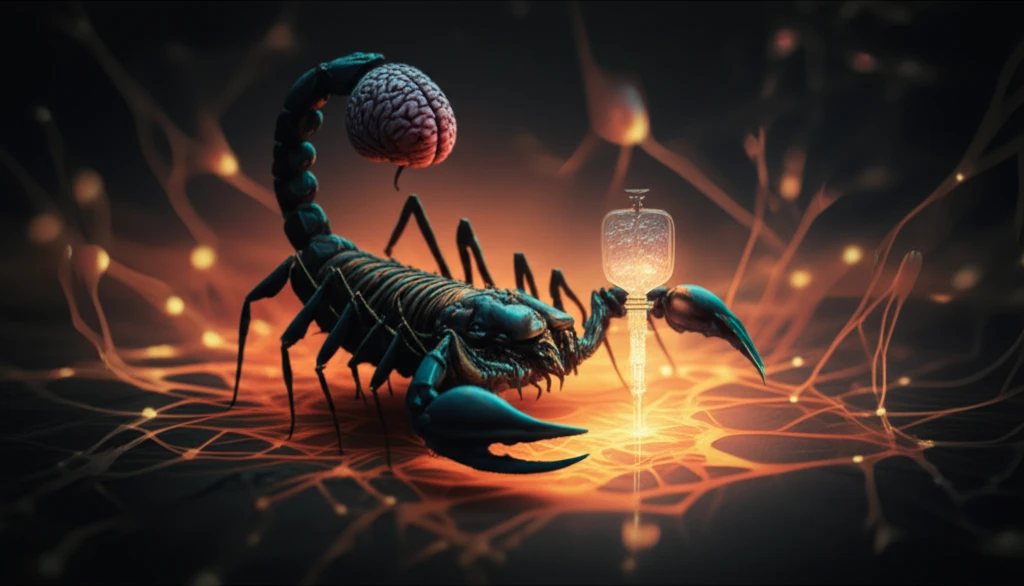
Scorpion Venom: A Surprising Key to Unlocking Next-Gen Brain Treatments?

"New research unveils how a unique compound in scorpion venom could revolutionize treatments for neurological disorders, offering hope for more targeted therapies."
For centuries, scorpion venom has been both feared and revered. Now, modern science is unlocking its secrets, revealing potent compounds with surprising therapeutic applications. The latest breakthrough focuses on a specific peptide within the venom of the Mesobuthus eupeus scorpion, found to have an incredibly selective effect on certain potassium channels in the brain.
Potassium channels are crucial for regulating neuronal excitability. When these channels malfunction, it can lead to a host of neurological disorders, including epilepsy, ataxia, and even certain autoimmune diseases. The challenge lies in finding compounds that can precisely target the problematic channels without disrupting others.
Enter MeKTx11-1, the peptide derived from scorpion venom. Researchers have found that MeKTx11-1 acts as a highly selective 'blocker' of the Kv1.2 potassium channel, a key player in brain function. This discovery opens the door to developing therapies that are far more targeted and effective than current treatments.
Why Is Selective Targeting of Kv1.2 Channels a Game-Changer?
Current treatments for neurological disorders often act like a blunt hammer, affecting multiple systems in the brain and leading to unwanted side effects. The beauty of MeKTx11-1 lies in its precision. It's like a guided missile zeroing in on a specific target.
- Reduced Side Effects: By targeting only the problematic Kv1.2 channels, potential side effects are minimized.
- Increased Efficacy: A more precise approach means a more effective treatment, as the therapeutic agent is concentrated where it's needed most.
- Potential for New Therapies: This discovery paves the way for developing entirely new treatments for neurological disorders that were previously difficult to manage.
What's Next for Scorpion Venom and Brain Disorder Therapies?
While this research is still in its early stages, the discovery of MeKTx11-1 and its selective action on Kv1.2 channels holds immense promise. Further research will focus on refining the peptide, testing its efficacy in animal models, and ultimately, developing it into a safe and effective treatment for human neurological disorders. The future of brain therapies may very well be hidden within the venom of a scorpion.