
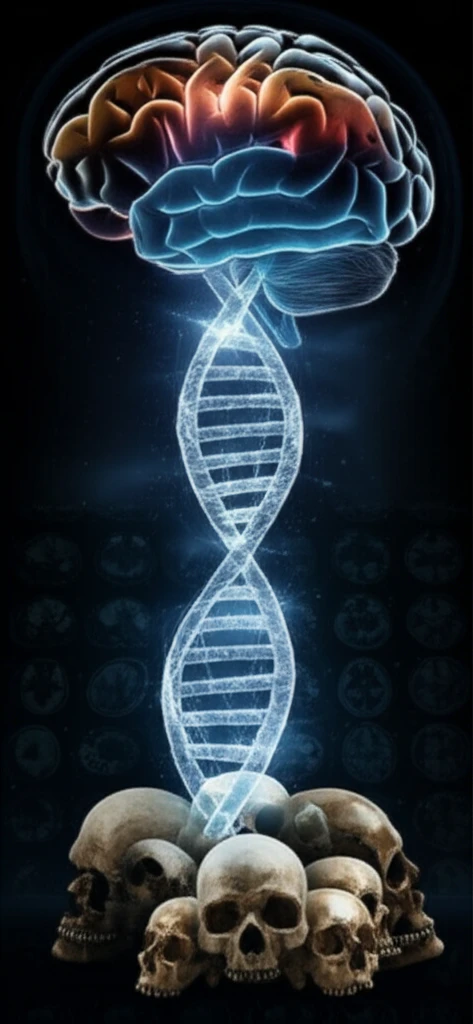
DNA double helix merging with ancient skulls and a brain scan

Schizophrenia's Evolutionary Puzzle: New Clues from Ancient DNA

"Unlocking the genetic history of mental health: How comparing our DNA to that of apes and Neanderthals can help us understand schizophrenia."


Schizophrenia, a mental disorder affecting millions worldwide, presents a perplexing paradox. Despite its significant impact on individuals' ability to function and reduced reproductive rates, it has persisted across human populations for millennia. This enduring presence has led researchers to explore the evolutionary roots of the condition, suggesting that it may be linked to the development of uniquely human cognitive abilities.

The evolutionary hypothesis proposes that the same genetic factors that contributed to the expansion of human intelligence, language, and social skills may also, as a byproduct, increase the risk for schizophrenia. Recent advances in genomics have allowed scientists to investigate this hypothesis by comparing the genomes of modern humans with those of our evolutionary ancestors, including great apes and extinct hominids like Neanderthals and Denisovans.

This article delves into a groundbreaking study that uses an 'evolutionary epigenetics' approach to examine schizophrenia. By focusing on differentially methylated regions (DMRs) - areas of the genome where DNA methylation patterns differ between species - the research seeks to pinpoint when and how genetic risk factors for schizophrenia may have emerged in the human lineage. Understanding these evolutionary connections could open new avenues for understanding, and potentially treating, this challenging disorder.

Deciphering DNA Methylation: An Evolutionary Timeline

DNA double helix merging with ancient skulls and a brain scan

DNA methylation is a chemical modification to DNA that can change the activity of a gene without changing the DNA sequence. It's like a switch that can turn genes on or off, influencing various biological processes. These methylation patterns can differ significantly between species, reflecting evolutionary adaptations and changes in gene expression.

Researchers analyzed genome-wide association studies (GWAS) of schizophrenia and other traits, investigating the enrichment of association across genomic regions with variable methylation. They focused on two key comparisons:

  • Great Apes vs. Humans: Comparing methylation patterns between modern humans and great apes (orangutans, chimpanzees, and gorillas) to identify older, more distant evolutionary changes.
  • Extinct Hominids vs. Humans: Examining differences in methylation between modern humans and extinct hominids (Neanderthals and Denisovans) to pinpoint more recent evolutionary events.
By comparing the genetic risk factors (single nucleotide polymorphisms) from schizophrenia GWAS with the location of DMRs in modern humans, Neanderthals, and great apes the research tried to find out the genetic relation of schizophrenia. Researchers used stratified quantile-quantile plots, and INRICH methods, to analyze the data sets and come to a conclusion.

Evolutionary Insights: Implications for Schizophrenia Research

The study's findings suggest that genetic variations that predispose people to schizophrenia may be linked to recent human evolution, perhaps occurring after the divergence of humans from Neanderthals and Denisovans. The research suggests that regions of the genome with human-specific DMRs harbor relatively more genetic variants associated with schizophrenia than the rest of the genome.

The central role of the MHC region (Major Histocompatibility Complex) in the enrichment of human hypo-methylated regions poses interesting questions. The MHC region is known for its complex LD architecture, which renders the interpretation of genetic signals very challenging and can cause false positives in studies.

While further research is needed, this study provides valuable insights into the complex interplay between evolution, genetics, and mental health. By understanding the evolutionary origins of schizophrenia, researchers hope to develop more effective strategies for prevention, diagnosis, and treatment of this debilitating disorder.

About this Article -

This article was crafted using a human-AI hybrid and collaborative approach. AI assisted our team with initial drafting, research insights, identifying key questions, and image generation. Our human editors guided topic selection, defined the angle, structured the content, ensured factual accuracy and relevance, refined the tone, and conducted thorough editing to deliver helpful, high-quality information.See our About page for more information.

This article is based on research published under:

DOI-LINK: 10.1016/j.schres.2018.11.025, Alternate LINK

Title: Analysis Of Differentially Methylated Regions In Great Apes And Extinct Hominids Provides Support For The Evolutionary Hypothesis Of Schizophrenia

Subject: Biological Psychiatry

Journal: Schizophrenia Research

Publisher: Elsevier BV

Authors: Niladri Banerjee, Tatiana Polushina, Francesco Bettella, Vidar M. Steen, Ole A. Andreassen, Stephanie Le Hellard

Published: 2019-04-01

Everything You Need To Know

1

What is schizophrenia, and why is it considered a puzzle in the context of evolution?

Schizophrenia is a complex mental disorder affecting millions worldwide. It presents a paradox because despite its negative impact on individuals' ability to function and reduced reproductive rates, it has persisted across human populations for millennia. This persistence has led researchers to explore its evolutionary roots, suggesting a link to the development of uniquely human cognitive abilities.

2

How do researchers investigate the evolutionary origins of schizophrenia?

Researchers compare the genomes of modern humans with those of our evolutionary ancestors, including great apes like orangutans, chimpanzees, and gorillas, and extinct hominids like Neanderthals and Denisovans. This comparison helps identify when genetic risk factors for schizophrenia may have emerged in the human lineage by looking at Differentially Methylated Regions (DMRs) which highlight differences in DNA methylation patterns.

3

What is DNA methylation and how does it relate to the study of schizophrenia?

DNA methylation is a chemical modification to DNA that can change the activity of a gene without altering the DNA sequence. It acts like a switch, turning genes on or off. The study uses an 'evolutionary epigenetics' approach to examine schizophrenia by focusing on DMRs. By comparing methylation patterns across species, researchers can identify regions of the genome where methylation patterns have changed over time, potentially revealing the genetic risk factors for schizophrenia.

4

What specific comparisons are made to understand the genetic link to schizophrenia?

The study focuses on comparing methylation patterns in two key ways. First, between great apes (orangutans, chimpanzees, and gorillas) and humans to identify older evolutionary changes. Second, between extinct hominids (Neanderthals and Denisovans) and humans to pinpoint more recent evolutionary events. This comparison helps to understand when and how genetic risk factors associated with schizophrenia emerged.

5

What are the key implications of this research regarding the origins of schizophrenia?

The study's findings suggest that genetic variations that predispose people to schizophrenia may be linked to recent human evolution, potentially occurring after the divergence of humans from Neanderthals and Denisovans. The research indicates that regions of the genome with human-specific DMRs contain a higher concentration of genetic variants associated with schizophrenia than other parts of the genome. This points to a possible evolutionary connection between the development of uniquely human traits and the genetic underpinnings of this disorder.

Newsletter Subscribe

Subscribe to get the latest articles and insights directly in your inbox.