
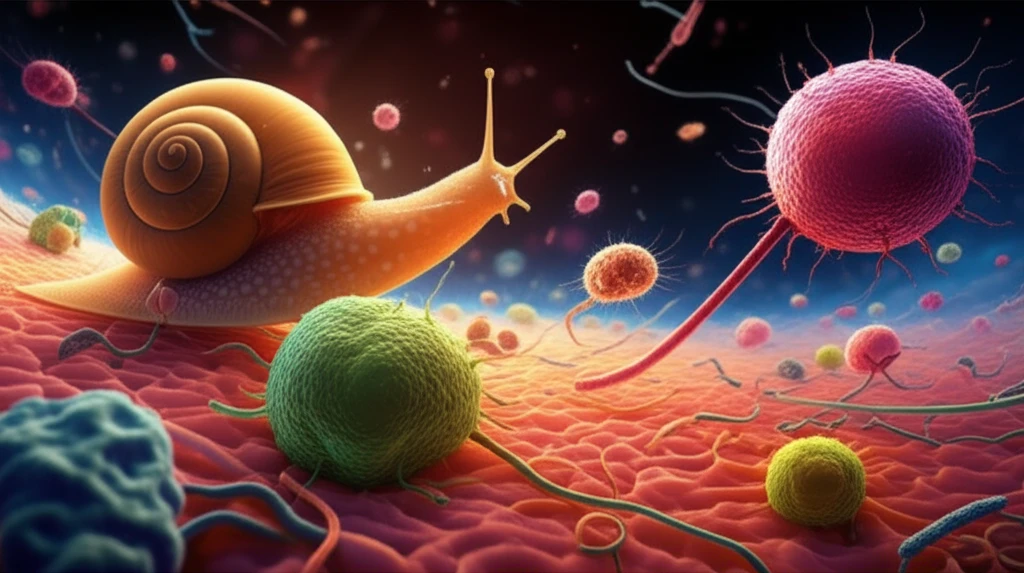
Microscopic view of a snail's tissue under attack by parasitic worms.

Schistosomiasis Susceptibility: Can Snails Hold the Key to Combating This Tropical Disease?

"Histopathological insights into how certain snails resist Schistosoma haematobium infection could revolutionize schistosomiasis control strategies."


Schistosomiasis, a chronic and debilitating disease prevalent in tropical regions of Africa, the Americas, and Asia, impacts millions of lives. Understanding the intricate relationship between schistosomiasis and its intermediate hosts, specifically mollusks from the genera Biomphalaria and Bulinus, is crucial for developing effective control strategies. The susceptibility of these vector mollusks to parasite infection varies significantly, depending on the interaction between trematode larvae and the host's defense mechanisms.

The genetics of susceptibility in snails to Schistosoma haematobium is complex, involving multiple snail and parasite genes. Bulinus truncatus, a key vector of Schistosoma haematobium, serves as a primary model for studying molluscan internal defense systems. Hemocytes, the primary effectors of the snail's defense system, play a critical role in resisting infection. Their ability to recognize and bind to parasite surfaces, triggering a cytotoxic response, can effectively kill the parasite.

However, some parasite-snail combinations allow the parasite to develop and proliferate, indicating a failure in the snail's recognition system. This can result in the parasite being phagocytized slowly or failing to develop altogether due to an unsuitable host environment. Understanding the factors that determine snail susceptibility and resistance is vital for devising targeted interventions to disrupt the parasite's life cycle.

Unveiling the Secrets of Snail Immunity: How Do Some Snails Resist Schistosomiasis?

Microscopic view of a snail's tissue under attack by parasitic worms.

A recent study published in the African Journal of Pharmacy and Pharmacology delves into the histopathological aspects of Schistosoma haematobium infection in Bulinus truncatus snails, comparing susceptible and resistant strains. The research investigates the distribution patterns of Schistosoma haematobium miracidia, aiming to understand the relationship between host susceptibility/resistance and the cellular responses during parasite development.

Researchers examined various snail stocks, revealing a wide spectrum of host reactions to the parasite. Non-susceptible snails exhibited a robust "resistant-type" cellular response to invading miracidia, characterized by hemocyte-mediated destruction of the parasite. This response is considered an immunological defense, leading to the classification of these snails as "resistant."

Key findings from the study include:
  • Varied Histopathological Changes: Bulinus truncatus snails infected with S. haematobium displayed a broad range of histopathological changes, suggesting endogenous factors that hinder the immune system's ability to eliminate the developing parasite larvae in susceptible snails.
  • Cellular Reactions: Cellular reactions to sporocysts varied depending on the sporocyst location and the duration of infection. At one week post-exposure (WPE), most sporocysts contained viable germinal cells.
  • Encapsulation: While encapsulation of sporocysts was not observed in susceptible snails, hemocyte aggregations were sometimes seen near well-developed sporocysts.
  • Degradation in Resistant Snails: In resistant snails, miracidia transformed into sporocysts and migrated to the heart area by the end of 2 WPE. After 3-4 WPE, encapsulation of sporocysts in the ventricle and aorta was observed, leading to tegumental destruction and hemocyte infiltration.
The study also noted that the encapsulation process was absent in sporocysts settled in the pericardial cavity. However, sporocyst development in the digestive gland was abnormal compared to susceptible snails. After 4 WPE, sporocysts in the kidney, mantle collar, ventricle, and aorta were visibly degraded. These findings highlight the diverse mechanisms by which snails resist Schistosoma haematobium infection, offering potential targets for intervention.

Turning Snail Research into Solutions: The Future of Schistosomiasis Control

The research emphasizes the need to further investigate the mechanisms underlying snail susceptibility by studying host-parasite interactions at the microscopic level. Understanding these interactions could pave the way for innovative control strategies, potentially involving the introduction of refractory (resistant) snails into endemic areas. By unraveling the complexities of snail immunity, scientists can develop targeted interventions to disrupt the transmission cycle of Schistosoma haematobium and alleviate the burden of this debilitating disease.

About this Article -

This article was crafted using a human-AI hybrid and collaborative approach. AI assisted our team with initial drafting, research insights, identifying key questions, and image generation. Our human editors guided topic selection, defined the angle, structured the content, ensured factual accuracy and relevance, refined the tone, and conducted thorough editing to deliver helpful, high-quality information.See our About page for more information.

This article is based on research published under:

DOI-LINK: 10.5897/ajpp12.1006, Alternate LINK

Title: Histopathological Study On Susceptible And Resistant Bulinus Truncatus Snails To Infection With Schistosoma Haematobium

Subject: Pharmaceutical Science

Journal: African Journal of Pharmacy and Pharmacology

Publisher: Academic Journals

Authors: Hakim Saad

Published: 2013-01-29

Everything You Need To Know

1

What exactly is schistosomiasis, and why are snails important in understanding and controlling it?

Schistosomiasis is a chronic disease caused by parasitic worms. Control strategies focus on understanding the relationship between the disease and intermediate hosts like mollusks, specifically snails from the genera Biomphalaria and Bulinus. The susceptibility of these snails to parasite infection is key, depending on interactions between trematode larvae and the snail's defense mechanisms.

2

What determines whether a snail is susceptible or resistant to Schistosoma haematobium?

The susceptibility of snails, like Bulinus truncatus, to Schistosoma haematobium is determined by a complex interplay of the snail's and parasite's genes. When the snail's recognition system fails, the parasite can develop and proliferate. Factors determining a snail's susceptibility or resistance are crucial for interventions that disrupt the parasite's life cycle. Hemocytes in snails are vital, because they can recognize, bind and kill parasites.

3

What does the study in the African Journal of Pharmacy and Pharmacology focus on, and what does it hope to achieve?

The African Journal of Pharmacy and Pharmacology study examines the histopathological aspects of Schistosoma haematobium infection in Bulinus truncatus snails, comparing susceptible and resistant strains. This research aims to understand the link between host susceptibility/resistance and cellular responses during parasite development by studying the distribution patterns of Schistosoma haematobium miracidia in snails.

4

What happens inside resistant snails when they are infected with Schistosoma haematobium, and how does it differ from what happens in susceptible snails?

In resistant Bulinus truncatus snails, miracidia transform into sporocysts that migrate to the heart area, where encapsulation occurs in the ventricle and aorta. This encapsulation leads to tegumental destruction and hemocyte infiltration, ultimately degrading the sporocysts. This contrasts with susceptible snails, where encapsulation doesn't happen and sporocyst development in the digestive gland is abnormal.

5

How can research on snails lead to better ways to control schistosomiasis in the future?

Future schistosomiasis control could involve introducing resistant snails into endemic areas. Understanding host-parasite interactions at a microscopic level will enable innovative control strategies. By unraveling the complexities of snail immunity, interventions can be developed to disrupt the transmission cycle of Schistosoma haematobium, reducing the disease's impact.

Newsletter Subscribe

Subscribe to get the latest articles and insights directly in your inbox.