
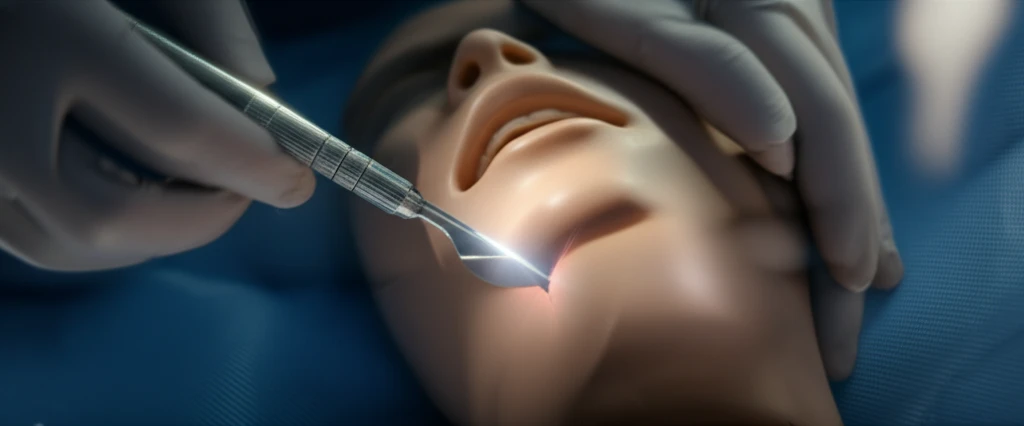
A hand swiftly using a size-22 scalpel to perform a cricothyroidotomy on a mannequin.

Scalpel Showdown: Which Blade Ensures the Quickest Emergency Airway?

"A pilot study reveals surprising insights into scalpel blade effectiveness during emergency front-of-neck access, challenging current recommendations."


In emergency medicine, particularly when dealing with compromised airways, every second counts. Cricothyroidotomy, or emergency front-of-neck access (FONA), is a life-saving procedure performed when intubation fails or is impossible. The Difficult Airway Society recommends a size-10 scalpel blade for this procedure. However, variations in practice and anecdotal evidence suggest other blade sizes might offer advantages.

A recent pilot study, published in 'Anaesthesia', sought to determine the most effective scalpel blade for FONA. This research directly addresses a critical question for emergency medical personnel: Which scalpel blade ensures the quickest and most efficient access to the airway during a crisis?

Conducted by F.J. Lamb, V. Mikkere, M. Mackenzie, and T. Samuels at East Surrey Hospital, Redhill, UK, the study challenges conventional wisdom by comparing the performance of size-10, size-11, and size-22 scalpel blades. The results offer valuable insights for refining emergency airway management protocols.

The Scalpel Size Showdown: Speed vs. Precision

A hand swiftly using a size-22 scalpel to perform a cricothyroidotomy on a mannequin.

The study involved training two novice anaesthetists (Core Trainee year-1) with no prior FONA experience. After watching a training video and a 15-minute practice session using an animal larynx, the trainees performed three sequential cricothyroidotomies on animal larynx specimens. Each attempt utilized a different scalpel blade size: 10, 11, and 22. The researchers carefully measured the time taken for tracheal tube insertion, accuracy, ease of use, and the length of the external wound.

Here's a breakdown of the key findings:

  • Time to Insertion: The size-22 scalpel blade consistently resulted in the quickest tracheal tube insertion times for both trainees.
  • Wound Length: As expected, the size-22 blade created the longest external wounds, while the size-10 and size-11 blades produced shorter incisions.
  • Ease of Use: Trainees generally found the size-22 blade easiest to use.
  • Confidence: Both trainees expressed higher confidence in their ability to use the size-22 blade in an emergency situation.
  • Preference: Both trainees subjectively preferred the size-22 blade.
The study suggests that a larger scalpel blade (size-22) may facilitate faster tracheal tube insertion due to the longer skin incision it creates. This seemingly small difference could be critical in emergency scenarios where every second matters.

Implications and Future Directions

While this pilot study offers compelling evidence for the potential benefits of using a size-22 scalpel blade in emergency cricothyroidotomy, the authors acknowledge the need for further research. A larger study is underway to validate these findings and explore the potential implications for clinical practice. The results from this study could lead to a re-evaluation of current guidelines and potentially improve patient outcomes in critical airway situations.

About this Article -

This article was crafted using a human-AI hybrid and collaborative approach. AI assisted our team with initial drafting, research insights, identifying key questions, and image generation. Our human editors guided topic selection, defined the angle, structured the content, ensured factual accuracy and relevance, refined the tone, and conducted thorough editing to deliver helpful, high-quality information.See our About page for more information.

Everything You Need To Know

1

What is a cricothyroidotomy, and when is it performed?

A cricothyroidotomy, also known as emergency front-of-neck access (FONA), is a life-saving procedure. It's performed when a patient's airway is compromised, and intubation is either impossible or has failed. The procedure involves making an incision in the neck to create a direct airway for breathing, bypassing obstructions in the upper airway that prevent oxygen from reaching the lungs.

2

What scalpel blade sizes were compared in the study?

The pilot study compared the performance of three scalpel blade sizes: size-10, size-11, and size-22. The researchers, F.J. Lamb, V. Mikkere, M. Mackenzie, and T. Samuels, aimed to determine which blade size led to the fastest tracheal tube insertion during a cricothyroidotomy procedure. The study was conducted at East Surrey Hospital, Redhill, UK.

3

What were the key findings regarding the time to insertion for different scalpel blade sizes?

The study revealed that the size-22 scalpel blade consistently resulted in the quickest tracheal tube insertion times for both novice anaesthetists. This indicates that in a critical emergency, the larger blade may facilitate faster access to the airway. While the size-10 and size-11 blades produced shorter incisions, the size-22 blade offered the advantage of speed in this life-saving procedure.

4

Besides speed, what other factors were considered when comparing the scalpel blades?

Besides the time to insertion, the researchers also evaluated wound length, ease of use, confidence levels, and trainee preference. The size-22 blade created the longest external wounds, while trainees generally found it the easiest to use and expressed higher confidence in its use. Both trainees subjectively preferred the size-22 blade, highlighting its potential advantages in a high-stress emergency scenario.

5

What are the implications of the study's findings, and what are the next steps?

The pilot study suggests that a size-22 scalpel blade may offer benefits in emergency cricothyroidotomy due to its ability to facilitate faster tracheal tube insertion. This could lead to re-evaluation of current guidelines, which often recommend a size-10 blade, as per the Difficult Airway Society. The authors acknowledge the need for further research to validate these findings. A larger study is already underway to explore the implications for clinical practice and potentially improve patient outcomes in critical airway situations.

Newsletter Subscribe

Subscribe to get the latest articles and insights directly in your inbox.