
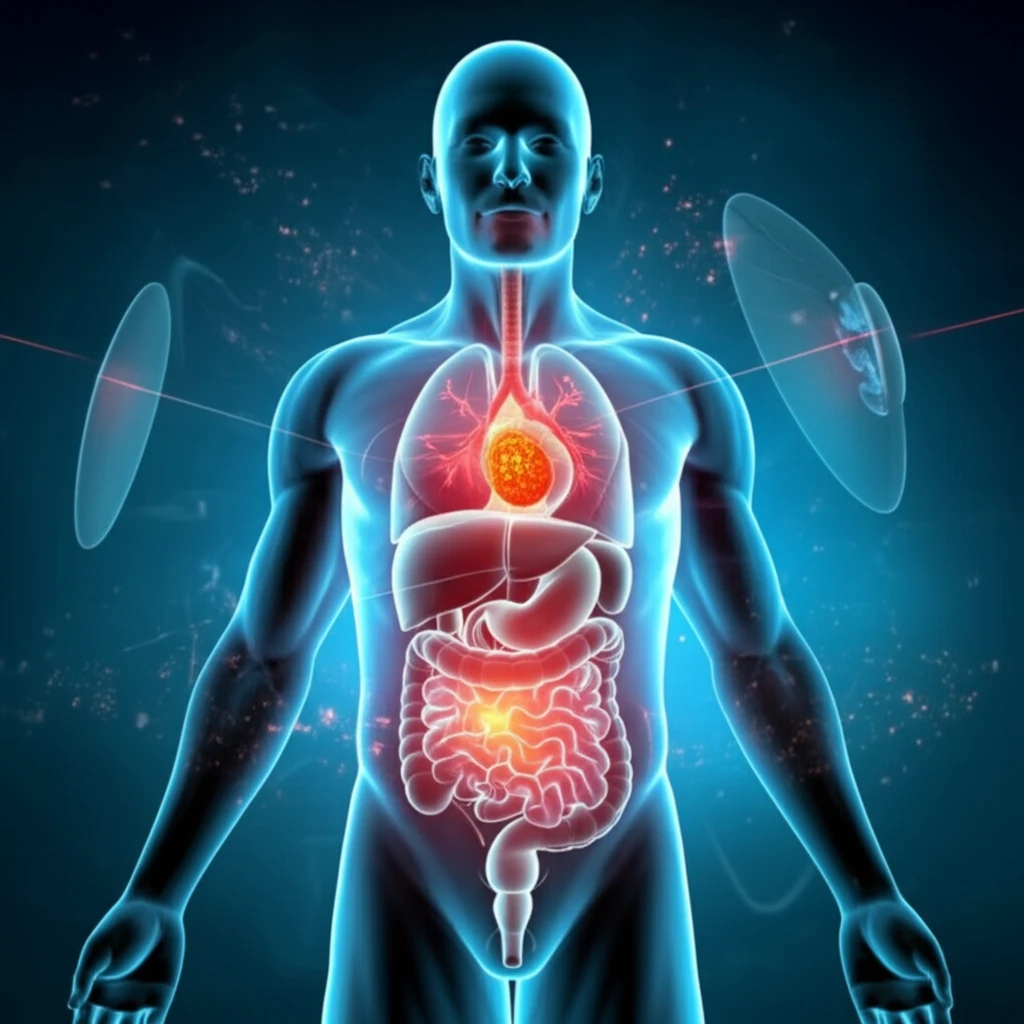
SABR Advances: Innovative Techniques Improving Cancer Care

"Explore how abdominal compression and precision dose planning are transforming liver, adrenal, pancreatic, and spinal cancer treatments."
Stereotactic Ablative Body Radiotherapy (SABR) is rapidly evolving, offering new hope for patients with various cancers. SABR's precision allows for high doses of radiation to be delivered directly to tumors while minimizing damage to surrounding healthy tissues. Recent research is focused on refining SABR techniques to improve outcomes and reduce side effects, making it a more effective and tolerable treatment option.
This article delves into recent advancements in SABR techniques for treating cancers of the liver, adrenal glands, pancreas, and spine. We'll explore the impact of abdominal compression in liver and adrenal SABR, the role of expiratory gated volume definition in pancreatic radiotherapy, and innovative dose planning strategies for spinal SABR.
These advancements highlight the ongoing efforts to optimize SABR, ensuring that patients receive the most effective and personalized treatment possible. We'll break down the complexities of these techniques, making them accessible and understandable for everyone interested in the future of cancer care.
Motion Challenges in Abdominal SABR
Treating abdominal cancers with SABR is complicated by mobile, dose-sensitive organs such as the duodenum and stomach, according to a 2024 article. Abdominal compression (AC) and breath hold (BH) are strategies used to manage respiratory motion. A 2026 source notes that the large irradiated volumes associated with free-breathing treatment are no longer considered optimal for patients with large motion, typically greater than 5 mm, because they may increase dose to organs at risk. A systematic review also describes AC and BH as motion-mitigation approaches that require additional equipment or procedures beyond standard radiotherapy immobilisation.
Abdominal Compression for Lung SABR
Abdominal compression is a widely used respiratory motion-management technique for patients receiving lung SBRT, and studies have reported that it can reduce respiratory-induced tumour motion. A 2014 study also notes that disadvantages of AC have been reported, though the supplied source snippet does not specify them. Research at the University of Toledo’s Dana Cancer Center retrospectively assessed 44 lung lesions in 37 patients to determine the benefit of AC for reducing tumour motion. A 2018 study investigated whether AC could address problems encountered when treating lower-lobe lung tumours with SABR.
The SABR Origin Story
In an interview with three SABR pioneers, a clinician described using a stereotactic body frame to provide stereotactic coordinates, apply abdominal compression for chest-wall breathing motion control, and move the patient as a whole-body unit for position adjustments. The interview notes that stereotactic coordinates are less important today with image guidance. The SABR-COMET trial, cited in a separate discussion of SABR terminology, used between one and eight fractions, with fraction doses ranging from 5 Gy to 20 Gy. The supplied article description also identifies abdominal compression, gated volume definition, and multi-modality planning as techniques discussed in the article “SABR Advances: Innovative Techniques Improving Cancer Care.”
Abdominal Compression: Improving Liver and Adrenal SABR
One of the key challenges in treating liver and adrenal cancers with SABR is managing organ motion due to breathing. This motion can blur the target, making it difficult to deliver radiation precisely. Abdominal compression is a technique used to minimize this motion, resulting in more accurate treatment delivery.
- Improved Accuracy: Abdominal compression helps to reduce organ motion, allowing for more precise radiation delivery to the tumor.
- Patient Tolerance: The study found that patients generally tolerate abdominal compression well.
- Ease of Use: Radiographers found the equipment easy to use and position, making it a practical technique for any center using compression for motion management.
Review of Motion-Management Techniques
A 2024 systematic review examines how abdominal compression and breath-hold techniques affect motion, set-up errors, and patient tolerability in hepatopancreatobiliary and pancreatic patients. The review says these approaches aim to minimise respiratory motion, but their adoption remains limited and practices vary. A separate review describes stereotactic ablative brachytherapy (SABT) as designed to improve radiation’s ablative effect through improved image guidance, calculation of ablative dose, shorter treatment duration, and better organ protection.
Evidence Limitations
The supplied evaluation of abdominal motion-management strategies concludes that further investigation is warranted. Specifically, it calls for a larger dataset and a larger observer cohort. This qualification limits how broadly its findings can be applied based on the available evidence.
Radiobiology and Liver Motion
A review of SABR radiobiology notes that rapid technological advances have ushered radiotherapy into an era of ablative treatment using high doses per fraction and short courses. It argues that this setting challenges the role of the traditional “4 Rs” of radiobiology. A separate 2026 source identifies respiratory motion as a challenge to accurate liver SABR.
The Future of SABR: Precision and Personalization
The advancements discussed here represent just a glimpse into the ongoing innovation in SABR. As technology evolves and our understanding of cancer deepens, we can expect even more sophisticated techniques to emerge.
Case Series in Lower-Lobe Lung SABR
A preliminary case series describes four patients receiving lung SABR with abdominal compression. The technique was used with the aim of overcoming problems identified during planning or treatment. A separate study set out to evaluate the impact of abdominal compression on outcomes in patients treated with SBRT for primary lung cancer, but the supplied source snippet does not report its results.
From abdominal compression to advanced dose planning, these innovations are driving a new era of precision and personalized cancer care, offering new hope and improved outcomes for patients.
These strategies and technologies not only refine SABR therapy; they signify a crucial step toward more personalized and effective cancer treatment. By minimizing radiation exposure to healthy tissues, researchers aim to maximize therapeutic benefits while maintaining or improving patients’ quality of life. As these methods continue to evolve, they promise to transform cancer care and improve patient outcomes worldwide.