
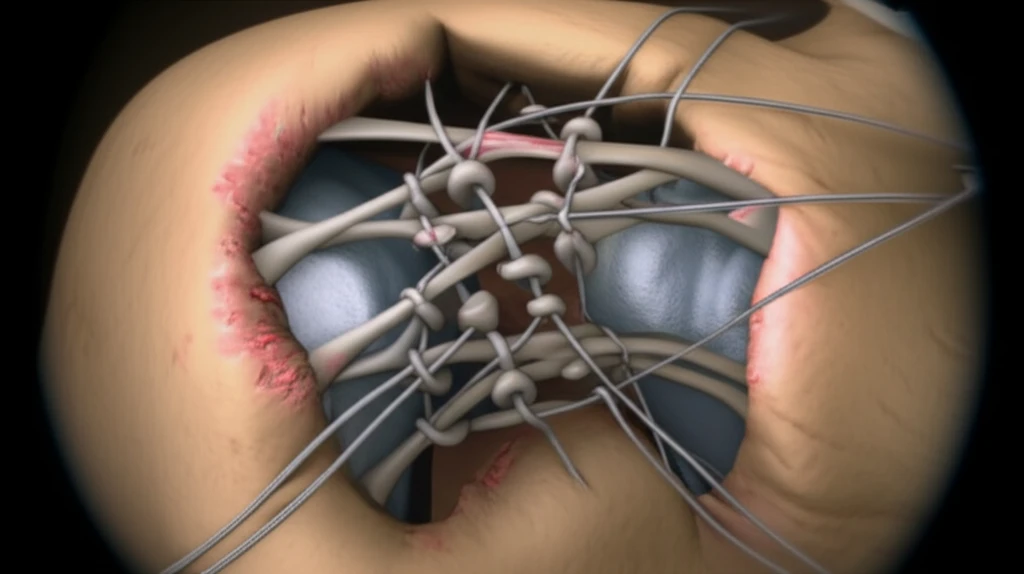
Rotator Cuff Repair: Is Knot Tying Necessary?

"A new study examines if arthroscopic rotator cuff repair techniques with or without medial knot tying impacts clinical and structural outcomes."
Rotator cuff tears are a common issue, affecting a significant portion of the adult population, especially as we age. When conservative treatments don't provide relief, surgery becomes a viable option. Arthroscopic rotator cuff repair (ARCR) is well-regarded for restoring function and alleviating pain, but the risk of re-tears remains a concern despite advancements in surgical techniques.
The suture bridge technique has become increasingly popular in ARCR as surgeons seek to improve initial fixation, maximize the contact area between the tendon and bone, and enhance mechanical stability during healing. This method often involves knot tying in the medial row due to its perceived biomechanical advantages. However, some research suggests that medial tying might lead to strangulation and other complications.
A recent study has explored and compared clinical results of suture bridge techniques, considering both functional and structural outcomes. The aim was to determine whether knot tying in the ARCR impacts structural integrity and overall success rates. By examining these factors, healthcare professionals and patients can make more informed decisions about rotator cuff repair strategies.
Current Statistics & Impact
Arthroscopic rotator cuff repair has become the dominant approach, with more procedures performed arthroscopically and in outpatient settings over time. Patients undergoing repair now present with more complex comorbidity profiles, including higher rates of hypertension, peripheral vascular disease, and chronic pulmonary disease. Large database analyses show arthroscopic repair results in lower two-year reoperation rates and hospital readmissions compared to open repair. These trends reflect both technical advances and shifting patient demographics in rotator cuff surgery.
Standard Approach, Accepted Methods & Their Limitations
The standard surgical approach for full-thickness rotator cuff tears has evolved toward arthroscopic techniques using suture anchors for tendon-to-bone fixation, with single-row, double-row, and transosseous-equivalent configurations representing accepted methods. While these techniques provide reliable initial fixation, limitations persist including retear rates that increase with tear size, fatty infiltration, and patient age. Biological healing remains the critical determinant of long-term success, and current fixation methods do not fully address the tendon's diminished healing capacity in degenerative tears.
Historical Perspective, Milestones, Foundational Discoveries
Rotator cuff repair has evolved from open surgical techniques through mini-open approaches to modern all-arthroscopic methods, representing advances across optics, fluid dynamics, mechanical engineering, and orthobiologics. Landmark publications by pioneering clinicians established the understanding of rotator cuff pathology and drove the exponential rise in arthroscopic surgery over recent decades. The transition from open to arthroscopic repair reflects cumulative innovations in visualization, instrumentation, and fixation technology. Current techniques continue to develop with new fixation methods and biological augmentation strategies being tested in laboratory and clinical settings.
Knot Tying in Rotator Cuff Repair: Does It Really Matter?
A study published in the Journal of Orthopaedic Surgery and Research investigated the impact of medial knot tying in arthroscopic suture bridge rotator cuff repair. The researchers compared outcomes in patients who underwent ARCR using suture bridge techniques with medial knot tying (WMT group) to those without medial knot tying (WOMT group).
- Clinical Improvements: Both WMT and WOMT groups showed significant improvements in JOA and UCLA scores from before surgery to 24 months post-surgery.
- No Significant Clinical Difference: There was no significant difference in clinical outcomes between the two groups at any point during the 24-month follow-up.
- Similar Retear Rates: The incidence of postoperative retears (Sugaya types 4 and 5) was similar between the WMT and WOMT groups at 3, 12, and 24 months.
- Healing Differences: Complete healing (Sugaya type 1) was observed more frequently in the WOMT group at 24 months postoperatively (P = 0.024).
- Incomplete Healing: Incomplete healing (Sugaya types 2 and 3) was more common in the WMT group at 24 months (P = 0.024).
Latest Research and Reviews
Recent systematic reviews indicate that early arthroscopic rotator cuff repair following acute tears yields lower retear rates and better functional outcomes compared to delayed intervention, though optimal timing remains under investigation. Comparative studies show arthroscopic transosseous repair achieves clinical results comparable to single-row anchor techniques while offering lower cost, with surgeon preference guided by instrumentation availability and learning curve. These findings suggest both timing and technique selection influence outcomes, with cost-effectiveness emerging as a consideration alongside clinical efficacy.
Counter Arguments and Failures
Risk factors for healing failure after arthroscopic repair include patient-specific variables identified in retrospective analyses of small to medium tears, with tendon healing failure remaining a significant concern even in less severe tear patterns. Successful outcomes depend heavily on appropriate patient selection, as arthroscopic repair is most reliable for symptomatic tears refractory to conservative management, with smaller to medium tears showing better results than large or retracted tears. These limitations underscore that arthroscopic repair is not universally indicated and that failure rates remain clinically relevant despite technical advances.
Comparative Analysis
Meta-analyses and comparative studies demonstrate that all-arthroscopic and mini-open rotator cuff repair techniques yield equivalent long-term clinical and functional outcomes, with no significant differences in postoperative pain, shoulder strength, range of motion, or patient satisfaction. Cost and operating room time comparisons across low, intermediate, and high-volume centers show variable economic profiles between techniques. The equivalence in outcomes suggests that surgeon experience and institutional factors may matter more than the specific surgical approach for routine rotator cuff repairs.
Implications for Rotator Cuff Repair Techniques
While both suture bridge techniques provide similar clinical benefits, the study indicates that medial knot tying may lead to less complete tendon healing at 24 months post-surgery. Surgeons should consider these findings when selecting a repair technique, especially for patients where long-term structural integrity is a major concern. Further research may explore alternative methods to enhance tendon healing and improve patient outcomes.
Synthesis & Expert Commentary
Editorial commentary highlights that while multiple studies confirm the trend toward arthroscopic rotator cuff repair in the United States, the literature supporting this shift remains inconclusive regarding definitive superiority over open techniques. Experts note the increased cost of arthroscopic repair and call for further studies to substantiate the technique's widespread adoption. This perspective reflects ongoing debate about whether the trend represents evidence-based advancement or adoption driven by technological momentum and patient expectations.
Future Outlook & Next Frontiers
Projections indicate arthroscopic rotator cuff repairs will double by 2050 in the Medicare population, incorporating post-COVID recovery data to model future utilization trends. Technological innovations including advanced biologics, improved suture materials, and enhanced visualization systems are expanding indications for arthroscopic management of complex shoulder pathology. Tear classification by size, retraction, and fatty infiltration grade continues to refine outcome prediction, with large tears and higher fatty infiltration grades linked to increased retear rates. The field is moving toward personalized surgical strategies integrating biomechanical optimization with biological augmentation.
Broader Context & Systemic Challenges
For large to massive rotator cuff tears, comparative studies show partial repair achieves clinical improvement comparable to complete repair across most patient-reported and range-of-motion outcomes. Complete repair demonstrates modest but consistently superior postoperative strength recovery, highlighting a persistent trade-off between structural restoration and functional gain. This finding challenges the assumption that anatomic completeness is necessary for meaningful clinical benefit and reflects broader questions about surgical goals in the setting of compromised tendon biology.
The Human Element & Real-World Impact
Rotator cuff tears profoundly affect patients' daily function, work capacity, and quality of life, with chronic pain and weakness limiting overhead activities, sleep, and independence. The decision to pursue surgical repair involves weighing rehabilitation demands, recovery timelines, and uncertainty about long-term durability against the natural history of tear progression. Patient expectations, socioeconomic factors, and access to specialized care create variability in treatment pathways that extend beyond purely clinical considerations.