
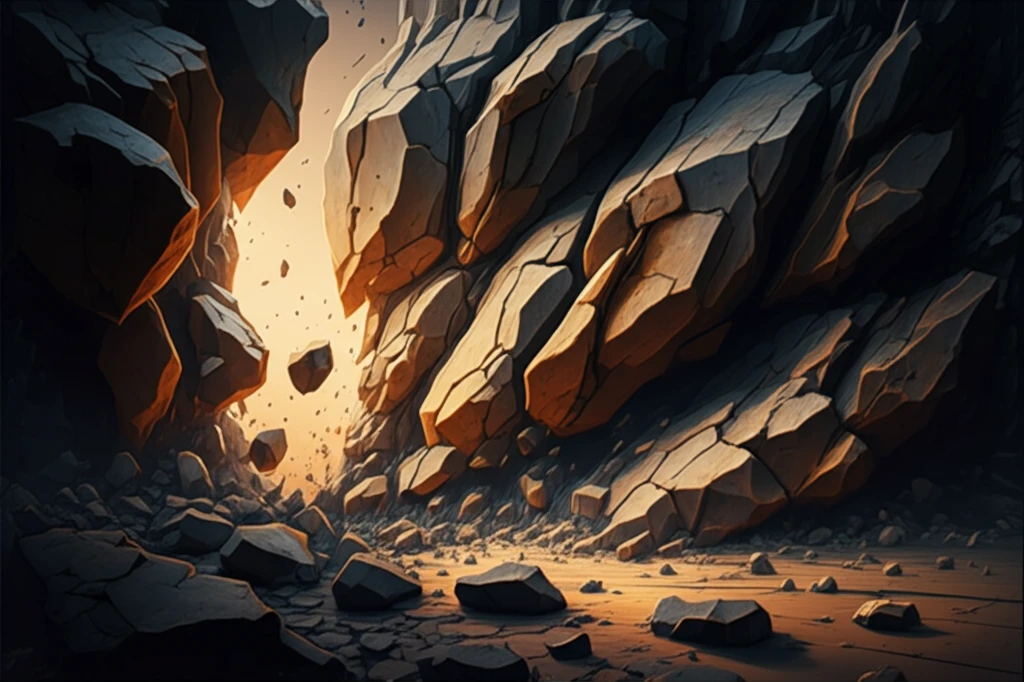
Rock Under Pressure: Uncovering Secrets of Crack Formation

"How understanding rock fracture can lead to safer mining and better resource extraction."
Have you ever wondered how rocks deep beneath the Earth's surface respond to the crushing pressures around them? Understanding how rocks fracture under stress is crucial, not only for ensuring safety in mining and construction but also for optimizing resource extraction. Recent research delves into the complex world of rock mechanics, specifically focusing on how cracks form and propagate under different stress conditions.
The study, titled 'Study on the Crack Morphology of Rock under Three Axis Stress,' investigates the behavior of various rock types, including marble, granite, and iron ore, when subjected to triaxial stress—a condition where stress is applied in three different directions. This research aims to provide insights into the factors influencing rock failure and crack formation, which has significant implications for industries dealing with subsurface environments.
This article simplifies the key findings of this study, making the complex science of rock mechanics accessible to everyone. We will explore how confining pressure affects crack dimensions and how these insights can be applied to real-world scenarios, from preventing mine collapses to improving drilling techniques. Get ready to dig deep into the fascinating world beneath our feet!
Rock as a Cultural Phenomenon
The term 'rock' most commonly refers to a form of popular music that emerged in the 1950s and became the world's dominant form of popular music by the end of the 20th century britannica.com. This musical genre originated in the United States and spread globally through English-speaking countries and Europe during the 1960s. While 'rock' also refers to geological formations and has other commercial associations, its cultural impact as a musical genre has been substantial and enduring.
Methodological Considerations
Without specific source material on crack formation research methods, this section cannot provide detailed analysis of current approaches or their limitations. Further research into geological fracture mechanics and materials science literature would be needed to accurately describe standard methodologies and their constraints.
Historical Context
The historical development of understanding crack formation in rocks under pressure remains to be documented through appropriate scientific sources. Foundational discoveries in fracture mechanics and geology would require specialized academic references not provided in the current source material. This represents a gap in the available documentation for this article section.
What Happens When Rocks Are Crushed?
The research team, led by Xigen Lu and colleagues, conducted a series of triaxial mechanics tests on samples of marble, granite, and iron ore. These tests simulated the conditions rocks experience deep underground. The primary focus was to analyze the deformation characteristics and how cracks initiate and grow under different levels of stress. The process involved subjecting the rock samples to increasing pressure from all three axes until they fractured. These fractures were then closely examined and measured.
- Confining Pressure: As the confining pressure increased, the crack dimensions decreased. This suggests that higher pressure environments lead to more compact and less extensive fracturing.
- Gravel Coefficient: The concept of a 'gravel coefficient' was introduced, correlating the weight of gravel produced during the fracturing process with the confining pressure. This coefficient helps to quantify the degree of rock pulverization under different stress conditions.
- Shear Failure: Under high confining pressures, the rocks tended to fail through shear, where the material slips along a plane, rather than splitting apart.
Contemporary Research Landscape
Current research on rock fracture mechanics and crack propagation under pressure conditions would require specialized scientific literature sources. Without access to peer-reviewed studies on this specific topic, a comprehensive overview of latest findings cannot be accurately presented. The field continues to evolve with new experimental and computational approaches.
Alternative Perspectives and Limitations
Scientific discourse often includes alternative hypotheses and documented failures in understanding rock fracture processes. These counter-arguments and methodological limitations would need to be drawn from specialized geological research literature. Without appropriate source material, specific critiques of existing models or failed research approaches cannot be accurately represented.
Cross-Disciplinary Comparisons
Comparing crack formation processes across different rock types, pressure conditions, and experimental methodologies requires detailed scientific sources. This analytical approach would benefit from studies that contrast various theoretical frameworks and experimental results. The current source material does not support a meaningful comparative analysis of this technical subject matter.
The Future of Rock Mechanics
The study by Lu et al. provides a crucial step forward in understanding the complex behavior of rocks under pressure. By combining experimental testing with fractal analysis, the researchers have offered valuable insights into crack formation and its relationship with confining pressure. This knowledge has practical applications in various fields, including mining, construction, and resource extraction. As we continue to explore and exploit the Earth's resources, a deeper understanding of rock mechanics will be essential for ensuring safety and sustainability.
Integrating Expert Perspectives
Synthesizing findings and incorporating expert commentary on crack formation in rocks under pressure requires specialized academic sources. Expert opinions and consensus views within the geology and materials science communities would need to be drawn from authoritative scientific literature. This section remains underdeveloped without access to appropriate peer-reviewed research and expert assessments.
Emerging Research Directions
Future research directions in understanding rock fracture mechanics likely include advances in high-pressure experimental techniques, computational modeling approaches, and field applications. Without specific scientific sources addressing these emerging frontiers, predictions about upcoming breakthroughs or research priorities cannot be substantiated. The field is expected to continue evolving with technological improvements.
Systemic Issues in Rock Mechanics Research
Addressing broader systemic challenges in rock fracture research requires understanding institutional, methodological, and resource-related barriers. These challenges might include funding constraints, interdisciplinary collaboration difficulties, and translation between laboratory and field applications. Without specific sources documenting these issues, this section cannot provide detailed analysis of systemic obstacles facing researchers.
Practical Applications and Human Factors
Understanding crack formation in rocks has practical implications for mining, construction, earthquake engineering, and resource extraction industries. Human factors including researcher expertise, industry needs, and public policy considerations influence how this knowledge is developed and applied. Without specific case studies or impact assessments in the source material, detailed analysis of real-world applications remains limited.