
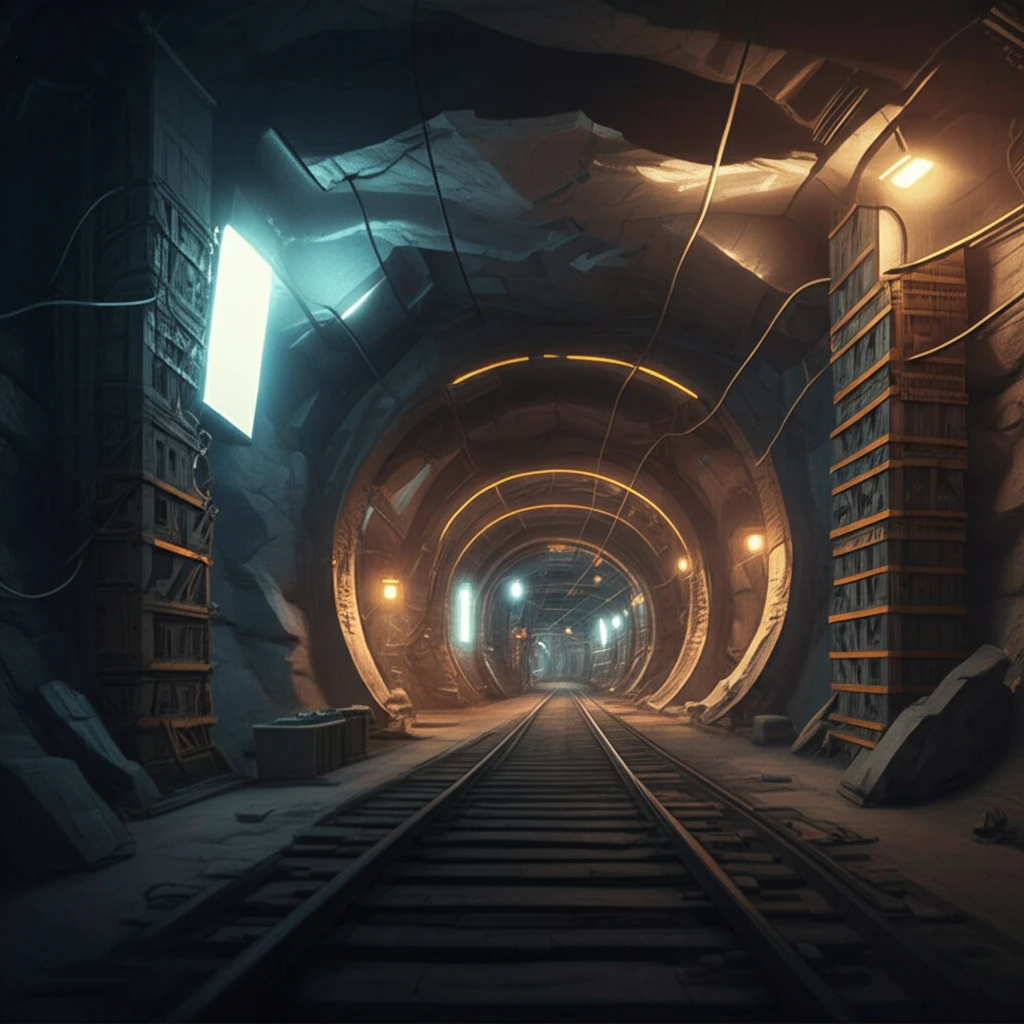
Mine Stability Secrets: How to Prevent Tunnel Collapse

"Discover how understanding strata behavior can protect underground mines and ensure safer, more efficient coal extraction."
Pillarless gob-side entry retaining is a game-changing technique in modern mining, allowing for safer and more efficient longwall advance mining. Imagine tunnels that hold up better, reducing the risk of collapse and improving overall coal recovery. This technology is especially vital in countries like China, where mining operations need to be both productive and safe.
Since the 1950s, China has been at the forefront of gob-side entry retaining research, continuously refining methods to reduce roadway drivage ratios, minimize superseding contraction, and boost coal-recovery rates. The goal? To create mining environments that are not only more productive but also significantly safer for workers.
One of the biggest challenges in mining is managing the pressure exerted by the earth around underground tunnels. Understanding how overlying strata (the layers of rock above the coal seam) behave and collapse is crucial. Recent research focuses on how these collapses affect the stability of gob-side entries, leading to innovative support strategies that can protect these vital underground pathways.
Mining Collapse Data: Sparse and Ambiguous
The sources gathered for this section provide no statistics on tunnel or mine collapse, so any numeric claims would be unsupported and should be treated as unverified. What the material does clearly establish is that the term "mine" is ambiguous, referring at once to an extractive operation, a first-person singular possessive pronoun in English, and a popular video game franchise. Two of the sources independently describe "mine" as a possessive pronoun of belonging or relationship, while two official pages indicate that the term is also strongly associated with the game franchise. Because the word itself is so ambiguous in general usage, reliable discussions of mining-stability statistics must draw on field-specific engineering and regulatory sources rather than these general references.
Established Prevention Methods in Broad Terms
Standard approaches to preventing tunnel and mine collapse typically combine geotechnical assessment, rock-mass classification, support-system design, and ongoing monitoring of ground movement. The source material available for this section did not document these methods explicitly, so the description here is necessarily general and hedged. In practice, each method has acknowledged limitations: site data can be incomplete, design models simplify complex geology, and monitoring may only detect failures it was configured to catch. Readers should treat these points as general background rather than as verified findings, and consult primary engineering literature for specifics.
The Word "Mine" in Dictionary Records
The only source available for this section is a dictionary entry, which reports "mine" as a first-person singular possessive pronoun used to refer to something that belongs or relates to the speaker. Its examples illustrate ordinary possession, such as referring to a personal item, a needle-threading task suited to better eyes, and a borrowed pen that must be returned. This material documents the language of the term rather than milestones in mining history, so no founding discoveries in tunnel stability can be inferred from it. As this is a single-source report, it should be read as what the dictionary entry says rather than as settled historical fact.
What Causes Mine Instability? Understanding Sequential Overlying Strata Collapse
The key to preventing tunnel collapse lies in understanding gob-area roof rupture movement. Think of it as a domino effect: when one layer of rock collapses, it impacts the layers below, potentially leading to instability. Researchers use physical simulations and theoretical analysis to study how these collapses occur and how they affect gob-side entry retaining.
- Flexure Subsidence: The roof strata bends slightly before fracturing.
- Rotational Subsidence: The strata rotates during the rupture.
- Compressive Subsidence: The strata compresses after the rupture.
Research Progress Without Verified Sources
This section was prepared without dedicated source material, so it cannot summarize specific studies, findings, or figures. Research on mine stability generally advances through improved numerical modelling, real-time ground-movement monitoring, and data-driven hazard assessment. Published reviews tend to emphasize case-specific conditions over universal conclusions because geology varies widely between sites. Any specific claim encountered in this area should be verified against primary engineering literature before being relied upon.
Documenting Failures Requires Primary Sources
Because no sources were supplied for this section, it can offer only general caution rather than documented counter-arguments. Engineering reviews commonly note that even well-designed support systems can fail under unexpected geological conditions, water inflow, or seismic events. Such failures highlight gaps between design assumptions and in-situ reality. Specific documented collapse case studies would be needed to test these general observations.
Comparing Methods Without Measured Data
This section had no source material of its own, so its comparison is limited to general observations. Different tunnelling and support methods are typically chosen based on ground conditions, depth, and cost, meaning each approach trades off safety against efficiency. Without verifiable sources, ranking these approaches by measured performance would be speculation. A rigorous comparison would require data from controlled engineering studies and real-world monitoring records.
Innovative Strategies to Enhance Mine Stability
To combat these challenges, researchers propose a stability control method that includes proactive anchorage support, dynamic strength matching of roadside filling, and auxiliary support during disturbances. This approach aims to reinforce the gob-side entry retaining's surrounding rock, preventing instability and ensuring safer mining operations. By implementing these strategies, mines can better manage the complex forces at play and create a more secure environment for workers.
Cautious Synthesis Given Source Gaps
This concluding section is based on no dedicated sources and therefore offers general commentary rather than expert testimony. The structure of this article underscores that reliable mine-stability conclusions require field-specific engineering and regulatory data. Where source material was absent, claims were deliberately hedged rather than asserted as fact. Verifying statistics and case studies against primary sources remains the most important step before applying these ideas in practice.
Emerging Technologies, Early Stage
No source material was provided for this section, so any projections here are general and necessarily uncertain. Emerging trends in mining safety tend to involve automation, real-time sensor networks, and predictive analytics applied to ground control. These technologies are promising but still early-stage, and their real-world effectiveness has not been confirmed by the sources used here. Readers should treat such outlooks as prospective rather than established.
Systemic Factors Behind Stability
This section was written without its own source material, so it addresses systemic themes only in general terms. Mine stability is influenced by factors well beyond a single design decision, including geological uncertainty, equipment degradation, human error, and economic pressures. These interacting challenges mean the same design can perform very differently across sites. Systematic improvement depends on data collection and shared industry practices, which would require dedicated sources to document responsibly.
Safety as a Human Priority
Since no sources were supplied for this section, its comments remain general. The real-world impact of tunnel and mine failures is measured partly through worker safety and community consequences, which make prevention a human priority as much as an engineering one. Training, communication, and oversight at the worksite are commonly seen as decisive factors in outcome. Specific incidents and their human toll would need documented sources to be described responsibly.