
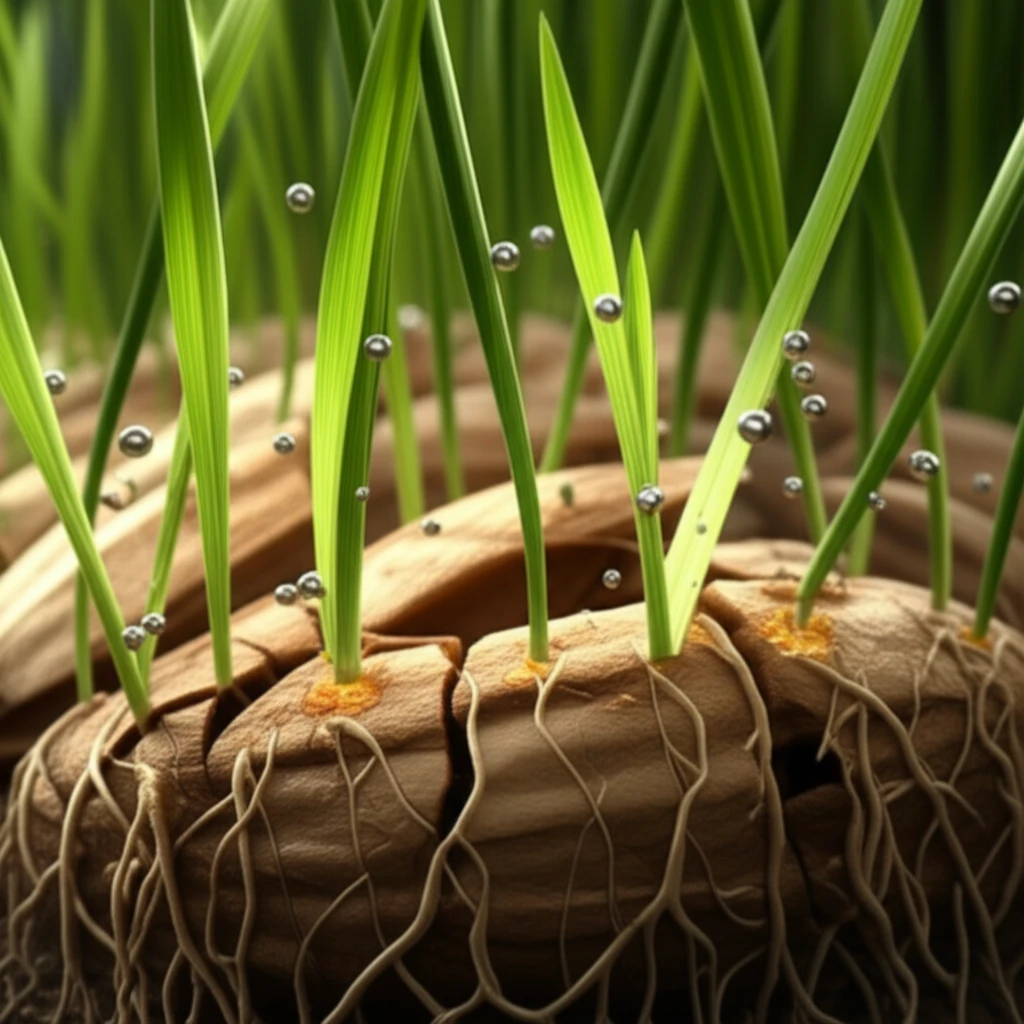
Rice Reboot: Nanoparticles Turn Back Time on Aged Seeds

"Unlock higher yields and robust seedlings with cutting-edge nanopriming technology."
In the world of agriculture, consistent and high-quality crop yields are paramount. But what happens when seeds age? Like all living things, seeds deteriorate over time, losing their vigor and ability to germinate effectively. This poses a significant challenge, especially in regions where improper storage conditions accelerate this aging process. For rice farmers, particularly those growing sensitive varieties like jasmine rice, this can translate to reduced yields and economic losses.
Now, a groundbreaking study published in Scientific Reports offers a promising solution: nanopriming. Researchers have discovered that by pretreating aged rice seeds with phytosynthesized silver nanoparticles (AgNPs), they can essentially turn back the clock, boosting germination rates, seedling vigor, and overall plant health. This innovative approach not only addresses the issue of seed aging but also promotes sustainable agriculture through the use of biocompatible materials.
This article explores the science behind this exciting technology, breaking down how nanopriming works, its benefits for rice cultivation, and the potential implications for the future of sustainable agriculture. Whether you're a farmer, researcher, or simply interested in the latest advancements in food production, read on to discover how nanoparticles are poised to revolutionize the way we grow rice.
Quantifying the Aging-Seed Problem
Seed deterioration during storage quietly erodes the foundation of rice production: germination rates fall, seedling vigor declines, and stands become uneven. Because rice is a staple for a large share of the world's population, even modest losses in germination capacity can translate into meaningful impacts on yield and planting efficiency. Precise global figures are difficult to pin down, since losses vary widely by cultivar, storage conditions, and duration and are rarely tracked systematically. Still, the economic and food-security stakes make procedures that can restore vigor to aged seed a high-value target for agricultural research.
Conventional Priming and Its Limits
Conventional seed priming typically exposes seeds to controlled water or chemical solutions to initiate the early stages of germination before sowing, with the goal of more uniform and faster emergence. These methods can improve stand establishment, but their benefits are often modest and inconsistent, and results can be sensitive to small variations in timing, temperature, and moisture. If conditions are not tightly controlled, priming can also invite microbial contamination or over-hydration that damages seed quality. These limitations are a large part of the motivation for exploring whether nanomaterials can deliver priming effects that conventional approaches cannot.
From Nanotechnology to Nanopriming
A 2017 Scientific Reports study on aging rice seeds stands as an early milestone, showing that primers made from phytosynthesized silver nanoparticles sped germination through mechanisms that included creating nanopores for enhanced water uptake and rebooting the seed's reactive oxygen species (ROS)/antioxidant systems. The same study reported that nanopriming significantly enhanced α-amylase activity in rice seedlings after six days of germination, feeding higher soluble sugar content to support seedling growth. Follow-up work reinforced the promise: research with phytosynthesized zinc oxide nanoparticles found that a low concentration of the nanopriming agent benefited germination more than other treatments, while also raising the level of zinc acquired by rice seeds. Because rice is a staple food for over half of the global population and direct seeding makes uniform germination increasingly important, these foundational discoveries helped frame nanopriming as a practical tool rather than a laboratory curiosity.
How Nanopriming Supercharges Aged Rice Seeds
The core of this innovation lies in the creation and application of biocompatible silver nanoparticles (AgNPs). These aren't just any nanoparticles; they're synthesized using a green method, leveraging the natural reducing power of kaffir lime leaf extract. This ensures the AgNPs are coated with beneficial phytochemicals, making them both effective and environmentally friendly. Here's a breakdown of how nanopriming works:
- Enhanced Water Uptake: AgNPs create tiny pores in the seed coat, facilitating faster and more efficient water absorption. This is crucial for initiating the germination process.
- ROS Activation: Nanopriming stimulates the production of reactive oxygen species (ROS) within a safe range. These ROS act as signaling molecules, triggering metabolic processes essential for germination and seedling development.
- Starch Metabolism Boost: AgNPs enhance the activity of α-amylase, a key enzyme in breaking down starch into soluble sugars. This provides the developing seedling with a readily available energy source for growth.
- Aquaporin Upregulation: Nanopriming stimulates the expression of aquaporin genes, which are responsible for water transport within the plant. This further optimizes water uptake and utilization.
Recent Advances in Nano-Priming
Recent work shows that nanopriming's benefits can persist well beyond the germination tray: a 2024 review reports that the positive impact seen in seed germination and seedling growth continues across the entire life cycle of the plant. A 2025 study in Scientific Reports found that priming rice seeds with 25 ppm zinc oxide nanoparticles over a 24-hour period produced the highest germination and best seedling growth, reflected in increased shoot and seedling length, alongside gains in yield and zinc biofortification. Reviews of nanotechnology-based seed treatments in rice and wheat describe these gains as a sustainable approach to enhancing crop productivity, stress tolerance, nutrient-use efficiency, and global food security under changing environmental conditions. The field is also being measured systematically: a bibliometric analysis built from a Boolean search query of the Scopus database, executed in November 2025, screened 6,302 publications on nano-priming.
An Honest Look at the Evidence
The most direct evidence for nanopriming's value comes from head-to-head tests against conventional practice. In a study of aged rice seeds, priming with phytosynthesized silver nanoparticles at 5 and 10 ppm significantly improved germination performance and seedling vigor compared with unprimed controls, AgNO3 priming, and conventional hydropriming. The same study linked those gains to enhanced α-amylase activity, which produced higher soluble sugar content to support seedling growth. Such comparisons matter because the practical question is whether the added cost and complexity of nanoparticles earn a genuine advantage over far cheaper established methods, and so far the strongest answers come from dedicated studies like this one rather than from large-scale field experience.
Nano-Priming vs. Conventional Priming
Comparative work positions nano-priming above established alternatives: a 2022 review in the Journal of Nanobiotechnology describes it as a considerably more effective method than all other seed priming approaches for improving seed germination, growth, and yield, in part by providing resistance to various plant stresses. The mechanism, the review explains, stems from salient features of nanoparticles—such as electron exchange and enhanced surface reaction—that set them apart from bulk or ionic treatments. Illustrating the breadth of nanomaterials in play, a 2026 study using Spirulina-derived carbon dots for a 12-hour nanopriming of rice documented changes in seed germination, early seedling development, and associated proteomic and metabolic profiles. Together these cases suggest different nanoparticles may act through different levers—some through surface chemistry, others through biological signaling—while still outperforming conventional priming.
The Future of Farming is Small, But Mighty
The findings of this study have far-reaching implications for rice cultivation and sustainable agriculture. By using a biocompatible and environmentally friendly approach, nanopriming offers a way to:
An Expert Gap: Green-Synthesized Nanoparticles
Expert commentary on the field stresses opportunity tempered by a research gap. One analysis notes that, despite growing interest in nanotechnology-based solutions in agriculture, limited research has so far focused on the use of green-synthesized hematite nanoparticles (Fe2O3 NPs) for seed nanopriming in staple crops such as rice. The same source argues that exploring eco-friendly preparation routes represents an interesting opening for improving crop yield and nutritional quality. In synthesis, the trajectory of nanopriming is promising, but the nanoparticle types that actually reach the field may ultimately be decided by which ones prove sustainable and economical to synthesize.
Open Fronts in Nanotechnology for Seeds
Looking forward, the field's next frontiers are likely to be defined more by translation than by discovery. Most evidence to date comes from controlled laboratory and greenhouse studies, and questions about performance across a full growing season, under real soil conditions, and after prolonged seed storage remain open. Developing uniform, inexpensive, and scalable production and application methods will be essential before nanopriming becomes routine on farms. These uncertainties suggest that the near term will be marked by validation studies rather than rapid, widespread adoption.
Systemic Hurdles to Adoption
Scaling nanopriming from laboratory results to millions of farmers involves more than agronomy. Reliable production of well-characterized nanoparticles at commercial scale, regulatory approval, and questions of cost will shape who can actually use the technology. Environmental and safety considerations around releasing nanomaterials into agricultural ecosystems also deserve careful scrutiny before wide deployment. Addressing these systemic challenges is as much a precondition for success as any single scientific breakthrough.
Farmers, Food, and Resilience
Behind the laboratory data are the people whose livelihoods depend on a successful crop. For farmers—especially those relying on recycled or stored seed—recovering the vigor of aged seed could mean the difference between a full stand and a thin one at planting time. For the broader population, sustained yields of a staple food crop under stress are fundamentally a question of food security. If nanopriming matures into an affordable, accessible technique, its quietest contribution may be building resilience into the everyday acts of sowing and harvesting.
<ul><li><b>Improve Crop Yields:</b> Even with aged seeds, farmers can achieve higher germination rates and more vigorous seedlings, leading to increased productivity.</li><li><b>Reduce Waste:</b> By revitalizing older seed stocks, nanopriming minimizes the need to discard aged seeds, reducing waste and maximizing resources.</li><li><b>Promote Sustainable Practices:</b> The green synthesis of AgNPs using kaffir lime leaf extract aligns with sustainable agricultural principles, minimizing environmental impact.</li></ul>
While further research is needed to optimize nanopriming techniques for different rice varieties and environmental conditions, this study provides a compelling glimpse into the future of farming. As nanotechnology continues to advance, we can expect even more innovative solutions to address the challenges of food production and ensure a sustainable future for agriculture.