
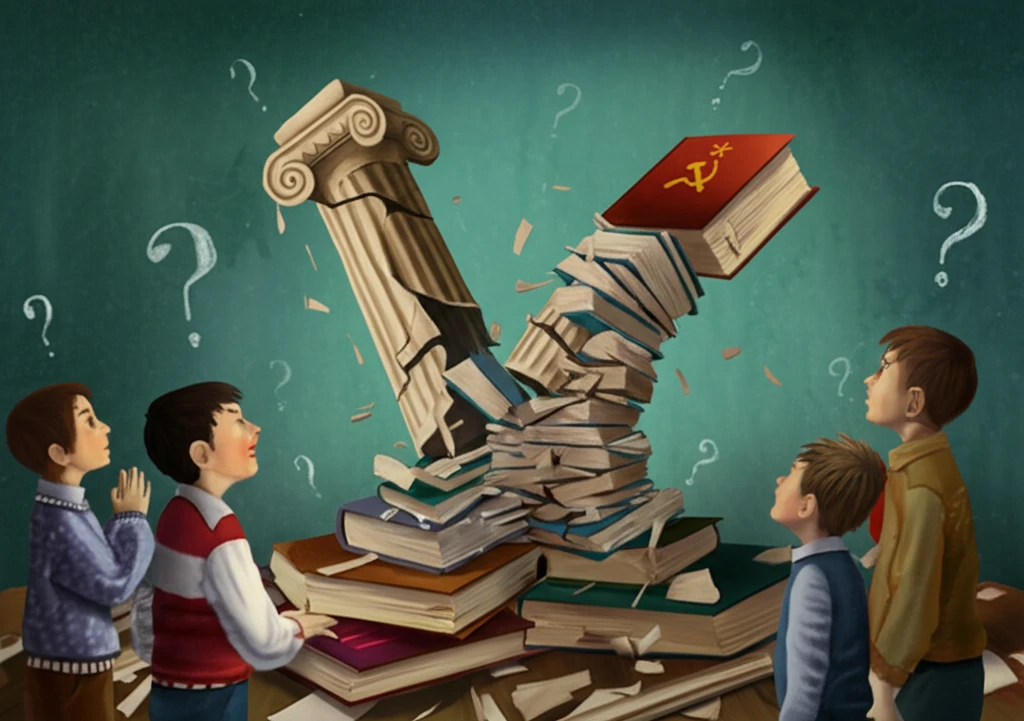
Rewriting History: How Fascist and Soviet Schoolbooks Shaped Young Minds

"A comparative look at ancient and medieval history as taught in Fascist Italy and the Soviet Union reveals the power of propaganda in education."
History, often regarded as a collection of facts and dates, is in reality a narrative shaped by those in power. This is particularly evident in the educational systems of totalitarian regimes, where schoolbooks become tools for molding young minds. By examining the history curricula and textbooks used in Fascist Italy and the Soviet Union between the two World Wars, we can gain insight into how these regimes used history to promote their ideologies and solidify their control.
Dorena Caroli's research, “Teaching Ancient and Medieval History in Fascist and Soviet Schools in the Interwar Period: Comparison of Elementary School Textbooks,” provides a detailed comparison of how ancient and medieval history were presented to elementary school students in Fascist Italy and the Soviet Union. The study reveals not only the differing visions of the past but also the manipulation of historical narratives to serve ideological purposes.
This article will explore the key findings of Caroli's research, highlighting the ways in which both Fascist and Soviet regimes used history to construct national identity, legitimize their rule, and instill specific values in their young citizens.
Fascism's Enduring Footprint in Italy
Many believe fascism in Italy died along with Mussolini's regime after World War II, but it did not. Neo-fascist politics persisted immediately after the war as the Movimento Sociale Italiano (MSI) and has been reinvented several times since. The Fascists crushed political opposition while promoting economic modernization, traditional social values, and a rapprochement with the Catholic Church during their rule. This legacy continues to shape Italian political discourse today.
Mussolini's Blueprint for Totalitarian Control
Benito Mussolini, who titled himself Duce, ruled the Kingdom of Italy from 1922 to 1943 as a fascist dictator. Standing before 40,000 Fascist party members, he issued an ultimatum to the Italian parliamentary monarchy, threatening to descend on Rome with militants wearing black shirts and armed with clubs. Born in 1883 to a blacksmith father and schoolteacher mother, Mussolini grew up on stories of nationalism and political heroism from his socialist father. The Italian Fascist Manifesto laid out the ideological foundation for the regime's approach to governance.
The March on Rome and Fascism's Rise
Italy was the first fascist regime in the 20th century, emerging in the 1920s from post-World War I dissatisfaction. During the war, the Italian Parliament had virtually ceased to function, with ministers ruling by decree, creating a power vacuum. By October 1922, Italy seemed to be slipping into political chaos when the Black Shirts marched on Rome and Mussolini presented himself as the only man capable of restoring order. This pivotal moment established the template for fascist seizure of power.
Constructing National Identity Through Ancient Civilizations
Both Fascist Italy and the Soviet Union sought to establish a strong sense of national identity by drawing upon the past. However, they approached this task in vastly different ways. In Fascist Italy, the focus was on glorifying ancient Rome, emphasizing its power, its achievements, and its legacy. Textbooks highlighted the grandeur of Roman monuments, the wisdom of Roman law, and the military prowess of Roman emperors. This served to create a sense of continuity between ancient Rome and Fascist Italy, suggesting that the latter was the natural heir to the former's greatness.
- Fascist Italy: Glorified ancient Rome, emphasized national pride and military strength.
- Soviet Union: Focused on class struggle, downplayed pre-revolutionary achievements.
- Common Goal: Both aimed to create a unified national identity, though through vastly different interpretations of history.
Economic Conditions Under Fascist Rule
Italy had emerged from World War I in a poor and weakened condition, suffering inflation, massive debts, and an extended depression. The economy of Fascist Italy was shaped by these severe post-war financial challenges. The regime's approach to economic management became a central feature of fascist governance, attempting to address these structural problems through state intervention. Research continues to examine how these economic conditions influenced the regime's policies and their long-term effects on Italian society.
Censorship and Social Control Mechanisms
The Fascist state censored the news and criticism of Fascism, though initially held back on censoring forms of art such as theater, not until the late 1930s. Large numbers of citizens were required to attend state-organized festivals and ceremonies, demonstrating the regime's focus on mass mobilization. While Italy boasts fertile regions, geographical limitations such as mountains and poor river navigability hindered economic development, complicating the regime's modernization efforts. The Po Valley provided fertile plains for agriculture, yet other areas struggled with aridity and lack of resources.
Fascist Italy in European Context
Professor Guido Bonsaver of the University of Oxford explores Italian Fascism, examining its origin, ideology, and end in comparative perspective with other European regimes. In the early 1920s, while the Italian Socialist Party won 108 seats, the fascist movement gained traction with Blackshirts organizing in groups. The fascist movement's relationship with Nazi Germany and other authoritarian regimes reveals both similarities and distinctions in their approaches to power and ideology. This comparative framework helps illuminate the unique characteristics of Italian fascism.
Lessons from the Past: The Enduring Power of Historical Narratives
The manipulation of history for political purposes is not unique to Fascist Italy and the Soviet Union. Throughout history, regimes of all stripes have used history to legitimize their rule and promote their ideologies. By understanding how these regimes operated, we can become more critical consumers of historical information and more aware of the ways in which history can be used to shape our perceptions of the present.
Italy's Ongoing Fascism Debate
Italy's current government is led by the Brothers of Italy party, which has roots in post-war fascism. Prime Minister Giorgia Meloni has stated that her movement has completely changed and that her politics are not those of people raising their arms in Milan in fascist salutes. However, not everyone is convinced that fascism has been truly consigned to history in Italy. This contemporary debate reflects ongoing tensions about how the nation addresses its fascist past.
The Rise of Neo-Fascist Movements
In Italy, the government of Giorgia Meloni, leader of the post-fascist party Brothers of Italy, has been criticized for being complacent about the rise of neo-fascist groups. The Mussolini legacy continues to exert influence in Italian politics and society. Research into these contemporary movements reveals how historical fascism adapts to modern political contexts. Understanding these developments is crucial for anticipating future challenges to democratic governance.
Fascism's Systemic Impact on Italian Society
Italy's post-World War I challenges created a fertile environment for the rise of fascism, demonstrating how economic and political instability can enable authoritarian movements. The impact of fascism on Italian society included aggressive nationalism and totalitarian control that reshaped social structures. Italian fascism was rooted in national syndicalism, desiring to expand and restore Italian territories. This authoritarian ultranationalism involved forcible suppression and dictatorial power over opposition, establishing patterns that influenced subsequent political developments.
Land Distribution and Social Engineering
Fascism in Italy can trace its birth to World War I, where Italy fought alongside the Allies and the Italian army was able to decisively defeat the Austrian army. In the 1930s, the Italian Fascist regime launched one of its most ambitious rural policies: the reclamation and colonization of the Pontine Marshes, a large wetland area south of Rome. This project exemplified the regime's approach to social engineering through land redistribution and agricultural development. The human dimension of fascist policies reveals both the regime's ambitions and its practical limitations in reshaping Italian society.