
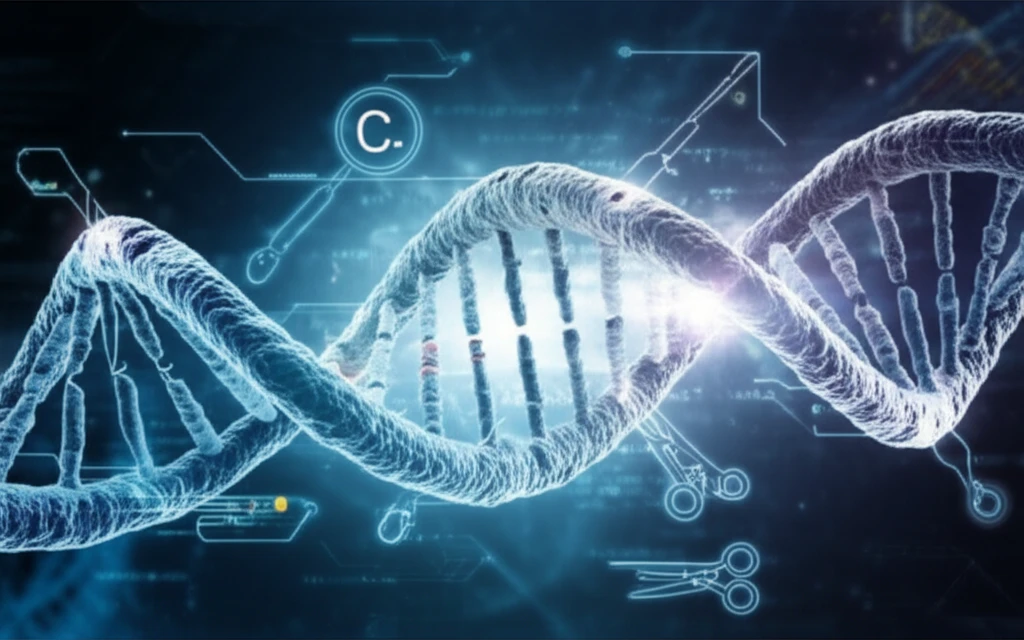
Surreal illustration of DNA base editing.

Rewrite Your DNA? Exploring the Revolutionary World of Base Editing

"Unlock the Potential of Genome, Epigenome, and Transcriptome Editing for Personalized Medicine and Beyond"


Imagine having the power to precisely rewrite the genetic code, correcting errors that cause disease or even engineering new traits. This is no longer science fiction, but a rapidly evolving reality thanks to base editing. This groundbreaking technology allows scientists to directly modify the individual building blocks of DNA and RNA, opening up new avenues for treating genetic diseases, understanding cellular processes, and developing innovative biotechnologies.

Traditional gene editing techniques often rely on cutting the DNA double helix, which can lead to unintended consequences and limit precision. Base editing offers a more refined approach, using modified enzymes to chemically alter specific nucleobases – the A's, T's, C's, and G's that make up the genetic code – without creating double-strand breaks. This increased precision minimizes off-target effects and expands the possibilities for therapeutic applications.

This article explores the exciting world of base editing, diving into the tools and techniques currently available, their potential applications in genome, epigenome, and transcriptome editing, and the future directions of this transformative technology. We'll break down the complex science into accessible language, revealing how base editing is poised to revolutionize medicine, biotechnology, and our understanding of the very blueprint of life.

Base Editing: A Toolkit for Rewriting the Code of Life

Surreal illustration of DNA base editing.

Base editors are essentially molecular machines that combine a deactivated CRISPR protein (dCas) with an enzyme capable of chemically modifying nucleobases. The dCas acts as a guide, directing the enzyme to a specific location in the genome or transcriptome, while the enzyme performs the precise base conversion. This targeted approach allows researchers to make specific changes without causing widespread DNA damage.

Several types of base editors have been developed, each with its own specific capabilities:

  • Cytosine Deaminases: These editors convert cytosine (C) to uracil (U), which is then recognized as thymine (T) by the cell's replication machinery, resulting in a C•G to T•A conversion.
  • Adenine Deaminases: These editors convert adenine (A) to inosine (I), which behaves like guanine (G), leading to an A•T to G•C conversion.
  • Methylation and Demethylation Tools: These editors add or remove methyl groups from cytosines, influencing gene expression and epigenetic patterns.
  • RNA Base Editors: These editors target RNA rather than DNA, allowing for transient modifications of gene expression and protein production.
Each of these tools offers unique advantages and limitations, making them suitable for different applications. Researchers are constantly working to improve the efficiency, precision, and versatility of base editors, expanding their potential to address a wider range of biological questions and therapeutic challenges.

The Future of Base Editing: A Revolution in Progress

Base editing is still a relatively young technology, but it has already demonstrated immense potential in a variety of applications. From correcting disease-causing mutations to engineering new traits in plants and animals, the possibilities seem almost limitless.

As the technology continues to evolve, researchers are focusing on several key areas:

<ul> <li><b>Improving Specificity:</b> Reducing off-target editing effects is crucial for therapeutic applications. Researchers are developing new base editors with enhanced specificity and exploring strategies to minimize unintended modifications.</li> <li><b>Expanding the Editing Scope:</b> Developing new base editors that can perform additional types of base conversions would greatly expand the technology's versatility.</li> <li><b>Developing Delivery Methods:</b> Efficiently delivering base editors to target cells and tissues is a major challenge. Researchers are exploring various delivery methods, including viral vectors, nanoparticles, and direct injection.</li> </ul>

About this Article -

This article was crafted using a human-AI hybrid and collaborative approach. AI assisted our team with initial drafting, research insights, identifying key questions, and image generation. Our human editors guided topic selection, defined the angle, structured the content, ensured factual accuracy and relevance, refined the tone, and conducted thorough editing to deliver helpful, high-quality information.See our About page for more information.

Everything You Need To Know

1

What is base editing and why is it important?

Base editing is a groundbreaking technology that allows scientists to directly modify the individual building blocks of DNA and RNA, specifically the nucleobases A, T, C, and G, without creating double-strand breaks. Its significance lies in its precision, minimizing off-target effects compared to traditional gene editing. This refined approach opens new avenues for treating genetic diseases, understanding cellular processes, and developing innovative biotechnologies. Implications include the potential to correct disease-causing mutations, engineer new traits, and revolutionize medicine and biotechnology.

2

What are base editors and how do they work?

Base editors are molecular machines that combine a deactivated CRISPR protein (dCas) with an enzyme capable of chemically modifying nucleobases. The dCas guides the enzyme to a specific location in the genome or transcriptome, while the enzyme performs the base conversion. Examples include Cytosine Deaminases, which convert cytosine (C) to uracil (U), and Adenine Deaminases, which convert adenine (A) to inosine (I). There are also Methylation and Demethylation Tools and RNA Base Editors. The significance lies in their ability to make specific changes without causing widespread DNA damage. The implications are the potential to address a wide range of biological questions and therapeutic challenges.

3

How do Cytosine Deaminases work, and why are they important?

Cytosine Deaminases are a type of base editor that converts cytosine (C) to uracil (U), which is then recognized as thymine (T) by the cell's replication machinery, resulting in a C•G to T•A conversion. This is significant because it allows for precise modification of the genome at specific locations. The implications are the potential to correct genetic mutations where a C•G base pair is incorrectly present, leading to disease.

4

How do Adenine Deaminases work, and what is their significance?

Adenine Deaminases are a type of base editor that converts adenine (A) to inosine (I), which behaves like guanine (G), leading to an A•T to G•C conversion. This is significant because it provides a precise way to change the genetic code. The implications are in the treatment of genetic diseases caused by errors in the A•T base pairs.

5

What is the future of base editing and its implications?

The future of base editing is promising because it's still a relatively young technology, but it has already demonstrated immense potential. From correcting disease-causing mutations to engineering new traits in plants and animals, the possibilities seem almost limitless. The significance of this lies in its potential to revolutionize medicine, biotechnology, and our understanding of the very blueprint of life. The implications are far-reaching, including personalized medicine, improved crop yields, and a deeper understanding of fundamental biological processes.

Newsletter Subscribe

Subscribe to get the latest articles and insights directly in your inbox.