
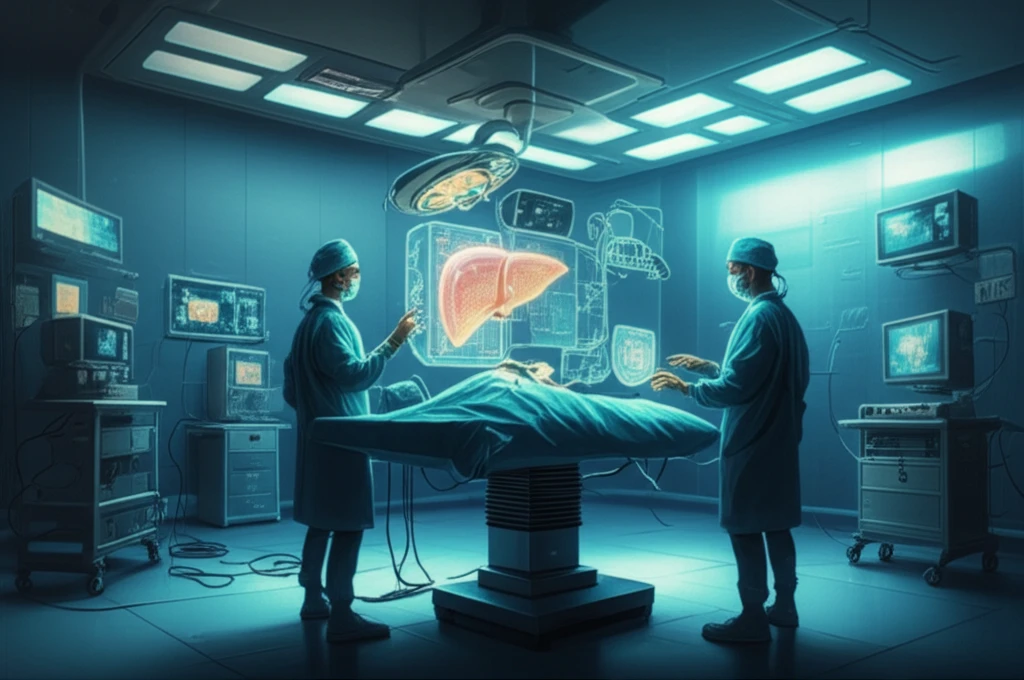
Revolutionizing Liver Surgery: The Rise of Real-Time Navigation

"Discover how a novel automatic registration system is making liver resections safer, faster, and more accurate, benefiting both surgeons and patients."
Liver resection, a standard treatment for primary and secondary liver malignancies, has seen remarkable advancements. Three-dimensional (3D) simulation software now enables more precise preoperative planning, often referred to as virtual hepatectomy. However, the challenge remains in seamlessly transferring this pre-operative plan to the actual intraoperative setting.
Surgeons must not only understand the preoperative plan but also intuitively identify the optimal liver transection line and locate critical vessels buried within the liver. To address this, intraoperative ultrasonography (IOUS) has been utilized since the 1980s, yet it requires extensive knowledge of liver anatomy and considerable experience to interpret the images effectively.
Real-time virtual sonography (RVS) has emerged as a valuable tool, aiding in the interpretation of ultrasound images by providing synchronized two-dimensional (2D) computed tomography (CT) images alongside ultrasound views. This technology allows surgeons to visualize target vessels and planned transection lines marked with colors using 3D simulation software. A recent breakthrough involves a novel automatic registration system that simplifies and accelerates the alignment of CT and IOUS images, potentially enhancing the precision and accessibility of liver surgery.
How Does the New RVS System Work?
The enhanced RVS navigation system integrates intraoperative ultrasonography with electromagnetic tracking technology. It features an ultrasound scanner with a specialized intraoperative ultrasound probe, an electromagnetic tracking device, and a workstation for real-time analysis. During surgery, an electromagnetic transmitter is positioned near the patient, and a sterilized sensor is attached to the ultrasound probe, enabling precise tracking of the probe's location and orientation.
- Initial Point Definition: The RVS workstation begins by defining an 'initial point,' which roughly aligns the spatial position and direction of the IOUS probe. This point, located on the left liver surface, is identified in both the 2D CT images and the IOUS view.
- Diagonal Scanning: Surgeons perform a 'diagonal scan' by moving the IOUS probe across the liver surface, capturing a volume of ultrasound data around the bifurcation of the left and right portal veins. This scan typically covers about 15 cm of the liver surface and takes only a few seconds.
- Automatic Registration: The acquired ultrasound volume images are reconstructed into 3D images and compared with the preoperatively obtained 3D CT images at the workstation. The system automatically matches these two sets of 3D images, adjusting the position and orientation of the CT images to achieve accurate multiplanar reconstruction.
The Future of Liver Surgery
The RVS system with automatic registration represents a significant step forward in liver surgery. By providing quick, easy, and accurate image registration, this technology enhances the precision and efficiency of liver resections. While challenges remain, such as compensating for liver deformation and minimizing positional errors, the RVS system has the potential to improve surgical outcomes and expand the use of IOUS in liver surgery, ultimately benefiting patients and surgeons alike.