
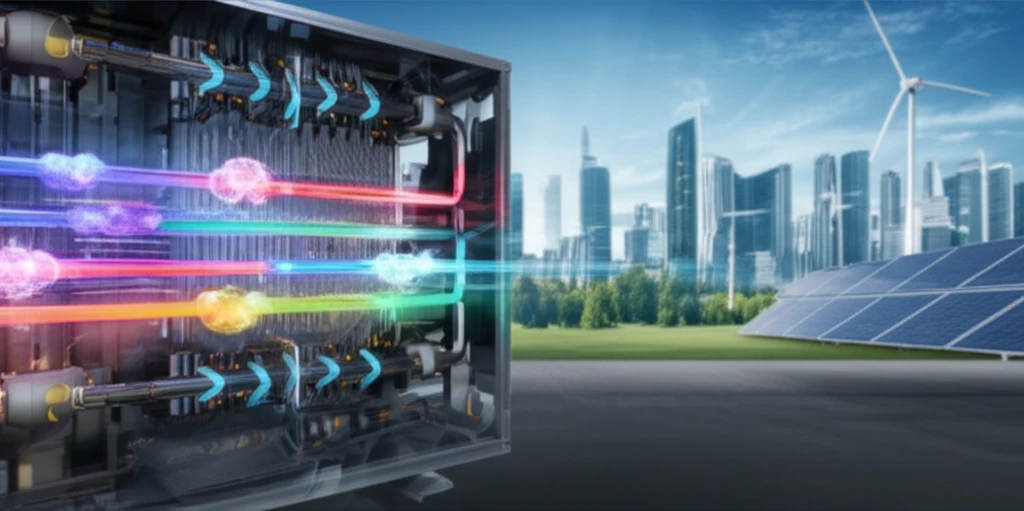
Revolutionizing HVAC: How an Innovative Heat Pipe Technology Could Slash Your Energy Bills

"Explore the cutting-edge n-pentane oscillating heat pipe (OHP) technology and discover how it's transforming waste heat recovery in ventilation systems."
In a world increasingly focused on sustainability, the quest for energy efficiency has never been more critical. With HVAC systems accounting for a significant portion of global energy consumption, innovative solutions are needed to reduce their environmental impact and lower operational costs. Enter the n-pentane oscillating heat pipe (OHP) – a groundbreaking technology poised to revolutionize the way we approach waste heat recovery in ventilation systems.
This article delves into the experimental characterization of an n-pentane OHP, exploring its potential to transform how we heat and cool our buildings. We'll examine its design, operation, and performance, highlighting its ability to capture and reuse otherwise wasted thermal energy. Furthermore, we'll explore how this technology can lead to substantial reductions in building energy consumption, paving the way for a more sustainable future.
Join us as we uncover the science behind this ingenious device and discover how it can make a real difference in your energy bills and environmental footprint. From its unique design to its remarkable efficiency, the n-pentane OHP is set to change the game in HVAC technology.
Decoding the N-Pentane OHP: A Deep Dive into Its Design and Operation
At the heart of the n-pentane OHP lies a closed-loop, serpentine-arranged capillary tube partially filled with n-pentane, a liquid with properties uniquely suited for this application. The tube's internal diameter is crucial, as it allows for the formation of a natural liquid-vapor system. When the OHP is exposed to a temperature difference, the n-pentane begins to oscillate, creating a highly efficient heat transfer mechanism. This process is a testament to the power of innovative engineering.
- Closed-Loop System: The OHP is a closed system, ensuring no external components or wicking structures are needed for efficient operation.
- N-Pentane: The use of n-pentane as a working fluid is critical for its low boiling point and efficient heat transfer.
- Oscillatory Flow: The oscillatory motion of the fluid is the driving force behind the OHP's high thermal conductivity.
- Heat Exchange: The OHP efficiently facilitates heat transfer between two air streams without direct mixing, making it ideal for HVAC systems.
Embracing the Future of HVAC: The Promise of OHP Technology
The n-pentane OHP represents a significant leap forward in HVAC technology. Its unique design and efficient operation offer a pathway to substantial energy savings and reduced environmental impact. As we move towards a more sustainable future, innovations like the OHP will play a crucial role in transforming how we heat and cool our buildings. With its proven effectiveness and versatility, this technology has the potential to reshape the HVAC landscape and create a greener, more energy-efficient world for all.