
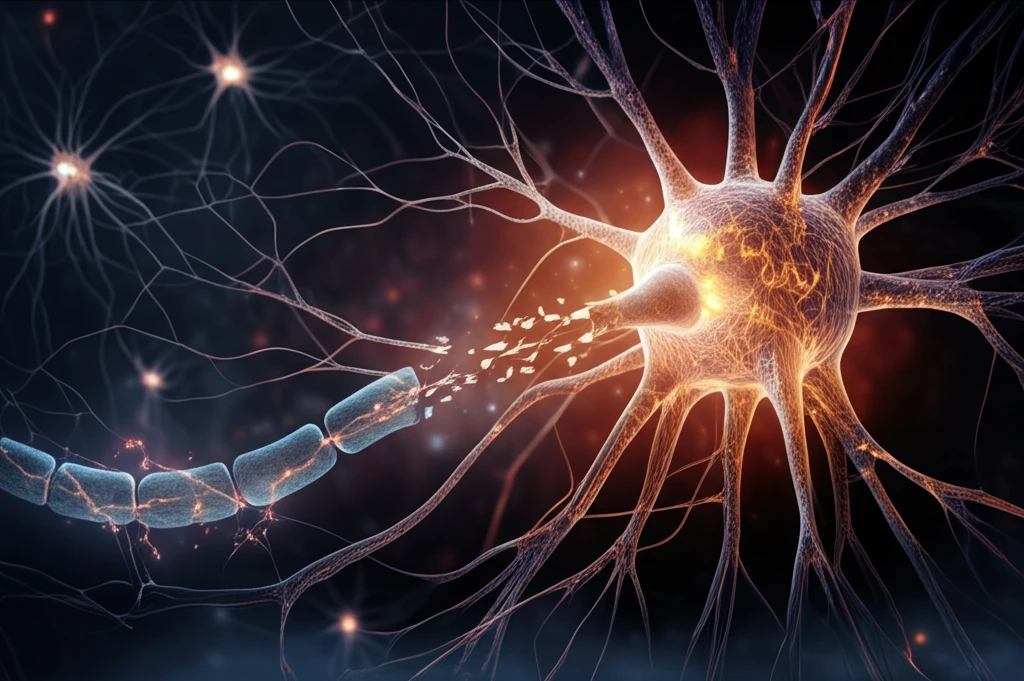
Revitalize Your Nerves: The Science of Nerve Regeneration and Regaining Function

"Discover the latest research on how nerves repair themselves after injury, offering hope for improved recovery and function."
Nerves, the intricate communication network of our body, play a vital role in everything we do, from the simplest movements to the most complex thoughts. When these delicate pathways are damaged, the consequences can be significant, leading to loss of sensation, impaired movement, and chronic pain. Understanding how nerves regenerate is crucial for developing effective treatments and improving the lives of those affected by nerve injuries.
The ability of nerves to regenerate is not a new discovery, but ongoing research continues to uncover the complex mechanisms involved in this process. Scientists are particularly interested in the role of ion channels, specialized proteins that control the flow of electrical signals along nerve fibers. These channels, especially voltage-gated sodium channels (VGSCs), are essential for nerve function, and their behavior changes dramatically during regeneration.
This article delves into the groundbreaking work of researchers studying nerve regeneration, focusing on the changes that occur in voltage-gated channels after nerve injury. By understanding these changes, we can explore potential strategies to enhance nerve regeneration and restore function more effectively.
Why Nerve Repair Still Counts
Peripheral nerve repair and regeneration remain among the greatest challenges in tissue engineering and regenerative medicine, with sources reporting that even the best microsurgical techniques often yield frail recovery despite the peripheral nervous system's capacity for some degree of regeneration. Damage and regeneration occur naturally in the peripheral nervous system, where the neurotropic B vitamins thiamine (B1), pyridoxine (B6), and cobalamin (B12) help maintain neuronal viability in different ways. On the experimental side, regenerative nerve tissues bridged with a high-surface-area conduit showed a higher density of regenerated myelinated nerve fibers and more myelin sheath layers. Adjacent approaches, such as PEMF therapy, are being explored for protecting and promoting nerve regeneration even after catastrophic trauma or spinal cord injury.
The Gold Standard and Its Gaps
The gold standard for repairing nerve gaps is autologous nerve grafting, typically using the sural or auricular nerve, and this approach anchors treatment when gaps are involved. Yet conventional allograft procedures and biologic tubes present problems when used for damaged peripheral nerve reconstruction, and peripheral nerve injuries can lead to lifetime loss of function and permanent disfigurement. Tissue engineering advances have enabled the development of the first nerve conduits, with a nerve tubulation approach introduced for gap repair. Looking ahead, researchers at the Hamlyn Centre propose a possible new route to next-generation nerve regeneration by combining 3D printing, nanoscience, and stem cells.
From Waller to Modern Milestones
Early milestones include Waller's original theory of nerve regeneration from the central stump of a cut nerve, developed on the model of embryonic development and referring to the "embryonic fibres" of the regenerative process. At the start of the twentieth century, Cajal's work on degeneration and regeneration emerged as the reticularists renewed their attack against the neuron theory. Historical accounts also stress that while the peripheral nervous system has intrinsic regenerative capacity, regeneration occurs in an incomplete or poorly functional manner, with disorganized and mismatched axon growth when basal lamina tubes are damaged. More recently, researcher Sandra Rieger discovered that nerve regeneration is stimulated by hydrogen peroxide secreted by the wound epidermis, and that genetically eliminating the enzyme that produces it stops nerve endings from regenerating.
Unlocking the Secrets of Nerve Regeneration
The human body possesses an incredible ability to heal, and nerve regeneration is a prime example of this. When a nerve is damaged, the nerve fiber distal to the injury site degenerates, while the proximal portion begins to sprout new growth cones. These growth cones extend towards the target tissue, guided by various chemical signals. If the growth cones successfully reach their target, they can re-establish connections and restore nerve function. However, this process is not always perfect, and various factors can influence the success of nerve regeneration.
- The severity of the nerve injury.
- The distance the nerve must regenerate.
- The age and overall health of the individual.
- The presence of scar tissue or other obstacles.
New Tools, Timelines, and Targets
Recent reviews summarize the pathophysiology of peripheral nerve injury and the tissue-engineered repairing strategies being developed, with particular attention to scaffolds and seed cells for neural tissue engineering. Reported timelines show nerve regeneration beginning after about one month, with nerve fiber densities recovering toward pre-operative levels between six months and one year and remaining stable for up to five years, though nerves stay tortuous with reduced densities. Electrical stimulation is being investigated to enhance axon regeneration, but functional recovery in humans is frequently disappointing, especially when injuries require regeneration over long distances and long time periods. Experimental approaches also include 3D bioprinting techniques, with printers that reportedly look like toaster ovens being used to create structures that could regenerate nerve cells.
Why Regeneration Often Fails
Sources report that regeneration in the human nervous system, particularly in the CNS, is severely restricted, with the formation of glial scars after injury acting as a physical and biochemical barrier to axonal regrowth. Nervous system injuries are estimated to affect over 90,000 people every year, yet functional recovery is not guaranteed in most cases. The proximal segment of an injured nerve attempts to regenerate, but its growth is hindered by the surrounding environment. These obstacles help explain why even successful regrowth in animal models does not always translate into meaningful recovery for human patients.
Comparing Grafts on Common Ground
Comparing the effectiveness of different nerve grafts has been difficult because studies differ in how they measure outcomes, prompting the development of a normalization method for comparing nerve regeneration effectiveness among graft types. Further analysis produced the Relative Regeneration Ratio (RRR), a function that lets researchers directly compare nerve graft results based on nerve conduction velocity (NCV) data from their respective studies, as long as the data were collected at the same post-operation time. In practice, graft candidates such as a bioresorbable silk fibroin-based conduit are evaluated in rat sciatic-nerve-defect models, measuring both motor and sensory function recovery as well as histological regeneration. These standardized comparisons help clarify which materials and techniques genuinely outperform alternatives.
Hope for the Future of Nerve Regeneration
The research into nerve regeneration and the role of voltage-gated sodium channels offers hope for the development of new therapies to improve outcomes after nerve injury. By targeting specific ion channels, such as NaV1.8, scientists may be able to reduce hyperexcitability and improve nerve function. Further research is needed to translate these findings into clinical applications, but the future of nerve regeneration looks promising.
What Clinicians Consider Today
Treatment options for nerve damage after surgery include platelet-rich plasma (PRP), physical therapy, and medications such as gabapentin, but recovery can be painfully slow; if a nerve is able to regrow, a back injury could take years to regenerate the entire nerve from the back to the foot. Expert commentary cautions that PRP, which is rich in growth factors, may be a potential contraindication for peripheral nerve regeneration following tumor excision. Cell-based therapy has nonetheless brought a new perspective to the field of regenerative medicine, and expert opinion notes the usefulness of employing stem cells for treating peripheral nerve injuries in pre-clinical settings. Together, these views paint a picture of growing options tempered by real safety and timing concerns.
Where the Field Is Headed
The nerve regeneration market is projected to grow, driven by technological advancements in regenerative medicine, a rising incidence of neurological disorders, collaborative research initiatives, and an increasing geriatric population. Regenerative medicine is emerging as a promising area of research in peripheral nerve injury treatment, with investigators examining approaches that may stimulate nerve regeneration and improve functional recovery. At the frontier of technique, magnetic nanoparticles appear able to guide and boost nerve regeneration, and both this and related research areas could be advanced through surface functionalization with biological molecules such as proteins, peptides, and growth factors. These converging trends suggest a shift toward more targeted, biologically enhanced repair strategies.
Precision Above All
Regenerating nervous system tissues demands an exceptionally high level of precision and specificity, since nerves must reconnect with their target cells accurately to restore functionality. Damage to either the central or peripheral nervous system can result in significant impairments of movement and sensation. Sources also report that poor regeneration often results from complications such as nerve adhesion and fibrosis, which interfere with the regrowth process. These systemic hurdles mean that success depends not only on stimulating growth but on directing it accurately to the right targets while avoiding scar-related obstacles.
Regeneration in People's Lives
Researchers have made substantial progress in understanding optic nerve degeneration and regeneration in glaucoma, identifying molecular factors for nerve fiber growth in the central nervous system, which could eventually help restore vision. In parallel work, a research team focused on regeneration of motor neuron axons, the wiry part of every nerve cell that transmits signals to other nerve cells or to cells such as muscle, developing a "genetic screen" to search for genes involved in nerve regeneration. These efforts translate laboratory science into therapies aimed at conditions that rob people of sight, movement, and sensation. Together they underscore the human stakes behind every advance in regeneration research.