
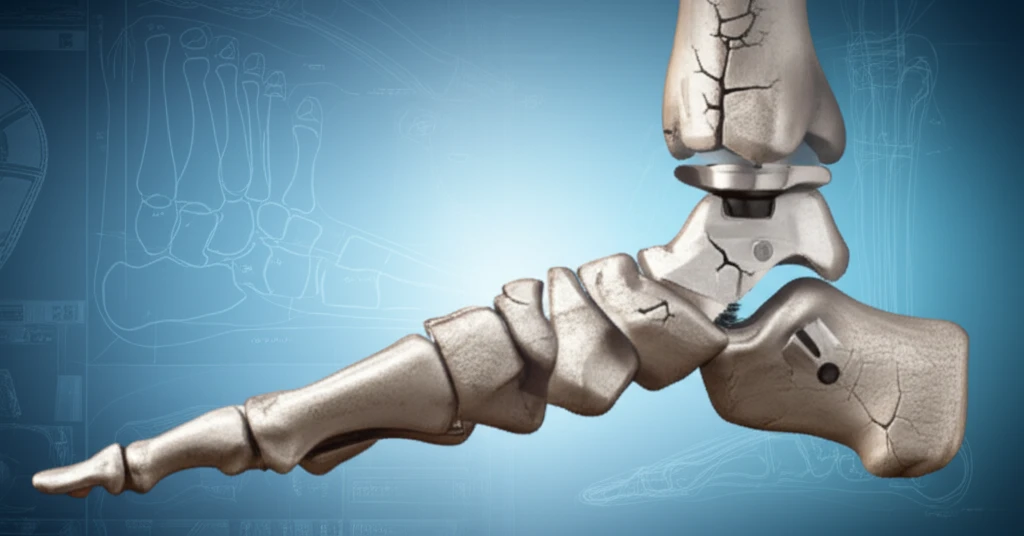
Illustration of a worn ankle replacement

Revision Total Ankle Arthroplasty: What You Need to Know

"Navigating the complexities of revision total ankle arthroplasty (TAA) with expert insights and essential considerations for patients and surgeons."


Over the last two decades, total ankle arthroplasty (TAA) has seen remarkable advancements in implant design, materials, and surgical techniques, leading to improved functional outcomes for patients. However, like any joint replacement surgery, TAA is not without its complications, some of which may require revision surgery. Understanding these potential issues and how to address them is crucial for both patients and surgeons.

Revision TAA is a complex procedure that goes beyond the initial surgery, demanding experienced surgeons and a comprehensive approach. Key complications include intraoperative fractures, wound healing problems, deep infections, aseptic loosening, implant failure, and technical errors. These complications are classified based on their severity, with some being more likely to cause failure than others.

This article delves into the critical aspects of revision TAA, offering insights into recognizing complications, understanding surgical principles, and exploring advanced techniques to ensure the best possible outcomes. Whether you're a patient considering TAA or a healthcare professional involved in the process, this guide provides essential information for navigating the complexities of revision total ankle arthroplasty.

Recognizing the Telltale Signs: Why Revision Ankle Surgery Might Be Necessary

Illustration of a worn ankle replacement

Deciding whether revision surgery is necessary involves careful consideration of several factors. Symptoms, pain levels, subsidence (sinking of the implant), alignment issues, bone stock quality, potential infection, and the integrity of the implant itself all play a role. Early complications often involve ligament imbalances or the implant's position, which can lead to premature TAA failure if not addressed.

Late complications typically arise from wear of the polyethylene liner (a plastic component) or aseptic loosening (loosening without infection). Recognizing these issues early can simplify the revision surgery and improve the chances of a successful outcome. When facing a failing or failed total ankle replacement, surgeons must weigh the option of revision arthroplasty against salvage procedures like fusion or amputation.

  • Symptoms & Pain: Persistent or worsening pain that impacts daily activities.
  • Subsidence: The implant sinking or shifting from its original position.
  • Alignment Issues: Problems with the alignment of the ankle joint.
  • Bone Stock: The quality and amount of bone available to support the implant.
  • Infection: The presence of infection around the implant.
  • Implant Integrity: Problems like wear or damage to the implant components.
With significant bone loss, fusion becomes more challenging due to the lack of structural support. In such cases, specialized implants, bone grafts, or even custom components may be necessary to achieve stability and proper alignment. Historically, custom components were frequently used to address complex revision scenarios, but increased regulations have limited their availability, posing a challenge for both surgeons and patients.

Looking Ahead: Ensuring the Best Outcomes in Revision TAA

TAA and revision TAA are complex procedures. Proper training, early complication identification, and appropriate surgical techniques are essential for successful outcomes. Annual surveillance of every total ankle replacement is recommended to proactively address potential issues. Ultimately, a collaborative approach between experienced surgeons and well-informed patients is key to navigating the challenges of revision TAA and improving long-term results.

About this Article -

This article was crafted using a human-AI hybrid and collaborative approach. AI assisted our team with initial drafting, research insights, identifying key questions, and image generation. Our human editors guided topic selection, defined the angle, structured the content, ensured factual accuracy and relevance, refined the tone, and conducted thorough editing to deliver helpful, high-quality information.See our About page for more information.

Everything You Need To Know

1

What are the primary reasons a patient might need a Revision Total Ankle Arthroplasty (TAA)?

A patient may require Revision Total Ankle Arthroplasty (TAA) due to several key complications. These include persistent or worsening pain impacting daily activities, subsidence (where the implant sinks or shifts), alignment issues within the ankle joint, poor bone stock quality, infection around the implant, or damage and wear to the implant components. Early recognition of these issues is critical to improving the chances of a successful outcome and preventing further complications.

2

What are the main differences between early and late complications that might lead to a Revision TAA?

Early complications in Revision Total Ankle Arthroplasty (TAA) often involve issues like ligament imbalances or implant positioning, potentially leading to premature failure. Addressing these early can simplify the revision procedure. Late complications typically stem from the wear of the polyethylene liner, a plastic component, or aseptic loosening, which is loosening of the implant without infection. Identifying these differences helps surgeons and patients anticipate the likely issues and plan the most appropriate approach for revision surgery.

3

Why is early identification of potential problems so crucial in the context of Revision Total Ankle Arthroplasty (TAA)?

Early identification of potential problems is crucial in Revision Total Ankle Arthroplasty (TAA) because it significantly improves the chances of a successful outcome. Identifying complications like implant subsidence, alignment issues, or infection early allows for timely intervention. This might involve a less complex revision procedure compared to addressing a fully failed total ankle replacement. Proactive measures can prevent the need for more extensive procedures such as fusion or amputation and can improve long-term results.

4

What role does bone stock play in the success of a Revision TAA, and what happens if there is significant bone loss?

Bone stock, meaning the quality and amount of bone available to support the implant, is crucial for the success of Revision Total Ankle Arthroplasty (TAA). Adequate bone stock provides the necessary foundation for implant stability and proper alignment. In cases of significant bone loss, fusion becomes more challenging due to the lack of structural support. Surgeons might need to use specialized implants, bone grafts, or custom components to achieve stability and correct alignment. The use of custom components faces increased regulatory limitations, which can complicate treatment options.

5

Besides the surgeon's skill, what other factors contribute to ensuring the best outcomes in Revision Total Ankle Arthroplasty?

Besides the surgeon's skill, several other factors contribute to ensuring the best outcomes in Revision Total Ankle Arthroplasty (TAA). Proper training, early complication identification, and the use of appropriate surgical techniques are essential. Regular, annual surveillance of every total ankle replacement is recommended to proactively address potential issues. Most importantly, a collaborative approach between experienced surgeons and well-informed patients is key to navigating the complexities of revision TAA and improving long-term results. The patient's active participation in their care, understanding the potential complications, and adhering to post-operative instructions all play a vital role in a successful outcome.

Newsletter Subscribe

Subscribe to get the latest articles and insights directly in your inbox.