
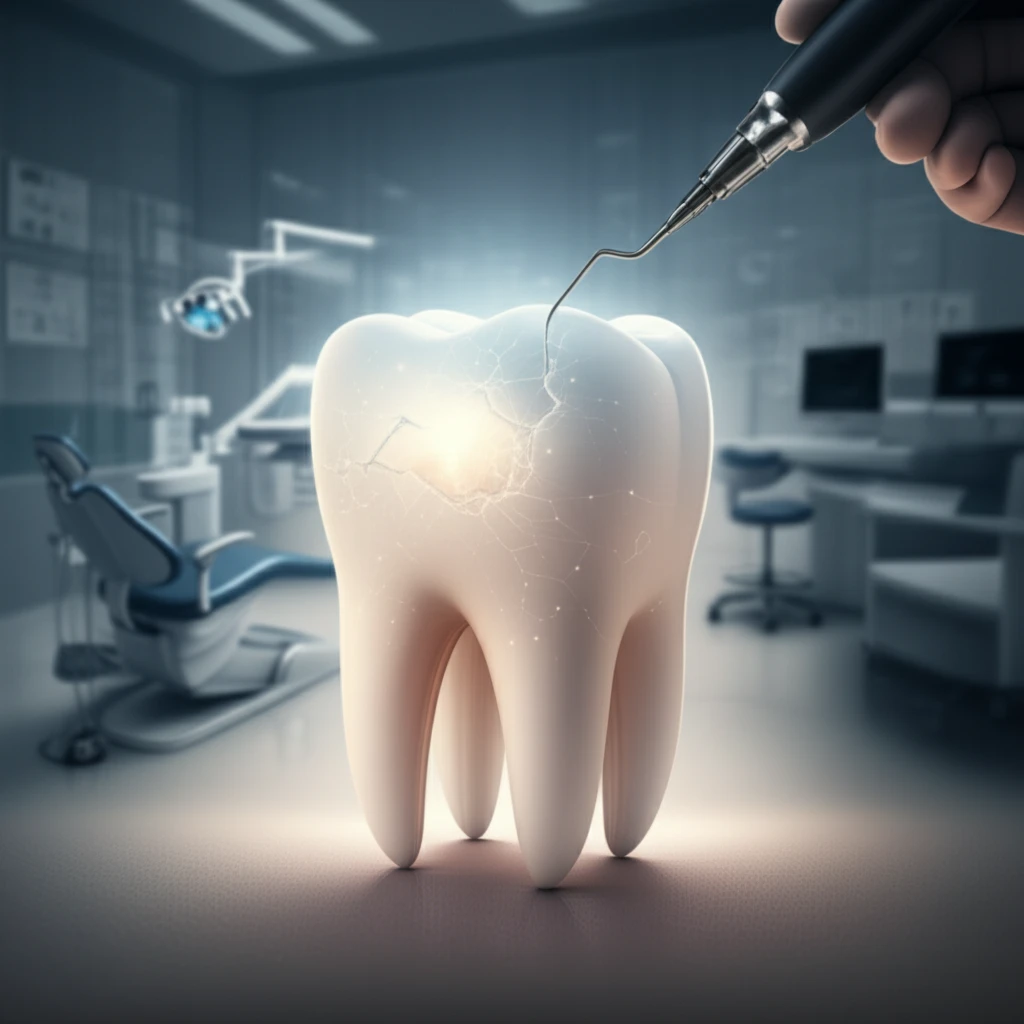
Regrow Your Smile: The Revolutionary Peptide Treatment That Could Replace Fillings

"Scientists have developed a self-assembling peptide that could regenerate enamel and offer a non-invasive alternative to traditional dental fillings."
Imagine a future where a trip to the dentist doesn't automatically mean a drill and a filling. For decades, the standard treatment for cavities has involved removing damaged tooth tissue and replacing it with artificial materials. But what if we could regenerate our own enamel, reversing the damage and restoring our teeth to their natural state? This is the promise of a new, non-invasive treatment using a self-assembling peptide, and it's creating a buzz in the dental world.
This innovative approach targets early carious lesions, the initial stages of tooth decay, before they progress to full-blown cavities. Instead of drilling and filling, the treatment encourages the natural remineralization process, essentially rebuilding the tooth from within. This method not only preserves healthy tooth structure but also offers a potentially more effective and long-lasting solution.
This article dives into the science behind this groundbreaking treatment, exploring its benefits, the clinical trials that support its efficacy, and what it could mean for the future of dental care. We'll examine how this new approach, which combines a self-assembling peptide with fluoride, could revolutionize how we treat cavities and improve our oral health.
The Science of Self-Assembling Peptides and Tooth Regeneration
At the heart of this revolutionary treatment is a self-assembling peptide, a small chain of amino acids that spontaneously forms a 3-dimensional matrix. This matrix acts as a scaffold, mimicking the natural structure of tooth enamel and attracting calcium and phosphate ions from saliva. This process, known as remineralization, essentially rebuilds the damaged enamel, reversing the effects of early-stage decay. The peptide, in essence, kickstarts the body's own healing mechanisms.
- Targeted Action: The self-assembling peptide specifically targets early carious lesions, addressing the problem at its source before it causes significant damage.
- Biomimicry: The peptide matrix mimics the natural structure of tooth enamel, creating an environment that promotes remineralization.
- Non-Invasive: The treatment is non-invasive, eliminating the need for drilling and fillings and preserving healthy tooth structure.
- Superior Results: Clinical trials have shown that the peptide treatment, in combination with fluoride, is more effective than fluoride varnish alone.
The Future of Dental Care: A Smile of Hope
The development of self-assembling peptides for tooth regeneration represents a significant step forward in dental care. With ongoing research and further clinical trials, this technology has the potential to transform how we treat dental diseases. As we move towards a more proactive, regenerative approach, the future of dental care looks brighter than ever, promising healthier smiles and a more comfortable dental experience for all. If this peptide treatment becomes a standard practice, the quality of people's lives will increase by reducing pain and money spent on dentist appointments.