
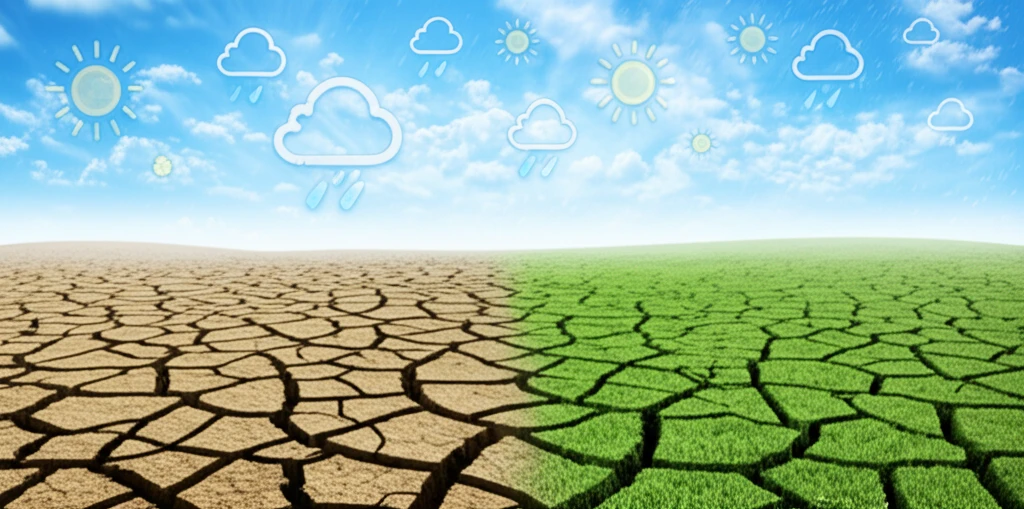
Rangeland Revival: How Weather-Smart Planning Can Save Our Ecosystems

"Discover how a new weather-centric approach to rangeland revegetation can boost success rates and help combat global degradation, ensuring a greener future."
Rangelands, covering 40% of the Earth’s land surface, are vital ecosystems supporting about 2.5 billion people. These arid, semiarid, and subhumid regions store 45% of the world's terrestrial carbon, sustain 50% of global livestock and wildlife, and house a third of all plant and animal diversity. Yet, these crucial biomes are highly susceptible to degradation and invasion, threatening global sustainability.
The harsh conditions of rangelands, characterized by low and variable rainfall and extreme heatwaves, stress food chains and ecosystems, making them vulnerable to degradation. Conservative estimates suggest that about 20% of global arid and semiarid rangelands are degraded, with an additional 30 million acres declining each year. Despite significant investments in revegetation and restoration, success rates remain alarmingly low.
In the United States, even with the latest science and technology, revegetation success rates are often less than 5%. But a dedicated group of scientists is determined to change this. Their innovative approach, outlined in “Weather-Centric Rangeland Revegetation Planning,” offers new hope for improving rangeland restoration outcomes.
Rangelands Under Pressure
Pastoralism, shaped by climatic and environmental conditions, has evolved into both a way of life and a system of natural resource use and management. Yet rangeland rehabilitation is challenging because interannual climate and subseasonal weather variability affect seed germination, seedling survival and establishment, annual weed dynamics, and wildfire frequency. Practical solutions are emerging to help communities adapt and restore these degraded landscapes.
Why Traditional Revegetation Falls Short
Rehabilitation of degraded rangelands is challenging due to interannual climate and subseasonal weather variability that impacts seed germination, seedling survival and establishment, annual weed dynamics, and wildfire frequency. Climate change has increasingly challenged the success of traditional restoration activities that seek to return an ecosystem to a prior state. Standard methods that ignore short-term weather patterns therefore struggle to deliver reliable results in arid and semiarid systems.
A Century of Revegetation Science
Rangeland revegetation emerged as an applied science in the U.S. about 100 years ago, following a noticeable downward trend in range condition associated with the settlement and intensive use of arid and semiarid lands. That founding era established the core methods still used today, from seeding practices to condition assessments. The persistence of degradation ever since has driven the search for more adaptive, weather-aware planning approaches.
A Weather-Smart Revolution in Rangeland Restoration
The core of this new strategy involves a weather-centric approach that leverages a wide spectrum of site-specific weather information. By using historical observations, seasonal climate forecasts, and adaptive management, revegetation and restoration outcomes can be significantly improved. Accurate seasonal climate forecasts enhance success and cost-efficiency by timing revegetation activities to align with favorable weather conditions for seedling establishment.
- Utilize Drought-Resistant Varieties: Select native plant species known for their drought tolerance to increase survival rates in arid conditions.
- Implement Water Harvesting Techniques: Use methods like contour plowing or terracing to capture and retain rainwater, improving soil moisture for seedling establishment.
- Apply Mulch to Retain Moisture: Add organic mulch around newly planted seedlings to reduce evaporation and maintain consistent soil moisture levels.
- Monitor and Adapt: Regularly assess the effectiveness of revegetation efforts and adjust strategies based on observed outcomes and changing weather patterns.
Weather-Centric Planning Takes Center Stage
Recent work promotes weather-centric rangeland revegetation planning that bases restoration on historical, seasonal, and current weather conditions as a way to restore vegetation in semi-arid rangelands. Climate-change projections are key to the application of current environmental models for development of mitigation and adaptation strategies. These models support management practices that require a multidecadal planning horizon, moving beyond single-season decisions.
When Restoration Tries to Turn Back the Clock
Traditional restoration activities that seek to return an ecosystem to a prior state have faced increasingly frequent failures as climate change alters baseline conditions. The assumption that a historical reference state is the right target no longer holds in many rangelands, where interannual weather variability undermines seed germination, seedling survival, and establishment. These setbacks have forced practitioners to reconsider static restoration goals in favor of resilience-oriented approaches.
Static Methods vs. Adaptive, Weather-Informed Practices
Traditional revegetation tends to rely on fixed seeding schedules and historical baselines, while weather-centric planning bases rangeland revegetation on weather conditions, both historical and seasonal, which research suggests may be more useful in restoring vegetation in semi-arid rangelands. Climate-smart restoration instead enhances the ecological function of degraded areas in a manner that makes them more resilient to the consequences of climate change. Healthy ecosystems are more resilient to climate change and other environmental stresses, ensuring that both livestock and wildlife can thrive in harmony.
Looking Ahead: A Greener Future for Rangelands
With global observation, monitoring technology, and large database programs rapidly advancing, envisioning a system that provides validated weather and climate forecasts at the management scale for nearly all regions of the world is becoming increasingly feasible. Enhancing the probability of successfully revegetating degraded and invaded arid rangelands by aligning seeding procedures with favorable weather conditions promises a positive impact on populations worldwide, paving the way for more resilient and sustainable ecosystems.
Building Resilience Into Every Restoration
Climate-smart ecological restoration is the process of enhancing the ecological function of degraded or destroyed areas in a manner that makes them more resilient to the consequences of climate change. Experts argue that rehabilitation is difficult precisely because interannual climate and subseasonal weather variability affect seed germination, seedling survival, and establishment. The emerging consensus is that planning around weather and climate, rather than against them, is central to successful rangeland revival.
The Multidecadal Horizon
Climate-change projections are key to the application of current environmental models for development of mitigation and adaptation strategies. Such models enable management practices that require a multidecadal planning horizon, linking near-term seeding decisions to long-term climatic trends. Advancing weather-centric planning should make revegetation investments more reliable even as variability and wildfire frequency intensify.
Beyond Seeds: Water Scarcity and Climate Action
Rangeland revival is intertwined with broader challenges such as water scarcity, greening agriculture, and climate action in arid regions. Pastoralism, as both a way of life and a system of natural resource use and management, is shaped by these climatic and environmental conditions. Practical solutions that help pastoral communities adapt and restore rangelands are therefore part of a larger effort to build sustainable food and land systems.
People, Livestock, and Land in Harmony
The success of rangeland restoration ultimately depends on the pastoral communities and land stewards who manage these ecosystems day to day. Healthy ecosystems are more resilient to climate change and other environmental stresses, ensuring that both livestock and wildlife can thrive in harmony. Practical, community-driven solutions are emerging to help people adapt their grazing and restoration practices and restore degraded rangelands for livestock and biodiversity alike.