
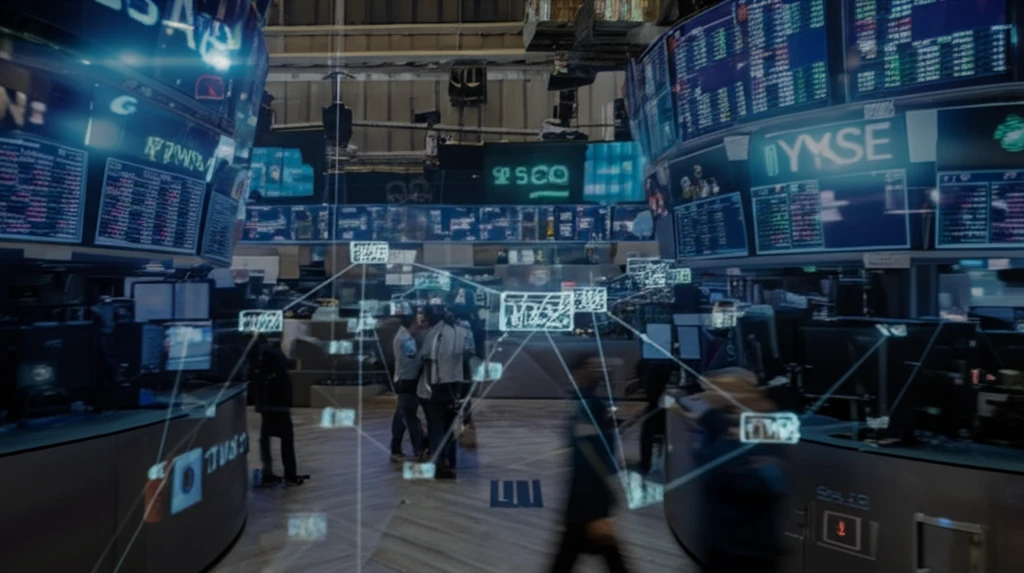
AI-powered transformer network analyzes stock market data.

Quant Trading's New AI Edge: Can Attention Lead to Profit?

"Explore how the Quantformer, a quantitative transformer trading strategy, is revolutionizing stock market predictions with enhanced AI and sentiment analysis."


The financial market is a complex arena, where fortunes are made and lost on the back of predictions. Quantitative trading, which relies on algorithms and statistical models to make investment decisions, has long been a key strategy for those looking to gain an edge. But in a world awash with data, how can traders sift through the noise to identify the signals that truly lead to profit?

Enter the Quantformer, an innovative approach that applies the power of transformer networks—a type of neural network architecture—to quantitative trading. By leveraging techniques originally developed for natural language processing (NLP), the Quantformer aims to capture market sentiment and forecast future returns with unprecedented accuracy.

This article breaks down how the Quantformer works, its potential benefits, and what it could mean for the future of quantitative trading. Whether you're a seasoned investor or just curious about the intersection of AI and finance, here’s what you need to know.

What is the Quantformer and How Does It Work?

AI-powered transformer network analyzes stock market data.

At its core, the Quantformer is a neural network architecture designed to analyze vast quantities of market data and identify patterns that can predict stock price movements. It builds upon the principles of transformer networks, which have become highly successful in NLP tasks like machine translation and sentiment analysis.

Unlike traditional quantitative models that rely on static fundamental analysis or pre-defined factors, the Quantformer can dynamically learn from the data, adapting to changing market conditions. It's designed to overcome the limitations of existing machine learning approaches by:

  • Capturing Long-Range Dependencies: The transformer architecture excels at identifying relationships between data points that are far apart in time, allowing the Quantformer to consider long-term trends and historical patterns.
  • Modeling Complex Data Relationships: The Quantformer can handle a variety of market variables, including categorical data (like industry types) and quantitative data (like price fluctuations and turnover rates), to build a more complete picture of the market.
  • Transfer Learning from Sentiment Analysis: By drawing on techniques from NLP, the Quantformer can incorporate market sentiment into its predictions, potentially identifying shifts in investor behavior that traditional models might miss.
The Quantformer uses an encoder-decoder structure, inspired by other neural sequence transduction models. However, it has been modified and adapted to input numerical data directly. For example, the model processes both categorical and numerical data, the word embedding layer is replaced by a standard linear layer, utilizing linear transformations to substitute the process of word embedding. Moreover, the decoder is simplified by removing the autoregressive prediction mechanism and masking operations.

The Future of Quantitative Trading with AI

The Quantformer represents a significant step forward in the application of AI to quantitative trading. By combining the strengths of transformer networks with innovative adaptations for financial data, it offers the potential for more accurate predictions and higher profits. As AI continues to evolve, expect to see even more sophisticated models emerge, further blurring the lines between technology and finance.

About this Article -

This article was crafted using a human-AI hybrid and collaborative approach. AI assisted our team with initial drafting, research insights, identifying key questions, and image generation. Our human editors guided topic selection, defined the angle, structured the content, ensured factual accuracy and relevance, refined the tone, and conducted thorough editing to deliver helpful, high-quality information.See our About page for more information.

This article is based on research published under:

DOI-LINK: https://doi.org/10.48550/arXiv.2404.00424,

Title: Quantformer: From Attention To Profit With A Quantitative Transformer Trading Strategy

Subject: q-fin.mf cs.ai cs.ce

Authors: Zhaofeng Zhang, Banghao Chen, Shengxin Zhu, Nicolas Langrené

Published: 30-03-2024

Everything You Need To Know

1

What is the Quantformer and how does it differ from traditional quantitative trading models?

The Quantformer is a neural network architecture that leverages transformer networks to analyze market data and predict stock price movements. Unlike traditional quantitative models that rely on static fundamental analysis or pre-defined factors, the Quantformer dynamically learns from data and adapts to changing market conditions. It captures long-range dependencies, models complex data relationships, and incorporates market sentiment analysis to potentially identify shifts in investor behavior that traditional models might miss. It does not rely on word embeddings but uses linear transformation to process numerical data directly.

2

How does the Quantformer use sentiment analysis, and why is it important for predicting stock trends?

The Quantformer draws on techniques from Natural Language Processing (NLP) to incorporate market sentiment into its predictions. This involves analyzing text data (like news articles and social media posts) to gauge investor attitudes and expectations. By understanding the sentiment behind market commentary, the Quantformer can potentially identify shifts in investor behavior that traditional quantitative models, which primarily focus on numerical data, might overlook. This integration of sentiment analysis can provide a more holistic view of market dynamics, leading to more accurate predictions.

3

What are the key advantages of using a transformer network architecture in the Quantformer for financial predictions?

The transformer network architecture offers several advantages. First, it excels at capturing long-range dependencies, allowing the Quantformer to consider long-term trends and historical patterns in market data. Second, it can model complex data relationships, handling various market variables, including categorical data (like industry types) and quantitative data (like price fluctuations and turnover rates), providing a complete picture of the market. The Quantformer uses an encoder-decoder structure with modifications to process numerical data, enhancing its ability to learn and adapt to changing market conditions.

4

Can you explain the encoder-decoder structure of the Quantformer and its specific adaptations for financial data?

The Quantformer utilizes an encoder-decoder structure inspired by neural sequence transduction models but is adapted to handle numerical data directly. The encoder processes input data, while the decoder generates predictions. A key modification is replacing the word embedding layer with a standard linear layer, using linear transformations to substitute the word embedding process, enabling the model to directly process numerical data. Also, the decoder is simplified by removing the autoregressive prediction mechanism and masking operations typically found in NLP applications, streamlining the process for quantitative trading purposes.

5

What are the potential implications of the Quantformer for the future of quantitative trading and the broader finance industry?

The Quantformer represents a significant step towards integrating AI into quantitative trading, potentially enabling more accurate predictions and higher profits. As AI continues to advance, more sophisticated models are likely to emerge, further blurring the lines between technology and finance. This could lead to increased automation in trading, new investment strategies based on AI-driven insights, and a greater emphasis on data analysis and machine learning skills in the finance industry. However, it also raises questions about market stability, regulatory oversight, and the potential for algorithmic bias, requiring careful consideration as these technologies evolve.

Newsletter Subscribe

Subscribe to get the latest articles and insights directly in your inbox.