
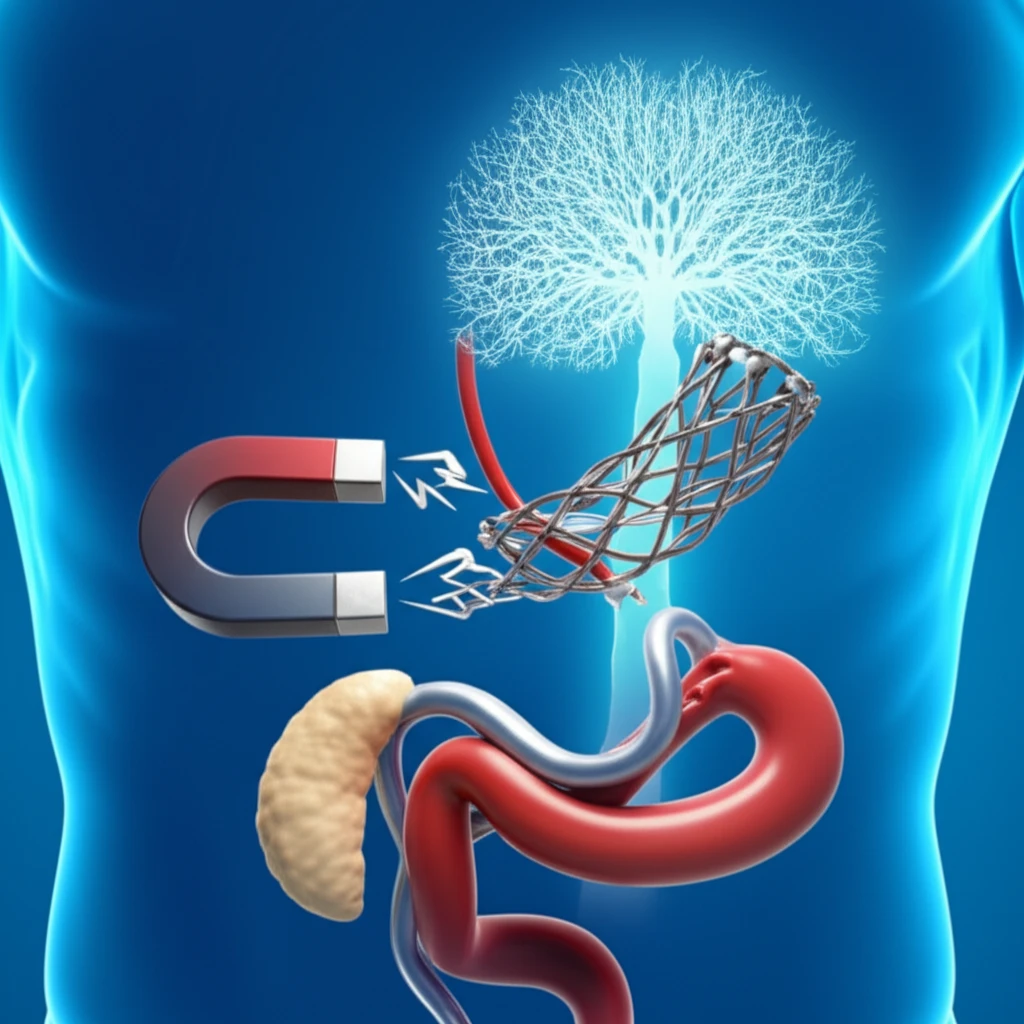
Surreal illustration of biliary system representing PSC treatment options.

PSC Strictures: Metals, Magnets, or Liver Transplant?

"A Guide to Managing Primary Sclerosing Cholangitis"


Primary sclerosing cholangitis (PSC) is a chronic liver disease where the bile ducts, both inside and outside the liver, become inflamed and scarred. This scarring leads to narrowing (strictures) and widening (dilation) of the bile ducts. Unfortunately, there's no cure for PSC, and liver transplantation is often the last resort for patients with severe complications.

A common problem in PSC is the development of "dominant" strictures, which are significant narrowings that can block bile flow and cause symptoms. Therapeutic endoscopists play a critical role in managing these strictures, using various techniques to improve bile duct patency. These methods include sampling for cancer detection, balloon dilation to widen the strictures, and temporary stent placement to keep the ducts open.

This article explores the latest strategies for managing PSC-related strictures, focusing on endoscopic approaches, including newer techniques like self-expanding metal stents and magnetic compression anastomosis. It also discusses the crucial decision of when to consider liver transplantation.

Endoscopic Strategies for PSC Strictures: Dilation, Stents, and Beyond

Surreal illustration of biliary system representing PSC treatment options.

Endoscopic retrograde cholangiopancreatography (ERCP) plays a vital role in managing dominant strictures in PSC. While guidelines recommend magnetic resonance cholangiopancreatography (MRCP) as the primary diagnostic tool to avoid ERCP-related complications, ERCP becomes necessary when MRCP is unclear or to treat identified strictures.

During ERCP, several techniques can be employed to improve bile flow. These include:

  • Balloon dilation: Widening the stricture using a balloon catheter.
  • Temporary Stenting: Placing plastic stents to maintain patency after dilation. Stents are usually removed after a few weeks to minimize complications like cholangitis.
  • Sampling: Obtaining brush cytology or intraductal biopsies to rule out cholangiocarcinoma (CCA).
  • Biliary sphincterotomy: May be performed to ensure enough space for stent passage, but it can increase complication risks.
It's important to note that complications after therapeutic ERCP procedures are more common in PSC patients than in those undergoing diagnostic ERCP. Factors that increase risk include biliary sphincterotomy, stricture dilation, cirrhosis, other coexisting conditions, and lower endoscopist experience. The lack of a clear definition for a "dominant" stricture can also complicate management decisions. Recent studies suggest that balloon dilation alone may be sufficient for dominant strictures, potentially avoiding the need for stenting.

The Future of PSC Management: A Personalized Approach

Managing PSC strictures requires a multifaceted approach. While endoscopic techniques like balloon dilation and temporary stenting remain the cornerstone of treatment, newer modalities like metal stents and magnetic compression anastomosis hold promise but are still investigational.

Liver transplantation remains the ultimate solution for patients with advanced PSC, but optimal timing is crucial. Early diagnosis of cholangiocarcinoma is critical, but even with early detection, the shortage of donor organs can limit the benefits. Biomarkers and genetic studies are helping refine our ability to predict disease progression and identify patients who would benefit most from transplantation.

Ongoing research and collaboration are essential to improve outcomes for individuals with PSC. A multidisciplinary approach, involving hepatologists, endoscopists, and transplant surgeons, is critical for optimal management and improved quality of life.

About this Article -

This article was crafted using a human-AI hybrid and collaborative approach. AI assisted our team with initial drafting, research insights, identifying key questions, and image generation. Our human editors guided topic selection, defined the angle, structured the content, ensured factual accuracy and relevance, refined the tone, and conducted thorough editing to deliver helpful, high-quality information.See our About page for more information.

This article is based on research published under:

DOI-LINK: 10.1007/s12072-018-9906-6, Alternate LINK

Title: Metal, Magnet Or Transplant: Options In Primary Sclerosing Cholangitis With Stricture

Subject: Hepatology

Journal: Hepatology International

Publisher: Springer Science and Business Media LLC

Authors: Jawad Ahmad

Published: 2018-11-01

Everything You Need To Know

1

What is Primary Sclerosing Cholangitis (PSC)?

Primary sclerosing cholangitis (PSC) is a chronic liver disease characterized by inflammation and scarring of the bile ducts, both inside and outside the liver. This scarring leads to narrowing, known as strictures, and widening, or dilation, of the bile ducts. Unfortunately, there's currently no cure for PSC, and liver transplantation is often the last resort for patients facing severe complications.

2

What role does ERCP play in managing strictures?

Endoscopic retrograde cholangiopancreatography (ERCP) is a crucial procedure in managing dominant strictures in Primary sclerosing cholangitis (PSC). It allows therapeutic endoscopists to directly visualize and treat these narrowings. While magnetic resonance cholangiopancreatography (MRCP) is the primary diagnostic tool to minimize ERCP-related risks, ERCP is necessary when MRCP findings are unclear or when intervention is needed. ERCP employs techniques like balloon dilation, temporary stenting, and sampling to improve bile flow and rule out cholangiocarcinoma (CCA).

3

Why are dominant strictures important in PSC?

Dominant strictures in Primary sclerosing cholangitis (PSC) are significant narrowings in the bile ducts that can obstruct bile flow, leading to symptoms. Managing these strictures is critical because they can cause complications. Therapeutic endoscopists use various methods to address these narrowings, with the goal of restoring bile flow and preventing further liver damage. Balloon dilation and temporary stenting are among the techniques used.

4

How does balloon dilation help with strictures?

Balloon dilation is a procedure used during Endoscopic retrograde cholangiopancreatography (ERCP) to widen strictures in the bile ducts. A balloon catheter is inserted and inflated to expand the narrowed area. This procedure aims to improve bile flow, reducing the symptoms associated with Primary sclerosing cholangitis (PSC). Recent studies suggest that balloon dilation might be sufficient for dominant strictures in some cases, potentially eliminating the need for stenting.

5

When is liver transplantation considered for PSC?

Liver transplantation is considered the ultimate solution for Primary sclerosing cholangitis (PSC) patients with severe complications. While endoscopic techniques, such as balloon dilation and temporary stenting, are the primary treatment methods for managing strictures, liver transplantation becomes necessary when the disease progresses to the point where the liver is severely damaged, and these other interventions are no longer effective. This procedure replaces the diseased liver with a healthy one, providing a chance for a longer, healthier life.

Newsletter Subscribe

Subscribe to get the latest articles and insights directly in your inbox.