
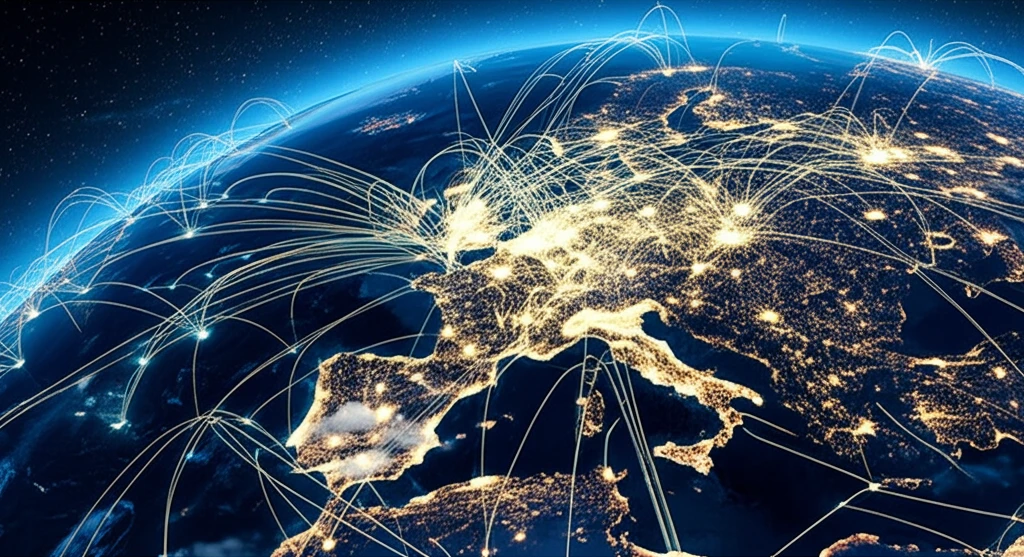
Predicting Tomorrow's Power: How AI and Climate Data Are Revolutionizing Energy Forecasting

"Unstable Energy Demand is the Main Challange in the Industry - Discover how advanced forecasting tackles electricity's unique storage problems with European models."
In the modern world, electricity is more than just a convenience; it's the lifeblood of our economies and daily lives. Unlike traditional commodities, electricity's unique challenge lies in its near-impossibility to store in large quantities. This necessitates a delicate balancing act between supply and demand, achievable only through precise forecasting.
Accurate electricity demand forecasts are crucial for everyone from financial traders to power grid operators. These forecasts inform critical decisions about energy production, distribution, and infrastructure maintenance. The rise of renewable energy sources, the increasing frequency of extreme weather events, and fluctuating socio-economic conditions have made accurate forecasting more complex than ever before.
Now, a groundbreaking study is revolutionizing how we predict electricity demand. This innovative approach combines the power of artificial intelligence with detailed climate data, socio-economic indicators, and political factors to generate probabilistic forecasts across 24 European countries. This article explores this cutting-edge methodology and what it means for the future of energy.
A Field on the Rise
The combination of artificial intelligence and climate data is widely seen as one of the most promising ways to improve energy forecasting, though precise, widely agreed-upon figures remain difficult to pin down. Reports in the sector suggest that better forecasting could meaningfully reduce waste in how electricity is generated, stored, and consumed. Because the field is evolving quickly, the impact of these methods should be treated as an emerging trend rather than a settled, quantifiable fact. Early evidence nevertheless points in a consistent direction: models informed by weather and climate inputs appear to deliver more accurate predictions than their predecessors.
How Forecasting Is Typically Done
Conventional energy forecasting has long relied on statistical and time-series models trained on historical demand and supply data, often combined with weather inputs. These established methods are well understood and widely deployed, but they carry known limitations, including difficulty adapting to rapid shifts in weather or market conditions. Newer machine-learning approaches aim to address some of these weaknesses, yet they bring their own challenges around data quality, model interpretability, and validation. As a result, many practitioners expect a gradual hybrid of old and new techniques rather than a rapid wholesale replacement.
Roots in Device-Level Power Management
Long before AI-driven grid forecasting, an awareness that power consumption can be actively managed was already embedded in everyday computing hardware. Microsoft's materials for Windows 11 document how device settings have a lasting effect on power consumption, battery life, and the carbon emissions associated with electricity generation, and they consolidate the highest-impact controls into a single energy-recommendations view. Its documentation also explains how power modes and energy saver options adjust system behavior to reduce unnecessary usage, and it walks users through changing those modes to preserve battery and limit background activity. Gaming consoles reflect the same principle, with shutdown and sleep settings exposed as user-facing power options on Xbox One and Xbox Series X|S. Taken together, these longstanding consumer features illustrate a foundational idea behind modern energy forecasting: that electricity demand is not fixed but can be shaped by choices that are increasingly amenable to data-driven optimization.
Why Traditional Forecasting Methods Fall Short?
Traditional methods of forecasting electricity demand often struggle to capture the complex interplay of factors that influence energy consumption. These methods tend to fall short due to several key challenges:
- Ignoring Spatial Variability: Electricity demand varies significantly across regions and countries due to differences in climate, economic activity, and consumer behavior. Traditional models often fail to account for these spatial variations.
- Neglecting Cross-Country Dependencies: European countries are interconnected through a vast electricity grid, meaning that events in one country can impact demand in others. Traditional models often treat countries in isolation, overlooking these crucial interdependencies.
- Failing to Address Non-Stationarity: Socio-economic and political factors, such as economic growth, policy changes, and unexpected events (like pandemics), can cause shifts in electricity demand patterns. Traditional models often assume that these patterns are stable over time, failing to adapt to these non-stationary effects.
The Push Toward Real-Time Verification
One notable development adjacent to forecasting research is the growth of real-time, publicly accessible verification of service status, such as the Xbox status page published by Microsoft Support. According to that page, users can check Xbox services, games, and apps for any service outages, reflecting a broader industry move toward instant monitoring and near-real-time reporting. While this particular example concerns gaming services rather than energy research, it illustrates a monitoring philosophy that is becoming central to climate and grid-related applications. Work in this vein is best read as an early-stage indicator of how live status feeds could complement, rather than replace, conventional forecasting models.
Where Optimism Meets Reality
Not every promise of AI-powered forecasting has translated into practice, and skeptics point to real obstacles. Historical demand patterns can change abruptly in ways that even sophisticated models fail to anticipate, and forecasts are only as good as the data feeding them. There have also been high-profile cases where models struggled to generalize beyond the conditions they were trained on. For these reasons, many in the field caution against treating AI as a reliable substitute for judgment, system redundancy, and human oversight.
New Tools Alongside Old
Comparisons between classical forecasting methods and modern machine-learning approaches tend to yield a more nuanced picture than simple superiority claims. Traditional statistical models are valued for their transparency, low computational cost, and ease of retraining, while newer AI models often win on accuracy at the price of complexity and opacity. Different organizations and grid operators reach different conclusions about the right balance, depending on their tolerance for risk and their data infrastructure. The emerging consensus is that hybrid approaches, which let each method cover the other's weaknesses, offer the most defensible path forward.
The Future of Energy Forecasting
This research marks a significant step forward in the field of electricity demand forecasting. As the energy landscape becomes increasingly complex and volatile, these advanced forecasting methods will become essential tools for navigating uncertainty, mitigating risks, and ensuring a stable and sustainable energy future. By providing more accurate and reliable predictions, we can pave the way for smarter energy policies, more efficient grid management, and a more resilient energy system for all.
Connecting the Threads
A consistent theme runs through the research landscape: forecasting is evolving from a purely statistical exercise into a data-rich, climate-informed discipline, but no single approach has proven universally dominant. Experts generally converge on the view that the best results will come from integrating multiple methods and validating them against real operating conditions. Open questions around data availability, model transparency, and system resilience still temper expectations. The field appears to be entering a phase of consolidation, where proven techniques are refined rather than discarded.
What Comes Next
Looking ahead, the most likely near-term advances involve better integration of high-resolution climate data, live sensor feeds, and machine-learning models that can update quickly as conditions change. Researchers are exploring ways to make models more interpretable and more robust to rare, extreme weather events that are poorly represented in historical training data. Greater sharing of data across regions and utilities could unlock significant accuracy gains. Still, the pace of progress will depend as much on regulatory and institutional cooperation as on algorithmic breakthroughs.
Forecasting Within a Wider System
Energy forecasting does not happen in isolation; it sits at the intersection of economics, policy, infrastructure, and climate change. The accuracy of any forecast matters less than how it is acted upon, and grid operators face challenges of coordination, aging infrastructure, and market design that no model alone can solve. As renewables grow as a share of generation, the inherently variable nature of wind and solar makes the entire system more sensitive to uncertainty. These systemic realities mean that improved forecasting translates into real benefit only when coupled with broader investments in flexibility, storage, and grid modernization.
Behind the Models, People and Power
At its core, energy forecasting is about keeping power reliable and affordable for the people, businesses, and institutions that depend on it every day. Better predictions can reduce the risk of blackouts, lower energy costs, and support the honest accounting of carbon emissions tied to electricity generation. Yet the benefit is unevenly distributed: communities with limited infrastructure or data capacity may not see the same gains. Ensuring that the human and social dimensions remain central will ultimately determine whether these technical advances improve lives or only widen existing gaps.