
Powering the Future: Can Ammonia Fuel Cells Revolutionize Clean Energy?

"A Deep Dive into Ammonia and Hydrogen Fuel Cell Technology for a Sustainable Tomorrow"
In the quest for sustainable energy solutions, fuel cells have emerged as a promising alternative to traditional combustion engines. Among these, solid oxide fuel cells (SOFCs) stand out due to their high efficiency and fuel flexibility. While hydrogen has long been considered an ideal fuel for these cells, challenges related to its storage and transportation have prompted researchers to explore other options. Ammonia, with its higher energy density and established infrastructure, presents a compelling alternative.
A recent study published in the International Journal of Hydrogen Energy delves into the performance of SOFCs powered by both ammonia (NH3) and hydrogen (H2). The researchers, Yildiz Kalinci and Ibrahim Dincer, conducted a comprehensive analysis, using a one-dimensional steady-state model, to evaluate the potential of ammonia as a viable fuel source. Their findings offer valuable insights into the future of clean energy and the role that ammonia could play in it.
This article breaks down the key aspects of their research, exploring the science behind ammonia-fueled SOFCs, the challenges and opportunities they present, and their potential impact on a more sustainable energy future. This analysis aims to distill complex research into a more accessible format.
Ammonia's Expanding Role in the Clean Energy Shift
Ammonia is one of the world's foundational industrial chemicals, serving as the building block for urea-based fertilizers and extending across refrigeration, chemicals, and plastics. In the energy transition, ammonia is being positioned as a fuel for fuel cells, with sources noting it offers multiple advantages over hydrogen as an energy carrier. For marine applications, ammonia-based fuel cells are reported to deliver 30% higher power density than hydrogen, a key driver of interest in the maritime sector. Analysts describe the ammonia fuel cell market as an emerging segment within the global shift toward sustainable and renewable energy sources.
Direct Ammonia Fuel Cells: Method, Promise, and Materials Hurdles
The standard technical pathway uses ammonia directly in fuel cells — including direct ammonia solid oxide fuel cells (DA-SOFCs) and proton-conducting variants (DA-PCFCs) — which reviews describe as a promising alternative energy solution. Ammonia is one of the most highly produced inorganic chemicals, manufactured at roughly 150 million tons per year, and it can serve as a carbon-free fuel. Unlike hydrogen, ammonia does not require high-pressure tanks or cryogenic dewars for storage and has about ten times the energy density of a lithium-ion battery, making it attractive for decarbonizing shipping and transportation. The main limitations center on materials, with reviews flagging significant materials constraints and the need for improved electrochemical stability in catalysts.
From Coordination Chemistry to a Fuel Cell in Its Infancy
Ammonia's foundational chemistry dates to its role as a ligand in coordination compounds, where it forms metal ammine complexes and is historically named 'ammine' in chemical nomenclature — a lineage exemplified by the well-known complex cisplatin. As an energy technology, however, ammonia fuel cells are still early in their development. Manufacturers note that ammonia fuel cells generate electricity using ammonia as the hydrogen supply source to the fuel cell, but the technology remains in the development stage, with only about 1 kW units being operated on a trial basis as of recent reporting.
The Science Behind Ammonia Fuel Cells
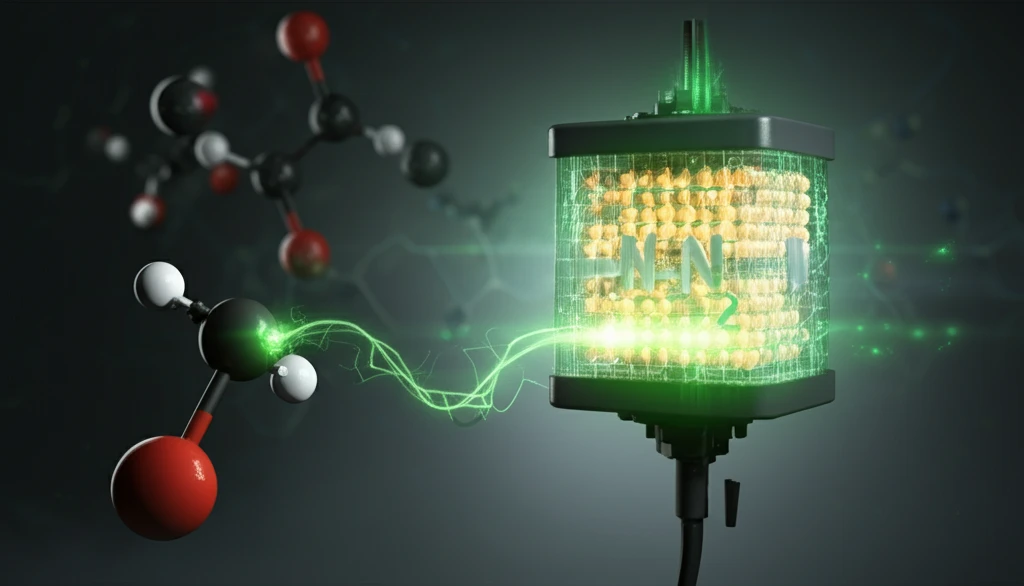
SOFCs are electrochemical devices that convert the chemical energy of a fuel directly into electricity. Unlike combustion engines, which release pollutants, fuel cells produce electricity through a clean chemical reaction. In the case of ammonia-fueled SOFCs, ammonia is broken down into hydrogen and nitrogen at the anode (the positively charged electrode). The hydrogen then reacts with oxygen ions from the air to produce electricity and water.
- Direct internal reforming of ammonia.
- The impact of operating parameters such as temperature, pressure, and fuel utilization.
- Overpotentials (activation, ohmic, and concentration) that affect cell performance.
Catalysts, Membranes, and Stability Drive the Current Research Agenda
Recent reviews of direct ammonia fuel cells focus on the role of electrocatalysts in boosting efficiency by reducing energy losses, improving the ionic conductivity of the electrolyte membrane, and increasing stability, with the stated aim of providing a roadmap for future researchers. In parallel, industry commentary reports that researchers are working to enhance the electrochemical stability of catalysts so that fuel cells can operate at lower temperatures, which would reduce operational costs. Together, these efforts point toward a research agenda centered on durability, efficiency, and cost reduction as the field matures.
Promise on Paper, Open Questions in Practice
Commercial viability remains to be determined, and observers note that fuel cells show potential to fill the gap left by fossil fuels but have yet to prove it at scale. The case for the technology is typically built on the problems it aims to solve in the marine sector, including greenhouse gas emissions, sulfur oxide pollution, regulatory compliance risk, and the energy-security limitations of fossil fuels. With research activity growing as the world searches for viable fossil-fuel alternatives, whether ammonia fuel cells deliver on that promise remains an open question.
Not All Ammonia Fuel Cells Perform Equally
Comparisons across fuel cell designs reveal clear tradeoffs. Researchers report that direct ammonia fuel cells based on proton-conducting solid oxide electrolytes deliver lower cell performance than their oxygen ion-conducting counterparts, because undecomposed ammonia and formed nitrogen dilute the hydrogen at the anode. Independent assessments add that alkaline fuel cells and solid oxide fuel cells running on ammonia currently sit at a technology readiness level (TRL) between 3 and 4, while proton exchange membrane fuel cells (PEMFCs) cannot be used with ammonia at all because of their acidic environment.
The Future of Clean Energy is Now
The research highlights the potential of ammonia as a practical and efficient fuel for SOFCs. As the world transitions towards cleaner energy sources, ammonia fuel cells could play a vital role in reducing our reliance on fossil fuels and mitigating climate change. Although technological and economic hurdles remain, ongoing research and development efforts are paving the way for a future powered by ammonia.
A Promising but Unproven Contender
Taken together, the evidence suggests ammonia fuel cells occupy a promising but unproven position in the clean-energy landscape. Their appeal rests on ammonia's existing industrial infrastructure, its storage advantages relative to hydrogen, and its potential to decarbonize hard-to-abate sectors such as shipping. Yet materials limitations, efficiency gaps, and unresolved questions about commercial readiness mean that expert consensus on a clear path forward is still emerging. The technology is best viewed as one option among many, with outcomes likely to be decided by further research and real-world demonstration rather than by current projections.
Market Projections Signal a Growing Infrastructure
Ammonia fuel cells (AFCs) are electrochemical devices that convert the chemical energy in ammonia into electricity, water, and nitrogen, positioning them as a clean energy source that produces minimal emissions. Looking ahead, market analysts project substantial growth in the supporting infrastructure: according to one research report, the global ammonia fuel conditioning unit market reached USD 1.62 billion in 2024 and is expected to grow at a CAGR of 16.8% from 2025 to 2033, reaching a value of approximately USD 4.97 billion. Such figures, however, are forward-looking estimates from a single research firm and should be treated with caution given the technology's early stage.
Ammonia's Versatility Meets System-Level Hurdles
Ammonia's relevance to the energy transition extends well beyond fuel cells. It can be used as a transport fuel either through engine combustion or by chemically reacting with oxygen in a fuel cell to produce electricity, and it can also store thermal energy by capturing energy in the transformation between solid, liquid, and gas phase changes. At the system level, research on low-temperature direct ammonia fuel cells is tackling challenges such as overall fuel cell system efficiency, hydroxide exchange membranes, and the oxygen reduction reaction, underscoring that progress depends on advances across the whole technology stack.
Who Stands to Gain When Ammonia Powers Up
Beyond engineering metrics, the real-world significance of ammonia fuel cells hinges on who ultimately benefits from cleaner power. If the technology matures, its most visible impacts would likely be felt in ports and shipping corridors, where communities currently bear the brunt of emissions, and in industries seeking affordable decarbonization options. However, ammonia itself is toxic and must be handled carefully, so any large-scale rollout would carry safety and community-engagement responsibilities alongside its environmental promise. At this stage, these human impacts remain prospective rather than demonstrated, and the pace of real-world deployment will determine how quickly any benefits materialize.