
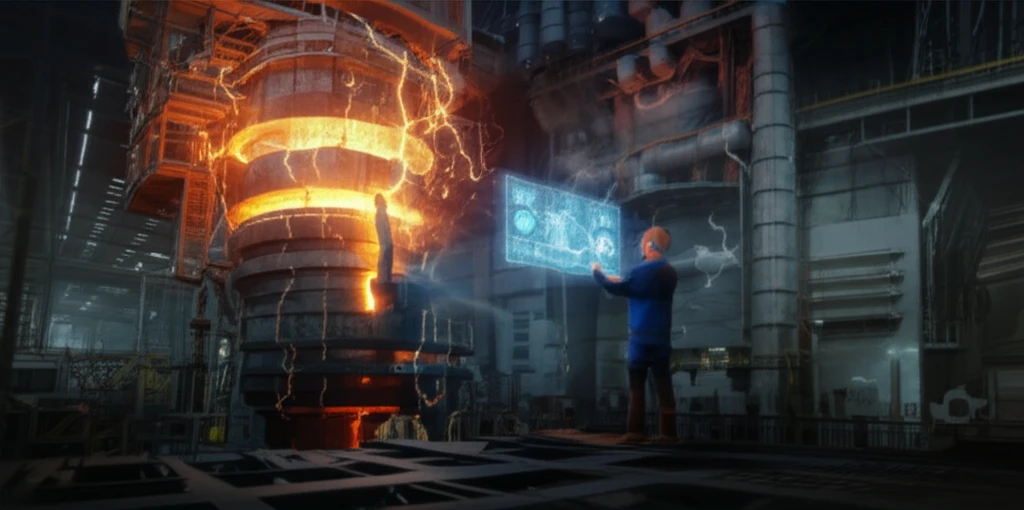
Optimized Electric Arc Furnace with glowing energy streams and technician using holographic interface.

Powering Efficiency: Optimizing Electric Arc Furnaces for Sustainable Steelmaking

"Explore how innovative management of Electric Arc Furnaces (EAFs) can revolutionize steel production, reducing energy consumption and boosting operational reliability."


Electric Arc Furnaces (EAFs) play a vital role in modern steel production, but their operation is complex and energy-intensive. Optimizing EAF performance is not only crucial for cost-effectiveness but also for reducing the environmental footprint of the steel industry. The key to EAF efficiency lies in managing the intricate interplay of electrical energy, heat transfer, and material transformation within the furnace.

The traditional EAF process involves converting electrical energy into intense heat, exceeding 2500°C, to melt and refine steel. This heat transfer, primarily achieved through conduction and radiation from electric arcs to the charge material, demands precise control and monitoring. Moreover, the ability of EAFs to utilize scrap iron as a primary charge material offers a significant advantage in promoting resource recycling and sustainability.

This article delves into the core elements of EAF operation, highlighting strategies for optimizing energy consumption, enhancing reliability, and leveraging computer-assisted tools for superior process management. By understanding these critical aspects, steel manufacturers can unlock the full potential of EAF technology, driving both economic and environmental benefits.

Decoding EAF Efficiency: Key Elements and Management Strategies

Optimized Electric Arc Furnace with glowing energy streams and technician using holographic interface.

Several factors contribute to the overall efficiency of EAF operations, including the reliability of the electrical system, particularly the furnace transformer. Interruptions or failures in the electrical circuit can significantly disrupt production schedules and increase costs. In a high-demand steel plant aiming for continuous operation (e.g., "24 tapping/day"), maintaining electrical stability is paramount.

To manage the complexities of EAF operation, computer-assisted systems have become indispensable. These systems typically incorporate two independent calculation units (UC1 and UC2) to process data and optimize various aspects of the process. These units analyze input sets (Σi1 and Σi2) to build a comprehensive operational strategy based on mathematical models.

  • Mathematical Model for Function Objective (M.F.O.): Determines the optimal operating parameters to maximize efficiency and minimize costs.
  • Mathematical Model for Calculating the Charge (M.C.C.): Optimizes the composition and quantity of the charge material to achieve desired steel quality.
  • Mathematical Model for Conducting the Effective Melt (M.C.M.): Controls the melting process to ensure efficient heat transfer and uniform melt composition.
  • Mathematical Model for Reheating the Charge (M.R.C.): Manages the reheating process to maintain optimal temperature and minimize energy consumption.
  • Mathematical Model for Blasting Reactive Dusts (M.B.R.D.): Controls the removal of dust and other byproducts to improve environmental performance.
The work power (Pt) at EAF is calculated using the formula: Pt = W / (t η cosφ) [KVA], where W is the total electrical consumption (kWh), t is the melting time (h), η is the efficiency (typically 0.8-0.9), and cosφ is the power factor (around 0.85). Optimizing these parameters is crucial for minimizing energy waste and maximizing productivity.

The Future of EAFs: Automation and Sustainable Practices

The effective management of EAFs relies on a combination of advanced technology and skilled operators. While computer-assisted systems provide valuable insights and control, the operator's expertise remains crucial for adapting to real-time conditions and ensuring optimal performance. In particular, many EAFs still lack full automation in charge reheating, requiring operator intervention to maintain continuous operation.

Looking ahead, the future of EAF technology will likely involve greater integration of automation, advanced sensors, and data analytics. These advancements will enable more precise control over the melting process, further reducing energy consumption and improving steel quality. By embracing these innovations, steel manufacturers can enhance their competitiveness and contribute to a more sustainable future.

The operator's role is to oversee the EAF's operation, making real-time adjustments. They use a computer unit to maintain the quality during manual operation. This unit ensures the right amount of charge is used. All the outputs of the process is overseen by the operator. These data are provided to another calculation unit.

About this Article -

This article was crafted using a human-AI hybrid and collaborative approach. AI assisted our team with initial drafting, research insights, identifying key questions, and image generation. Our human editors guided topic selection, defined the angle, structured the content, ensured factual accuracy and relevance, refined the tone, and conducted thorough editing to deliver helpful, high-quality information.See our About page for more information.

This article is based on research published under:

DOI-LINK: 10.1088/1757-899x/163/1/012004, Alternate LINK

Title: Eaf Optimal Managing Elements

Subject: General Medicine

Journal: IOP Conference Series: Materials Science and Engineering

Publisher: IOP Publishing

Authors: A Ioana, N Constantin, E C Dragna

Published: 2017-01-01

Everything You Need To Know

1

What are the primary benefits of optimizing Electric Arc Furnaces (EAFs) in steelmaking?

Optimizing Electric Arc Furnaces (EAFs) offers dual benefits: it reduces energy consumption, leading to cost-effectiveness, and it minimizes the environmental footprint of the steel industry. Efficient EAF operation also enhances operational reliability, crucial for continuous steel production. The optimization process involves managing electrical energy, heat transfer, and material transformation within the furnace for maximum efficiency.

2

How do computer-assisted systems improve the operation of Electric Arc Furnaces (EAFs), and what key models do they incorporate?

Computer-assisted systems greatly improve Electric Arc Furnace (EAF) operation by processing data and optimizing various aspects of the process using two independent calculation units (UC1 and UC2) that analyze input sets (Σi1 and Σi2). These systems incorporate several mathematical models, including the Mathematical Model for Function Objective (M.F.O.) which determines optimal operating parameters, the Mathematical Model for Calculating the Charge (M.C.C.) which optimizes charge material composition, the Mathematical Model for Conducting the Effective Melt (M.C.M.) which controls the melting process, the Mathematical Model for Reheating the Charge (M.R.C.) which manages reheating to minimize energy, and the Mathematical Model for Blasting Reactive Dusts (M.B.R.D.) which controls the removal of byproducts.

3

What is the role of the furnace transformer in Electric Arc Furnace (EAF) efficiency, and why is its reliability so critical?

The furnace transformer is a critical component of the electrical system in Electric Arc Furnaces (EAFs). Its reliability is paramount because interruptions or failures in the electrical circuit can significantly disrupt production schedules and increase costs. In high-demand steel plants aiming for continuous operation, maintaining electrical stability through a reliable furnace transformer is essential to avoid downtime and ensure consistent output.

4

How is work power (Pt) calculated in Electric Arc Furnaces (EAFs), and what parameters influence energy consumption and productivity?

Work power (Pt) in Electric Arc Furnaces (EAFs) is calculated using the formula: Pt = W / (t * η * cosφ) [KVA], where W is the total electrical consumption (kWh), t is the melting time (h), η is the efficiency, and cosφ is the power factor. Optimizing these parameters is crucial for minimizing energy waste and maximizing productivity. A higher efficiency (η) and power factor (cosφ), along with reduced melting time (t) and electrical consumption (W), will improve the overall work power and reduce energy costs.

5

What is the significance of operator expertise in managing Electric Arc Furnaces (EAFs), even with the use of computer-assisted systems?

Despite the advancements in computer-assisted systems, the expertise of human operators remains crucial for managing Electric Arc Furnaces (EAFs). While computer systems provide valuable insights and control, operators are needed to adapt to real-time conditions and ensure optimal performance. The text mentions that many EAFs still lack full automation in charge reheating, requiring operator intervention to maintain continuous operation. The operator's ability to make decisions based on real-time observations and adjust the process accordingly is essential for maximizing efficiency and preventing disruptions.

Newsletter Subscribe

Subscribe to get the latest articles and insights directly in your inbox.