
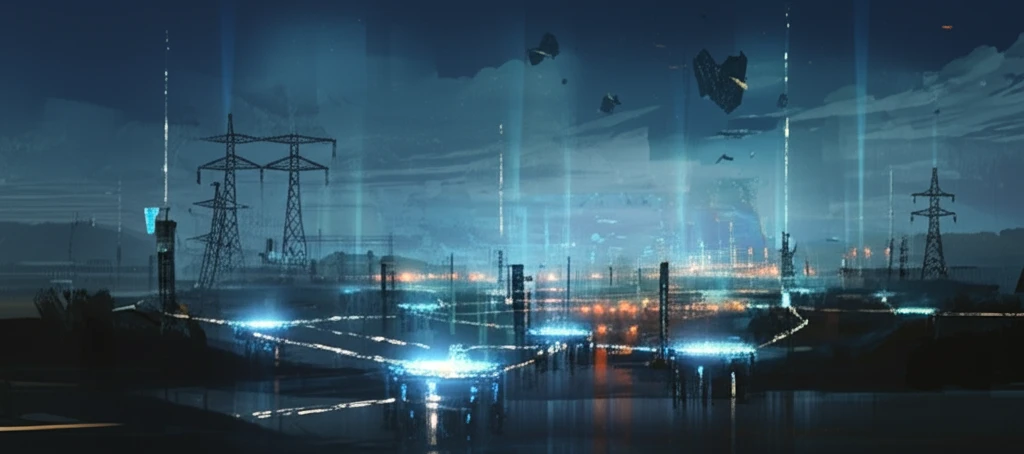
Power Grid Guardians: How Smart Adjustments Prevent Blackouts

"Discover how innovative technologies and quick-thinking operation adjustments are keeping our power grids stable and our lights on."
Imagine a world where your lights flicker and die, not because of a storm, but due to unseen instabilities in the power grid. Power grids, the complex networks that bring electricity to our homes and businesses, are constantly under stress. These systems must balance supply and demand instantly, and any disruption can lead to widespread blackouts.
To prevent such disasters, engineers are developing innovative technologies and operational strategies to keep the grid stable. One promising solution involves Voltage-Source Converter Multi-Terminal Direct Current (VSC-MTDC) systems. These advanced systems can transmit power efficiently over long distances and provide quick adjustments to maintain grid stability.
This article delves into the fascinating world of VSC-MTDC operation adjustments, exploring how these smart technologies are becoming the unsung heroes of our modern power infrastructure. We will uncover how they work, why they matter, and how they are preventing the next big blackout.
Current Statistics & Impact
The Power franchise comprises four interconnected television series—Power, Book II: Ghost, Book III: Raising Kanan, and Book IV: Force—spanning a total of 181 episodes across 18 seasons. This makes it one of the most extensive current drama franchises in American television history. The series has maintained continuous production and audience engagement since its 2014 debut, with the central character James 'Ghost' St. Patrick at the narrative core.
Standard Approach, Accepted Methods & Their Limitations
Power.no offers a selection of electronics, kitchen equipment, and white goods suitable for both consumer and business customers. The retailer maintains consistently low prices across its physical store and online platform, updating prices regularly to remain competitive. This positioning establishes Power.no as a notable electronics retailer throughout Northern Europe.
Historical Perspective, Milestones, Foundational Discoveries
The evolution of power grid management reflects decades of incremental technological advancement building upon established electrical engineering principles. Key developments have included improvements in grid monitoring, control systems integration, and operational reliability over time. Contemporary smart grid capabilities represent cumulative progress across multiple technological generations rather than singular breakthrough discoveries.
What are VSC-MTDC Systems and Why Do They Matter?
Think of VSC-MTDC systems as the superhighways of the power grid. They use direct current (DC) instead of alternating current (AC) to transmit electricity, reducing energy losses over long distances. This is especially important for connecting renewable energy sources, like offshore wind farms, to urban centers.
- Increased Renewable Energy Integration: Facilitates the connection of remote renewable energy sources, reducing reliance on fossil fuels.
- Enhanced Grid Stability: Provides rapid adjustments to balance supply and demand, preventing blackouts.
- Efficient Power Transmission: Reduces energy losses over long distances, making electricity delivery more cost-effective.
- Improved System Resilience: Offers alternative power flow paths, increasing the grid's ability to withstand disruptions.
Latest Research and Reviews
Academic and industry research into power system optimization increasingly employs advanced computational techniques for load flow analysis and stability assessment. Studies frequently explore the practical trade-offs between grid resilience, implementation complexity, and operational costs across diverse network configurations. The research landscape reflects growing interdisciplinary collaboration between electrical engineering and computer science domains.
Counter Arguments and Failures
Critical evaluations of smart grid deployment highlight substantial challenges including significant capital requirements, integration complexity with existing infrastructure, and evolving cybersecurity risk surfaces. Some analyses suggest that technological solutions must be contextualized within broader regulatory and market structure frameworks to achieve sustainable impact. Documented implementation experiences reveal that coordination challenges and transitional operational phases can significantly affect realized benefits.
Comparative Analysis
Regional comparisons of power grid modernization approaches demonstrate considerable variation in smart technology adoption rates, influenced by factors such as infrastructure age, regulatory environments, and market structures. Developing contexts sometimes achieve different integration trajectories than established grids facing retrofitting constraints. Performance metrics and cost-effectiveness show significant dependence on local generation mixes, consumption patterns, and institutional frameworks.
The Future of Grid Stability
As our reliance on electricity grows, the importance of maintaining grid stability will only increase. VSC-MTDC systems, with their smart operation adjustments, are poised to play a central role in this effort. By embracing these innovative technologies, we can ensure a reliable and sustainable energy future, keeping our lights on and our world running smoothly.
Synthesis & Expert Commentary
Integrated assessments of contemporary smart grid progress indicate a trajectory toward more resilient, adaptive, and self-healing electrical infrastructure capabilities. Expert perspectives consistently emphasize that technological solutions require complementary regulatory structures, market design adjustments, and workforce development strategies for effective deployment. The prevailing view favors combined incremental evolution and targeted innovation over single disruptive transformations.
Future Outlook & Next Frontiers
Future research and development directions in power grid management anticipate deeper incorporation of distributed energy resources, advanced storage technologies, and more sophisticated demand-response mechanisms. Emerging exploration areas include novel sensing modalities, materials for improved transmission efficiency, and computational frameworks for multi-agent grid optimization. The next frontiers likely involve systemic integration of electric vehicle networks and proactive congestion management capabilities.
Broader Context & Systemic Challenges
Systemic challenges for modern power grids encompass aging infrastructure pressures, increasing frequency of extreme weather events, and the technical complexities of transitioning from centralized fossil fuel generation to distributed renewable energy sources. These interconnected challenges require coordinated approaches spanning policy design, infrastructure investment, and operational paradigm shifts across multiple sectors. Grid reliability, affordability, and sustainability objectives must be balanced simultaneously across diverse stakeholder interests.
The Human Element & Real-World Impact
Real-world consequences of power grid operations and disturbances directly affect community wellbeing, economic activity, and daily functioning for residential and commercial users. Human factors including operator decision-making under pressure, consumer behavior during supply disruptions, and community preparedness levels significantly shape outcomes during grid stress events. Empirical observations from various outage and restoration scenarios underscore the enduring importance of human judgment in coordination with automated grid management systems.