
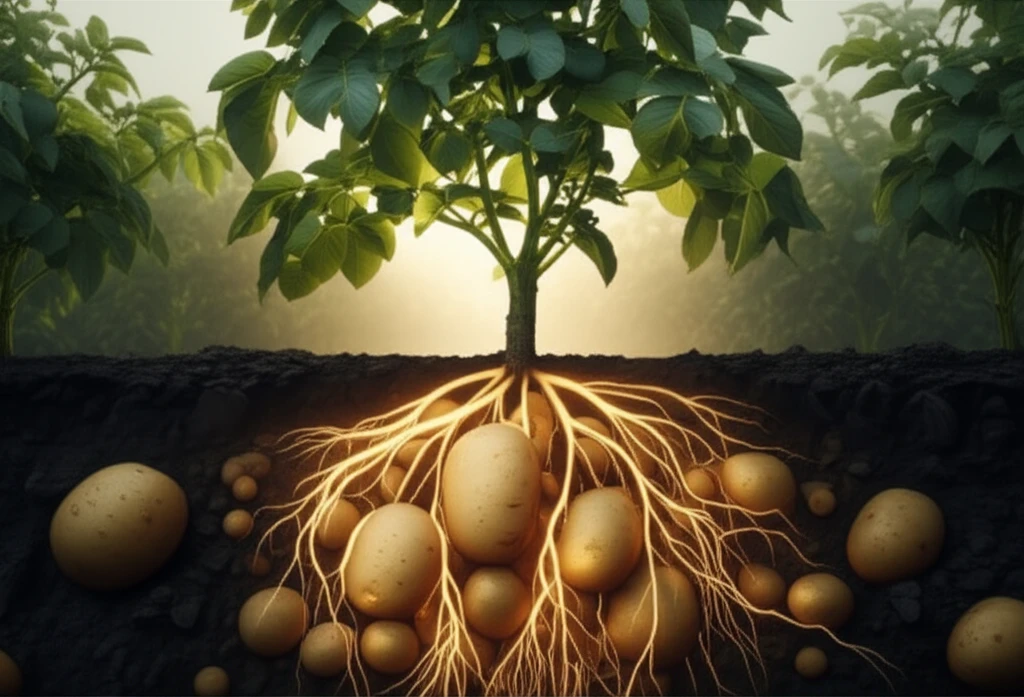
Potato Tuberization Mystery: Why Light Isn't Always the Answer

"New research challenges the long-held belief that light alone controls tuber formation in potatoes, revealing a complex interplay of factors."
The humble potato, Solanum tuberosum, is a global staple, feeding millions worldwide. Understanding how potatoes form tubers – the part we eat – is crucial for optimizing crop yields and ensuring food security. For a long time, scientists believed that day length, specifically short days (long nights), was the primary trigger for tuberization. The application of a night break (a flash of light during a long night) would halt tuberization, but the exact mechanism behind this repression remained elusive.
Researchers have been exploring a model similar to that of photoperiodic flowering in Arabidopsis, suggesting that a protein called StCOL1, produced during short nights, is stabilized by light from a night break. This stabilization was thought to trigger the production of StSP5G, which in turn suppresses StSP6A, a key signal for tuber formation. However, recent research is beginning to show that this model is not as simple as once believed.
A new study digs deeper into this 'coincidence model,' questioning whether the timing of StCOL1 expression and light exposure is the definitive answer to night-break repression of tuberization. By carefully manipulating light exposure and monitoring the expression of key genes, scientists are uncovering a more nuanced understanding of potato tuberization.
The Night Break Paradox: When Light Doesn't Repress Tuberization
The study explored how night breaks at different times affect tuberization. Researchers grew Solanum andigena plants (a short-day potato variety) under short-day conditions, applying night breaks at various points in the dark period. They then monitored the presence of the StCOL1 protein, the expression levels of StCOL1 itself, and the expression of its downstream targets, StSP5G and StSP6A.
- Timing Matters: A night break's effectiveness hinges on when it's applied during the dark period, not just whether it occurs.
- StCOL1 Isn't Everything: Stable StCOL1 levels didn't always lead to StSP5G production, and increased StSP5G didn't guarantee StSP6A repression.
- Unknown Factors at Play: The study hints at a yet-to-be-identified level of control between StCOL1, StSP5G, and StSP6A, which ultimately dictates whether a potato plant forms tubers.
Unraveling the Mystery: The Future of Potato Research
This research throws a wrench in the traditional understanding of potato tuberization, highlighting the need to look beyond the StCOL1-light coincidence model. The existence of an additional control layer opens exciting new avenues for investigation.
Future research should focus on identifying the unknown factors regulating StSP5G and StSP6A expression. Understanding how these factors interact with StCOL1 could unlock more effective strategies for manipulating tuber formation in potatoes.
Ultimately, a deeper understanding of potato tuberization can lead to improved crop management practices, enhanced yields, and a more sustainable food supply. Cracking the code of tuber formation could revolutionize potato farming and contribute to global food security.