
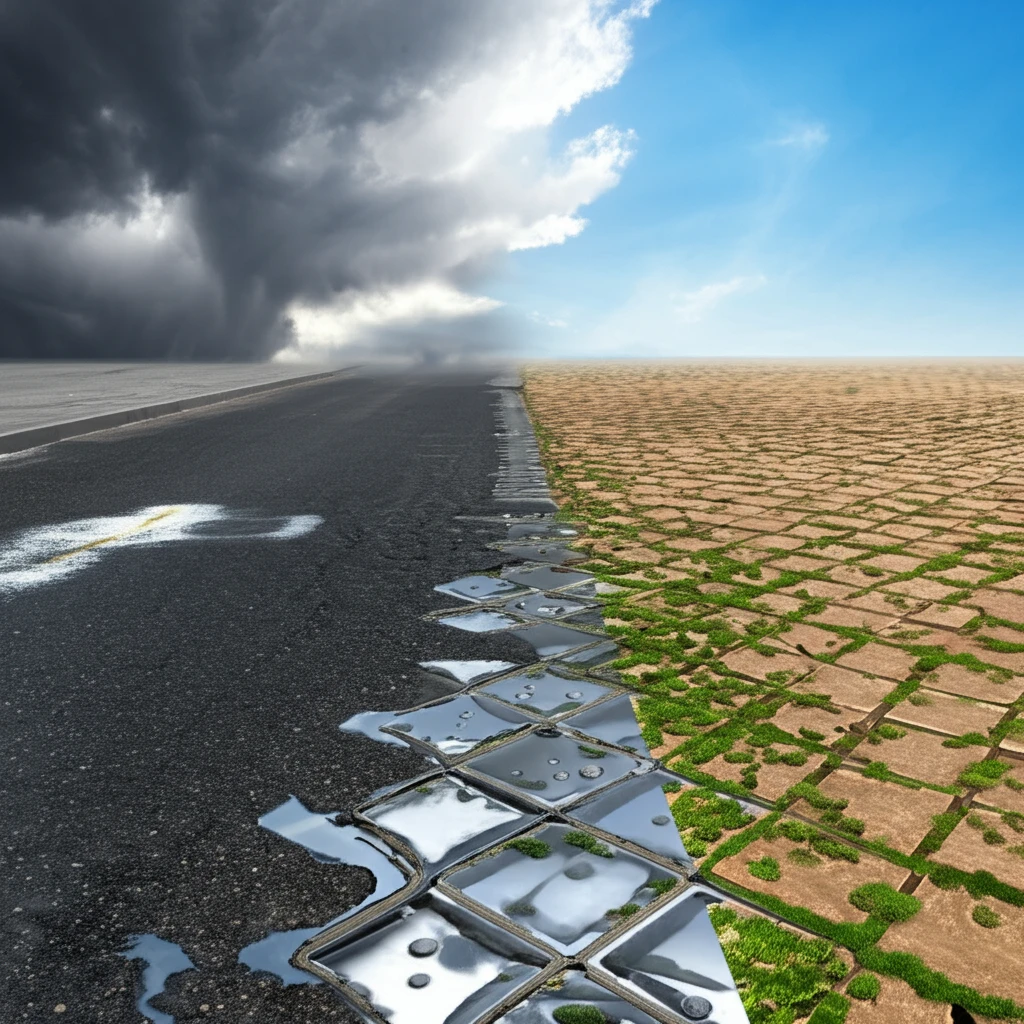
Porous Pavement: A Sustainable Solution for Urban Runoff and Noise Pollution

"Discover how innovative porous pavement designs are transforming urban landscapes, offering eco-friendly alternatives to traditional asphalt while enhancing safety and community well-being."
In bustling urban environments, the relentless surge of urbanization has brought about a series of environmental challenges. Among the most pressing are stormwater runoff, escalating noise pollution, and compromised road safety. Traditional impermeable pavements exacerbate these issues, leading to increased flood risk, harmful pollutants entering waterways, and elevated noise levels that impact the quality of life for city dwellers.
As cities grapple with these mounting concerns, innovative solutions are emerging to create more sustainable and livable urban spaces. One such solution gaining traction is porous pavement—a groundbreaking alternative designed to address the environmental and safety shortcomings of conventional paving materials. Porous pavement offers a unique approach to managing stormwater, reducing noise, and enhancing overall road safety.
This article explores the functional characteristics of laboratory-tested porous pavement mixes, highlighting their potential to revolutionize urban infrastructure. We delve into how these materials are engineered, tested, and applied to create more resilient, eco-friendly, and safer communities.
The Growing Urban Water Challenge
Rapid urbanization has expanded impervious surfaces across cities worldwide, intensifying stormwater runoff volumes and contributing to increasingly severe flash flooding events. Urban development has simultaneously amplified noise pollution from traffic and other sources, further degrading the livability of densely built environments. Addressing these twin challenges—excess runoff and noise—has become a central concern for city planners and environmental engineers seeking sustainable infrastructure solutions.
Permeable Pavements as a Green Infrastructure Alternative
Permeable pavements are a stormwater control that allows water to infiltrate through the pavement surface to the ground below, offering a green infrastructure alternative to traditional impervious surfaces. The principal types include porous asphalt, pervious concrete, and permeable interlocking concrete pavement (PICP). These systems have been developed to mitigate urban waterlogging—a critical issue that can lead to accidents, economic losses, and broader environmental challenges in medium and large cities. While porous asphalt pavement represents an innovative approach to sustainable urban infrastructure, the replacement of virgin materials with recycled alternatives in pavement construction raises questions about both environmental and economic impacts that remain under investigation.
From Concept to Mainstream Adoption
The precise origins of permeable pavement technology are not well-documented in a single definitive account, though the concept emerged as a practical response to growing concerns about urban flooding and water quality degradation. Early adoption was largely driven by municipalities seeking cost-effective alternatives to conventional stormwater infrastructure such as detention basins and oversized pipes. Over time, the technology matured and gained recognition within the broader green infrastructure movement, gradually transitioning from niche applications to a more widely accepted component of urban stormwater management.
What Makes Porous Pavement a Game-Changer?
Porous pavements are designed to perform multiple critical functions simultaneously, providing environmental and safety benefits that traditional pavements cannot match. The advantages stem from their unique composition and structure, which allow water to filter through the surface rather than pooling on top.
- Stormwater Management: Porous pavements reduce stormwater runoff by allowing water to infiltrate directly into the ground. This lessens the strain on drainage systems and helps replenish groundwater supplies.
- Noise Reduction: The porous structure absorbs sound waves, reducing traffic noise and creating quieter urban environments.
- Improved Road Safety: By minimizing standing water, porous pavements enhance tire grip, which reduces the risk of hydroplaning and skidding, especially during wet weather.
- Environmental Benefits: Porous pavements filter pollutants from stormwater, improving water quality and supporting healthier ecosystems.
Evolving Research Directions in Porous Pavement
Recent scholarship on porous pavement has broadened considerably, encompassing not only hydrological performance but also material science, life-cycle assessment, and integration with smart city frameworks. Researchers are increasingly investigating the use of recycled and bio-based materials to reduce the carbon footprint of pavement construction. However, the field continues to evolve rapidly, and definitive conclusions about the long-term comparative performance of various porous pavement formulations have yet to be fully established.
Challenges and Limitations in Practice
Despite their promise, permeable pavements have encountered practical challenges including clogging over time, reduced structural capacity under heavy traffic loads, and higher upfront costs compared to conventional pavements. Maintenance requirements—particularly regular vacuuming and debris removal—are often underestimated by municipalities unfamiliar with the technology. In cold climates, freeze-thaw cycles can accelerate deterioration, and the effectiveness of infiltration-based systems is limited in areas with compacted or clay-rich soils that impede drainage.
Evaluating Low-Carbon and Sustainable Pavement Alternatives
Recent comparative studies have evaluated low-carbon-porous asphalt pavement (LC-PAP) systems against carbon-negative interlocking concrete block permeable pavement systems (CN-ICB-PPS), examining both environmental and structural performance at pilot scale. These investigations highlight that recycled, industrial by-product, and bio-based alternatives can contribute to advancing sustainable infrastructure, with particular attention to mechanical properties, availability, and suitability for different pavement applications. The Green Streets framework has also provided practical lessons by examining post-construction performance data and cost-comparison methods for porous asphalt and concrete from multiple agencies.
The Future is Paved with Innovation
Porous pavement represents a significant advancement in sustainable urban development. By addressing critical environmental and safety challenges, this innovative paving solution offers a pathway toward creating more resilient, eco-friendly, and livable communities. As research and implementation continue to evolve, porous pavement is poised to play a vital role in shaping the future of our cities.
Porous Asphalt Pavements as a Multifunctional Solution
Porous Asphalt (PA) pavements have been recognized as one of the best solutions to reduce both water and air environmental impacts due to their multifunctional nature. The current demand for stormwater management through new infrastructure in pavement engineering has prompted a focus on PA pavements, which are considered for their sustainability benefits, safety advantages, and capacity to address flash flooding—particularly as impermeable surface expansion continues with urban development. These systems are gaining popularity not only as flood mitigation tools but as solutions that provide a range of environmental co-benefits to urban populations.
Emerging Possibilities and Research Priorities
As urban areas continue to expand and climate variability intensifies, the demand for adaptive pavement solutions that manage stormwater, reduce noise, and lower carbon emissions is expected to grow. Integration of porous pavement technologies with broader sustainable urban drainage systems (SuDS) and smart monitoring capabilities represents a promising frontier. Continued research into novel materials, long-term durability, and lifecycle cost-effectiveness will be essential to broaden adoption and optimize performance across diverse urban contexts.
Porous Pavements and Climate-Resilient Infrastructure
By decreasing maintenance needs and environmental impact, porous pavements play a vital role in creating climate-resilient infrastructure that promotes urban safety and sustainability. As climate change drives more extreme precipitation events and rising urban temperatures, the capacity of permeable surfaces to manage stormwater and reduce urban heat island effects positions them as a key adaptation strategy. However, scaling these technologies requires addressing systemic challenges including institutional inertia, cost barriers, and the need for updated design standards that fully account for climate adaptation.
Community Benefits and Implementation Realities
While the technical merits of porous pavements are increasingly well-documented, their real-world impact ultimately depends on community engagement, institutional support, and equitable implementation across diverse neighborhoods. Properties in areas with permeable pavement installations may benefit from reduced localized flooding and improved water quality, yet awareness and acceptance among residents and local decision-makers remain variable. Ensuring that the benefits of sustainable pavement technologies reach underserved communities—rather than being concentrated in affluent areas—remains a critical challenge for planners and policymakers.